
LXLZ Note: This Product Provides Solutions for Parameter Customization And Application.

Copper Busbar EMI Filter High Power VFD Noise Filter
If you're running VFDs (Variable Frequency Drives) in industrial environments, you already know the headache — motor interference, tripped equipment, corrupted sensor signals, and control systems behaving erratically. Most of the time, it's EMI noise riding on your power lines, and a standard filter just doesn't cut it under heavy load.
That's exactly what the LZ920-S Series EMI Filter was built for.
Designed specifically as a VFD input/output dedicated power line filter, this unit handles the aggressive high-frequency harmonics that PWM-driven drives generate — both from the grid side and the motor side. With a copper busbar terminal block, it's built to handle real industrial current without the heat buildup or connection failure you'd get from standard screw terminals at high amperage.
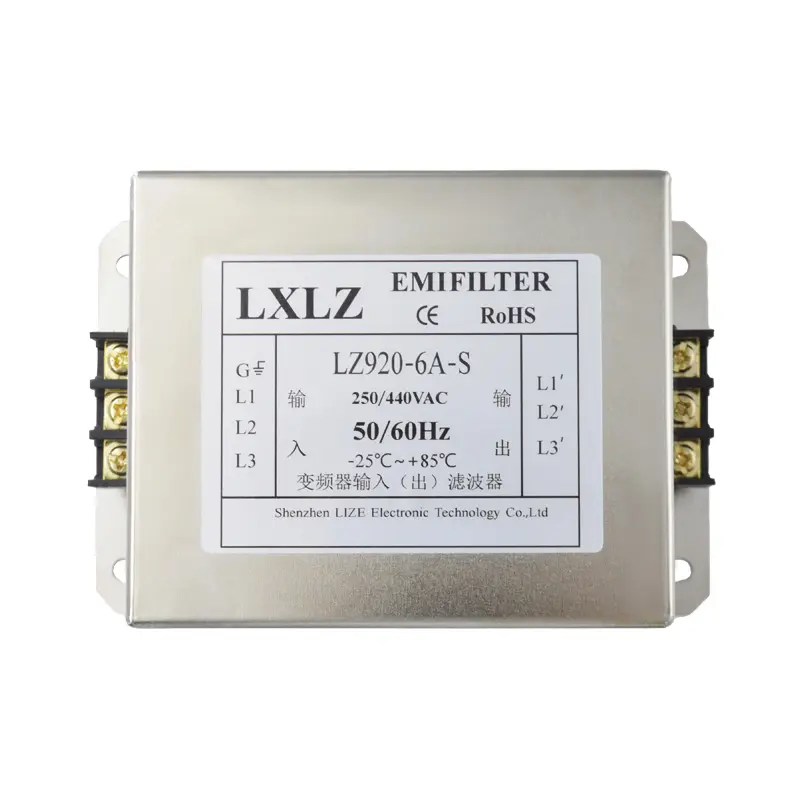
From the label on this unit: LZ920-6A-S, rated 250/440VAC, 50/60Hz, operating range -25°C to +85°C — CE and RoHS certified. This is a product made for serious electrical panels, not hobbyist cabinets.
Key Specifications
| Parameter | Details |
|---|---|
| Model Series | LZ920-S (e.g., LZ920-6A-S) |
| Rated Current Range | 0 – 100A (multiple variants) |
| Voltage Rating | 250V / 440VAC |
| Frequency | 50 / 60 Hz |
| Operating Temperature | -25°C ~ +85°C |
| Terminal Type | Large copper busbar terminals |
| Application | VFD input & output EMI filtering |
| Certifications | CE / RoHS |
| Enclosure | Stainless steel / metal shielded housing |
| Mounting | Panel mount with flange holes |
Note: Current rating variants available — contact us with your load requirements and we'll confirm the right model.
What Makes This Filter Different
① Built for VFDs — Not Just "Compatible"
Most general-purpose EMI filters struggle with the wideband noise profile that VFDs produce. The LZ920-S is engineered specifically around the harmonic characteristics of PWM inverter drives — both on the input side (protecting your supply network) and the output side (protecting your motor and cabling). You get real attenuation where it matters.
② Copper Busbar Terminals — Serious Current, Serious Connections
At 60A, 80A, or 100A, the connection point is where cheaper filters fail — oxidation, loosening, heat. Our solid copper busbar terminal design gives you low-resistance, stable contact that holds up through thermal cycling and vibration. Installers appreciate how clean the wiring looks in the panel too.
③ Wide Voltage Compatibility — 250V and 440VAC
Whether your facility runs on a 3-phase 230V system or a 380/440V industrial supply, this filter covers it. That makes it practical for export projects, mixed-grid factories, and OEM equipment targeting multiple markets.
④ Temperature Range That Matches Industrial Reality
-25°C to +85°C isn't a lab spec — it's what you actually need in a control cabinet next to a heat-generating drive, or in an outdoor enclosure in a cold climate. This filter won't drift or degrade at temperature extremes.
⑤ Metal Shielded Housing
The stainless-finish enclosure isn't cosmetic — it adds a layer of shielding that reinforces the filter's own EMI suppression and protects the internal components from physical damage in panel environments.
⑥ CE + RoHS — Ready for Your Compliance Paperwork
For buyers supplying into Europe or dealing with customers who require documentation, CE and RoHS compliance is already done. We can provide certificates on request.
Typical Applications
- Industrial VFD panels — CNC, conveyor systems, pumps, compressors, fans
- Elevator and lift control systems
- HVAC variable-speed motor systems
- Industrial automation and robotics cabinets
- OEM machine builders needing pre-certified EMI suppression components
- Power distribution boards in factories with sensitive measurement or communication equipment nearby
Installation Best Practices (From the Field)
After years of supplying these filters to panel builders and OEM manufacturers, here's what we consistently see from installations that actually work:
- Mount as close to the VFD as possible. Every centimeter of unfiltered cable between the filter and the drive is an antenna. Keep leads short.
- Use the input side filter on the mains side, output side filter on the motor side. Running one filter alone isn't always enough for high-power or long-cable installations.
- Ground the filter housing properly. The metal enclosure needs a solid, low-impedance ground connection — don't rely on the mounting screws alone. Use a dedicated ground conductor.
- Don't bundle filtered and unfiltered cables together. Parallel routing defeats the filter. Separate them physically.
- Check current rating with 20% headroom. If your drive runs at 50A peak, choose the 60A or higher variant. Continuous operation at rated maximum shortens service life.
FAQ
Can this filter be used on both the input and output side of the VFD?
Yes. The LZ920-S series is designed for both configurations. The input side suppresses harmonics from the drive from feeding back into your supply network. The output side reduces high-frequency noise on the motor cable, which is especially important for long cable runs (typically over 10–15 meters). We recommend specifying which side you're using when ordering, so we can confirm the right model.
What current rating do I need for my application?
Match the filter's rated current to your VFD's maximum output current — not your motor's nameplate current. Add at least 15–20% headroom. For example, a 37kW / 400V drive typically draws up to ~65A, so you'd go with an 80A rated filter. Send us your drive specs and we'll advise.
Do you offer OEM or custom labeling for panel builders?
Yes. For consistent volume orders, we support OEM labeling. We also work with machine builders who need specific terminal configurations, mounting dimensions, or documentation packages. Contact us to discuss.
What's the minimum order quantity and lead time?
We manufacture in-house, so MOQ and lead time depend on the variant and quantity. Standard current ratings (6A–100A) are typically in stock or available on short production runs. Contact us with your required specifications and quantities for a formal quote and delivery schedule.
How do I verify the filter is actually working after installation?
The most practical field check is measuring conducted EMI with a spectrum analyzer or using a power quality analyzer to compare harmonic levels before and after installation. Operationally, reduced control system faults, fewer VFD trips, and elimination of interference on nearby sensors or PLCs are the real-world indicators. If you're still seeing issues after installation, the most common cause is improper grounding or cable routing — not filter performance.
Ready to specify? Send us your VFD brand, power rating, cable length, and installation side (input/output) — we'll come back with the right model and a competitive factory price.