
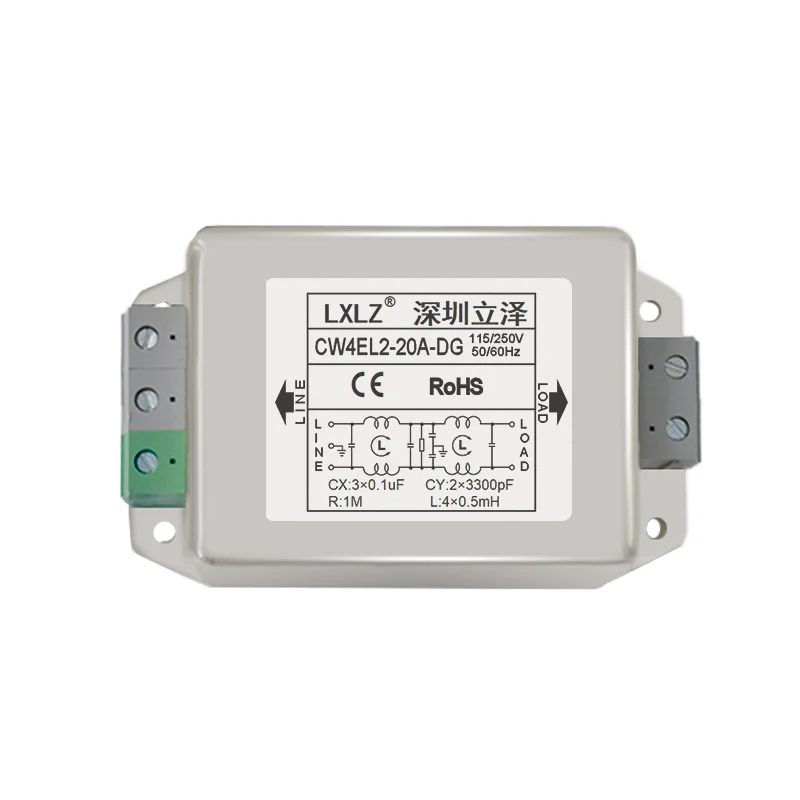
LXLZ Note: This Product Provides Solutions for Parameter Customization And Application.

DIN Rail Mount EMI Filter High Attenuation Power Line
Conducted EMI is one of the more stubborn problems in panel design — it doesn't always show up during bench testing, but it will show up during CE certification, and fixing it late in the process is expensive.
The CW4EL2 series is designed to deal with that problem at the source. It handles both common-mode and differential-mode noise on single-phase AC lines, rated from 1A up to 60A, so one product family covers most of what a control panel builder or OEM manufacturer runs into across different projects.
The housing clips onto a 35mm DIN rail and the wiring goes through a bottom-mounted Euro terminal block. That combination is standard practice in European-market panel builds, and it means your assemblers aren't adapting the filter to the panel — the filter fits the way the panel is already built.
Table of Contents
How It Actually Works
This matters if you're evaluating filters beyond just the datasheet rating.
The internal circuit runs a two-stage topology:
- Differential-mode suppression — handled by three CX film capacitors (3 × 0.1μF) wired line-to-line, targeting switching noise that travels between L and N
- Common-mode suppression — four common-mode chokes (4 × 0.5mH) in series with a CY capacitor pair (2 × 3300pF) referenced to ground, attenuating noise that appears identically on both lines
- Bleed resistor (1MΩ) — safely discharges the X capacitors after power-off, a detail that matters for both safety compliance and long-term capacitor health
The metal enclosure isn't just mechanical protection. It acts as an additional shielding layer, preventing radiated coupling from contaminating the filtered output — something open-frame designs can't offer in high-noise environments.
Specifications
| Parameter | Detail |
|---|---|
| Type | Single-Phase AC EMI Filter |
| Model Series | CW4EL2 / 09-CW4EL2-DG |
| Rated Voltage | 220VAC (115V–250V range) |
| Current Options | 1A, 3A, 6A, 10A, 16A, 20A, 30A, 40A, 60A |
| Frequency | 50 / 60Hz |
| Mounting | 35mm DIN Rail, bottom clip |
| Terminal | Euro-style screw terminal block |
| CX Capacitor | 3 × 0.1μF (differential-mode) |
| CY Capacitor | 2 × 3300pF (common-mode to GND) |
| Common-Mode Choke | 4 × 0.5mH |
| Bleed Resistor | 1MΩ |
| Operating Temp | –25°C to +85°C |
| Housing | Shielded metal enclosure |
| Certifications | CE · RoHS |
Where Engineers Actually Use This
VFD and servo drive input filtering Variable frequency drives generate substantial conducted emissions on the supply side. Placing a CW4EL2 at the drive input keeps those emissions off the shared power bus — and off the test probe during radiated/conducted emissions testing.
PLC and control logic protection Switching power supplies inside control cabinets create high-frequency noise that travels back through the mains. Sensitive PLC I/O modules and fieldbus communications are vulnerable. A filter on the incoming supply isolates the control section from whatever is happening upstream.
OEM equipment pre-compliance If your equipment ships to Europe and needs CE marking, filtering conducted emissions early in the design avoids late-stage EMC redesigns. The CW4EL2 series has documented attenuation curves — useful when you're working with an EMC test lab and need to show what mitigation is already in place.
Medical and lab equipment Leakage current requirements are tighter in these applications. The CY values and bleed resistor selection in this series are conservative enough to stay within Class I medical equipment ground leakage limits — worth verifying against your specific standard, but a reasonable starting point.
Distributed control systems in factories Long cable runs between panels pick up common-mode noise from motor switching. Filtering at both ends of the supply run is standard practice in larger installations.
Built for Panel Builders and OEM Lines
DIN rail mount, Euro terminals — no adaptation needed The bottom-clip DIN mount and Euro screw terminals match what's already in most European-standard control cabinets. There's no rework, no adapter bracket, no rewiring convention mismatch. Your assemblers follow the same process they use for every other DIN-mounted device.
1A to 60A under one part family Standardizing on one filter series across multiple machine variants simplifies your BOM management. Same installation procedure, same documentation, same supplier relationship — just a different current suffix on the part number.
Metal housing performs where open-frame doesn't In cabinets with variable frequency drives, contactors, or heavy inductive loads, radiated coupling inside the enclosure is real. The shielded metal housing keeps the filter's performance consistent regardless of what else is mounted nearby.
Working With the Factory
We manufacture the CW4EL2 series in-house in Shenzhen. That means a few practical things for your procurement process:
No intermediate markup. You're buying at production cost plus margin, not at a trading company's resale price.
Technical questions go to people who know the product. If you need attenuation curves at specific frequencies, modified capacitor values for a different leakage current requirement, or current ratings outside the standard range, that conversation happens with our engineering team — not a sales rep reading from the same datasheet you already have.
OEM and private label orders are straightforward. Custom labeling, modified terminal configurations, or adjusted component values for specific certifications are handled regularly. Lead times and MOQ depend on the specification — contact us with your requirements and we'll give you a direct answer.
Frequently Asked Questions (FAQs)
Here are some things folks ask us a lot.
What is the difference between a power line filter and a surge protector?
They don't do the same job. A filter stops steady high frequency noise. It stops radio-frequency interference. A surge protector fights huge lightning strikes. Use both to stay safe. They make a great team.
How does an input EMI filter actually suppress noise?
It acts like a wall. It lets slow 50-60Hz power pass but it blocks fast noise. Passive parts do the hard work. They block the trash. They let the good juice flow.
Where should a DIN rail EMI filter be placed in the system?
Put it right where the power comes in. Snap the DIN rail bracket on the rail. Keep wires neat. Good wires mean good sound.
How do I choose the right EMC/EMI filter for my application?
Look at your machine needs. Check the rated current and voltage ratings. Pick a unit that matches. Our line covers 1 to 60 amps. We have what you need. Call us if you need help.
Do I need a filter with a Metal Oxide Varistor (MOV)?
Yes you do! A surge suppression technology helps a ton. It helps if your power jumps a lot. It keeps your boards safe. It is worth the cash. Buy one today.