
LXLZ Note: This Product Provides Solutions for Parameter Customization And Application.

KZL-2 Fast Brake Rectifier 380V Input Motor Control
If you've ever dealt with a motor that takes too long to stop — or one that keeps creeping after the brake signal cuts — you already know how much a reliable brake rectifier matters. The KZL-2 is built specifically for that job, and built to do it right.
This is a dedicated motor brake rectifier designed to power electromagnetic braking coils on AC motors. It takes your standard 380VAC three-phase input and converts it to a stable 170VDC output — exactly what most motor brake coils need to engage cleanly and release fast. We manufacture two circuit versions: diode-type for standard applications, and MOSFET (field-effect transistor) type for installations where faster switching response and lower heat generation matter more.
Table of Contents
What You're Looking At
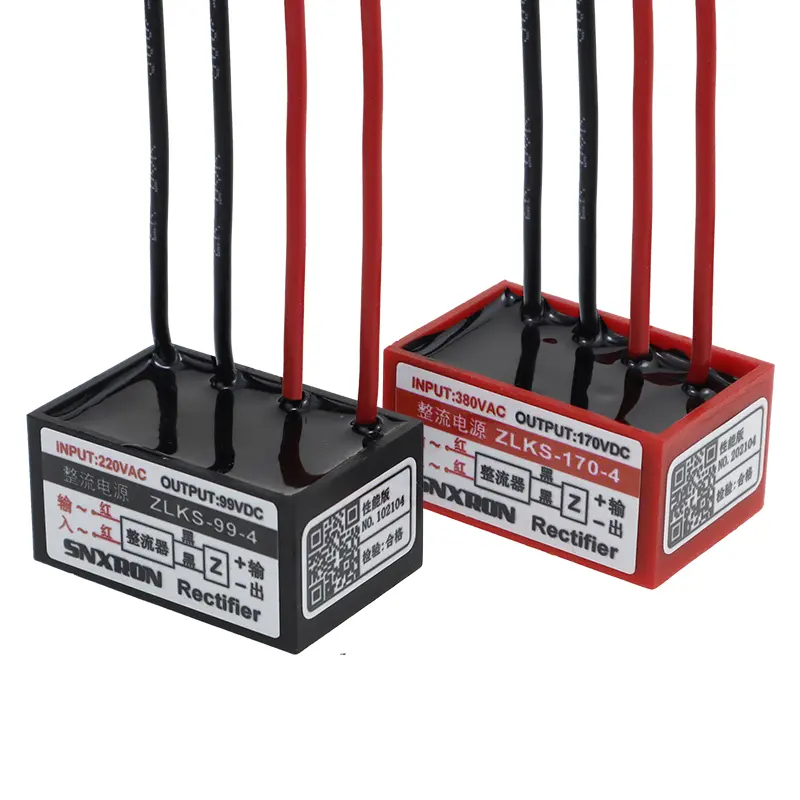
From the product image, you can see two units side by side — the black unit (ZLKS-99-4, 220V input / 99VDC output) and the red unit (ZLKS-170-4, 380V input / 170VDC output), which corresponds to this listing. Both units share the same compact, encapsulated block design with pre-wired leads coming directly out of the top.
Key things visible in the image:
- Pre-soldered copper lead wires — red and black, clearly labeled for input/output polarity
- Epoxy-potted body — the entire circuit is sealed inside resin, protecting against moisture, dust, and vibration
- Printed label with model number, input/output specs, QC inspection mark , and wiring diagram
- SNXRON brand marking — our factory brand for industrial control components
- Compact cube form factor — easy to mount inside motor control cabinets or junction boxes
Key Specifications
| Parameter | Details |
|---|---|
| Model | KZL-2 / ZLKS-170-4 |
| Input Voltage | 380VAC (50/60Hz) |
| Output Voltage | 170VDC |
| Circuit Type | Diode type / MOSFET type (selectable) |
| Brake Response | Fast-acting |
| Wire Material | Pure copper conductors |
| Housing Material | High-grade PBT thermoplastic |
| Protection | Full epoxy encapsulation |
| Application | AC motor electromagnetic brake coils |
Why This Design Works — Manufacturing Advantages
1. Pure Copper Wiring, Not Aluminum
We don't cut corners on conductors. Pure copper leads handle higher current density with lower resistance and less heat buildup over time. In industrial duty cycles, this directly translates to longer service life and fewer nuisance failures.
2. PBT Housing — Not Generic Plastic
PBT (polybutylene terephthalate) is a glass-fiber-reinforced engineering thermoplastic. It holds up to heat, resists electrical tracking, and doesn't become brittle in cold environments. If you've had cheap rectifiers crack or deform inside a warm motor cabinet, this is why material selection matters.
3. Full Epoxy Potting
The entire PCB and components are encapsulated in epoxy resin. This isn't just for looks — it eliminates vibration-induced solder joint failures, prevents condensation damage, and gives the unit a solid mechanical structure. Units installed in crane drives, hoists, and conveyor systems are particularly exposed to these stress factors.
4. MOSFET Option for Fast Brake Applications
The standard diode-type rectifier works well for most motors. But if your application demands near-instantaneous brake engagement — like positioning systems, packaging machinery, or any machine where stopping precision matters — the MOSFET version reduces the coil discharge time significantly. Faster de-energization = faster mechanical brake clamping.
5. Pre-wired Lead Design
No terminal block to wire, no screw torque specs to worry about. The leads are factory-soldered and encapsulated, so installation is straightforward. Color coding (red = AC input / black = DC output) matches standard industrial wiring conventions.
Typical Applications
This rectifier is used anywhere a three-phase AC motor has an electromagnetic (spring-applied) brake coil:
- Overhead cranes and hoists — load holding safety is critical; you need the brake to engage the moment power drops
- CNC machine tool spindles — quick stop cycles, high repetition
- Conveyor and material handling systems — controlled stopping to protect goods and reduce wear
- Elevators and vertical transport — brake coil reliability is a safety-critical requirement
- Packaging machines — positioning accuracy depends on consistent brake timing
- Woodworking and metalworking machinery — operator safety, rapid E-stop response
Best Practice Notes (From Field Experience)
These are things experienced electrical engineers and maintenance teams have learned the hard way. We're passing them along.
- Match your output voltage to your brake coil rating. A 170VDC rectifier on a 99VDC-rated coil will overheat the coil winding. Always confirm coil specs before ordering. We can supply 99VDC units (220V input) if needed.
- For the MOSFET type, observe polarity strictly. Unlike a basic diode bridge where reversed polarity just means no output, MOSFET circuits can be damaged by reverse connection. Wire it right the first time.
- Don't share a rectifier between multiple brake coils unless rated for it. Each coil should have its own dedicated unit. Parallel connection across unrated units causes inconsistent braking and premature failure.
- In dusty or high-humidity environments, the epoxy-potted body is your friend. But still check that the lead wire entry points into your control panel are sealed separately. The rectifier body itself is protected; your conduit entry points may not be.
- MOSFET type runs cooler at equivalent loads compared to diode type — useful in confined control panels where thermal management is tight.
- Check input voltage stability. Voltage fluctuations beyond ±10% of rated input on a sustained basis will shorten rectifier life. If your supply is unstable, a line conditioner upstream helps significantly.
FAQ — What B2B Buyers Ask Most
What's the actual difference between the diode type and the MOSFET type? Which should I order?
The diode-type uses a standard bridge rectifier circuit — reliable, simple, and cost-effective. The MOSFET type adds active switching components that allow the brake coil to discharge faster when power is cut, which means the mechanical brake clamps down quicker. For standard crane or conveyor duty where stop time isn't critical to the millisecond, diode type is fine. For high-cycle machinery or precision positioning, go MOSFET. If you're unsure, tell us your motor model and brake coil specs — we'll recommend the right one.
Can I use this with a single-phase 380V supply, or does it have to be three-phase?
The input draws from two legs of your three-phase supply — it uses single-phase 380VAC between two phases (line-to-line). So technically it's wired as single-phase 380V, pulled from a three-phase panel. This is standard practice for brake rectifier wiring on three-phase motor systems.
We're sourcing for a larger project — can you supply custom lead lengths, voltage variants, or OEM labeling?
The input draws from two legs of your three-phase supply — it uses single-phase 380VAC between two phases (line-to-line). So technically it's wired as single-phase 380V, pulled from a three-phase panel. This is standard practice for brake rectifier wiring on three-phase motor systems.
What's the expected service life, and what causes early failure?
Under normal operating conditions — correct voltage, clean environment, within rated load — these units regularly run 5+ years without issue. The most common causes of early failure we see from field returns: overvoltage on input (supply spikes), wrong output voltage matched to coil, or physical damage to lead wires at the entry point from repeated flexing. Proper installation eliminates most of these.
Do you provide documentation — wiring diagrams, test reports, CE or other certifications?
We provide standard wiring diagrams and product datasheets with every order. For large volume B2B orders, we can provide batch test records. Certification requirements vary by destination market — contact us with your specific compliance requirements and we'll advise on what we can support.
Ready to source? Send us your motor specs or brake coil model and we'll confirm compatibility before you commit to an order.