
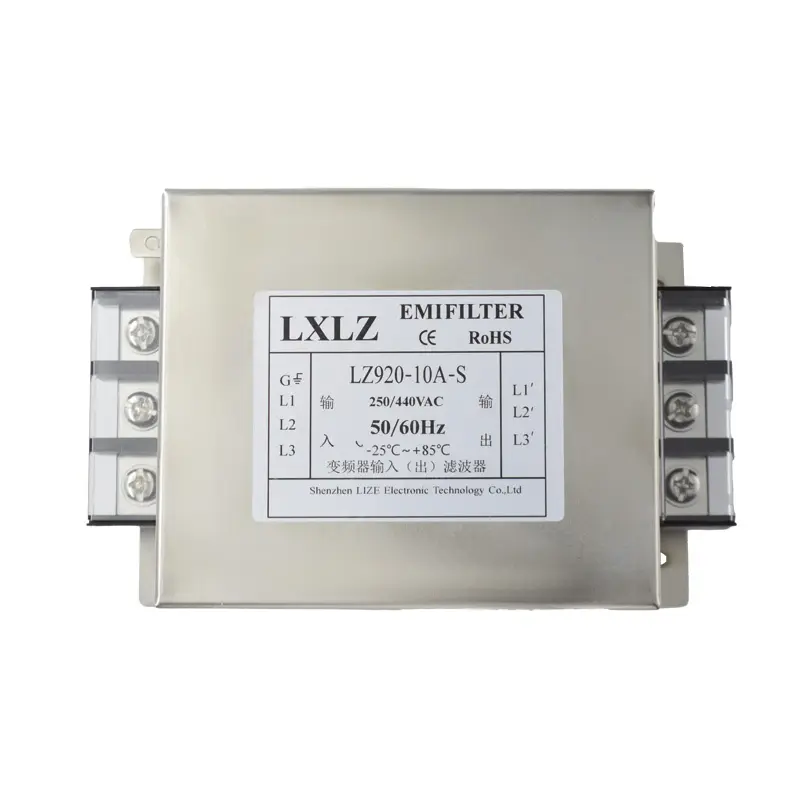
LXLZ Note: This Product Provides Solutions for Parameter Customization And Application.

VFD Input Output Filter Terminal Block Inverter EMC
If you've been dealing with VFD-induced electrical noise causing nuisance trips, damaged equipment, or failed EMC compliance tests — this filter was built to solve exactly that. The LZ920-S series is a three-phase EMI/EMC power line filter purpose-built for inverter (VFD) input and output circuits, where high-frequency harmonic interference is a constant challenge in industrial environments.
Unlike generic EMI filters, this unit is specifically engineered for the harsh electrical environment that VFDs create — switching frequencies, PWM harmonics, and common-mode noise that standard filters simply can't handle reliably long-term.
Table of Contents
Key Specifications at a Glance
| Parameter | Detail |
|---|---|
| Model Series | LZ920-S (Terminal Block Type) |
| Rated Voltage | 250V / 440VAC (Three-Phase) |
| Rated Current | 3A – 40A (multiple variants) |
| Frequency | 50 / 60 Hz |
| Operating Temperature | -25°C ~ +85°C |
| Connection Type | Terminal Block (Screw Terminal) |
| Certifications | CE, RoHS |
| Application | VFD Input / Output, Inverter Drive Systems |
| Phase | Three-Phase (L1, L2, L3 / L1', L2', L3') |
| Ground | G (Earth terminal included) |
What Makes This Filter Different
✦ Dedicated VFD-Grade EMI Suppression
Most standard power filters are rated for general industrial use. The LZ920-S is tuned specifically for variable frequency drive circuits — both on the input side (protecting the power grid from your VFD) and the output side (protecting motor windings and cables from reflected wave damage and leakage current).
✦ Terminal Block Interface — Built for Panel Integration
The screw-terminal (terminal block) design makes this unit a natural fit for control panel builders and OEM machine manufacturers. No specialized connectors, no proprietary wiring harness. Your electricians wire it in using standard practice, and it stays put. Terminal blocks on both input and output sides make in-field replacement straightforward without rewiring the whole panel.
✦ Wide Current Range: 3A to 40A
Whether you're filtering a small 0.75kW spindle drive or a 22kW conveyor system, there's a variant in this series to match. This matters a lot when you're standardizing a BOM across multiple machine sizes — one qualified supplier, one proven product family.
✦ High-Temp Rated: -25°C to +85°C
Industrial panels get hot. Enclosures in foundries, compressor rooms, and injection molding plants regularly see elevated ambient temperatures. The 85°C upper rating gives you real headroom, not just a spec that barely covers room temperature with a fan blowing on it.
✦ Compact, Robust Metal Housing
The stainless-brushed metal enclosure you see in the image isn't decorative — it's functional shielding. It contributes to the filter's attenuation performance and protects internal components from mechanical stress during shipping and installation. It also looks clean inside a panel, which matters to your end customers.
Where This Filter Gets Used — Real Application Scenarios
- CNC machining centers — suppressing spindle VFD interference from contaminating encoder signals and control electronics
- HVAC systems — fan and pump drive installations where EMC compliance is required for building certification
- Packaging and conveyor lines — multiple VFDs running simultaneously, where cross-interference between drives causes erratic behavior
- Injection molding machines — servo and inverter-dense environments where motor cable lengths amplify noise
- Industrial water treatment pumps — long cable runs between VFD and motor, high reflected wave risk
- Crane and hoist systems — where EMI from drives interferes with safety-critical PLC signals
Installation Best Practices (From Field Experience)
Getting the most out of any EMI filter comes down to installation quality. Here's what experienced panel builders consistently do right:
- Mount the filter as close to the VFD as physically possible. Every extra centimeter of unfiltered cable between the filter and the drive is an antenna.
- Keep input and output wiring separated. Running filtered and unfiltered cables in the same conduit or cable tray defeats the purpose of the filter entirely.
- Always connect the ground terminal (G) to the panel earth bus with a short, thick conductor. A long or thin ground wire significantly degrades common-mode noise rejection. Use the shortest path possible.
- Use shielded cable on the motor side output when cable runs exceed 5 meters. The filter handles what's inside the panel; shielded cable handles what happens in the field.
- Match current rating with 20-30% headroom. If your VFD draws 8A at full load, use the 10A or 12A variant — not the 8A. Thermal margin matters for filter longevity.
- For output-side installation: be aware that output filters are working against PWM waveforms, not clean sine waves. The LZ920-S is rated for this, but confirm motor cable length is within VFD manufacturer guidelines regardless.
Manufacturer Advantage — Why Source Direct from Us
We are the manufacturer, not a trading company. Here's what that means for your procurement:
- MOQ flexibility — We work with buyers at different volume stages. Pilot orders welcome, with pricing that scales as your volume grows.
- Custom current ratings on request — Need a specific amperage not listed? We can discuss custom production runs for qualified buyers.
- OEM labeling available — Your brand on the product, our quality inside. We support private label for machine builders and panel builders who need a consistent branded BOM.
- Consistent production quality — CE and RoHS compliance is maintained across production batches, not just for samples. We can provide test reports.
- Lead time transparency — Standard variants typically ship from stock or within short lead times. We communicate honestly, not optimistically.
FAQ
Can this filter be used on the output side of the VFD, not just the input?
Yes. The LZ920-S series is rated for both VFD input and output applications. Output-side use is actually where these filters earn their keep — suppressing PWM harmonics before they travel down motor cables and cause insulation stress or interference with nearby equipment. Just ensure your current rating matches the motor's full-load current.
What's the difference between the "-S" terminal block version and other variants in your range?
The "-S" suffix indicates the screw terminal block interface. Other variants in the LZ920 family may use different connection styles (such as stud/bolt terminals for higher-current versions). The terminal block version is the most common choice for panel builders because it integrates cleanly with standard din-rail wiring practice and doesn't require crimped ring terminals or special tools.
Does the filter meet CE and EN standards for European market machinery?
Yes. The filter carries CE marking and is RoHS compliant. For machinery directive compliance in European markets, this filter supports your EMC compliance effort — but final system-level EMC testing of the complete machine is always the customer's responsibility. We can provide documentation to support your technical file.
We're buying for multiple projects with different VFD sizes. Can we get mixed current ratings in one order?
Absolutely. Mixed-variant orders are standard for procurement teams managing multiple machine platforms. We can pack and label by variant for easy receiving and inventory management. Talk to us about your full requirement and we'll quote accordingly.
What's the expected service life, and is there any maintenance required?
EMI filters of this type are passive components with no moving parts and no consumables. Under normal operating conditions within rated voltage, current, and temperature specifications, service life easily exceeds 10 years. There is no scheduled maintenance. If the filter fails prematurely, it's almost always due to installation outside rated parameters — most commonly, a sustained overload condition or poor grounding.
Contact us for datasheet, test reports, volume pricing, or OEM discussion.