
LXLZ Note: This Product Provides Solutions for Parameter Customization And Application.

1500V High Voltage EMI Filter 3-Stage AC Power Line
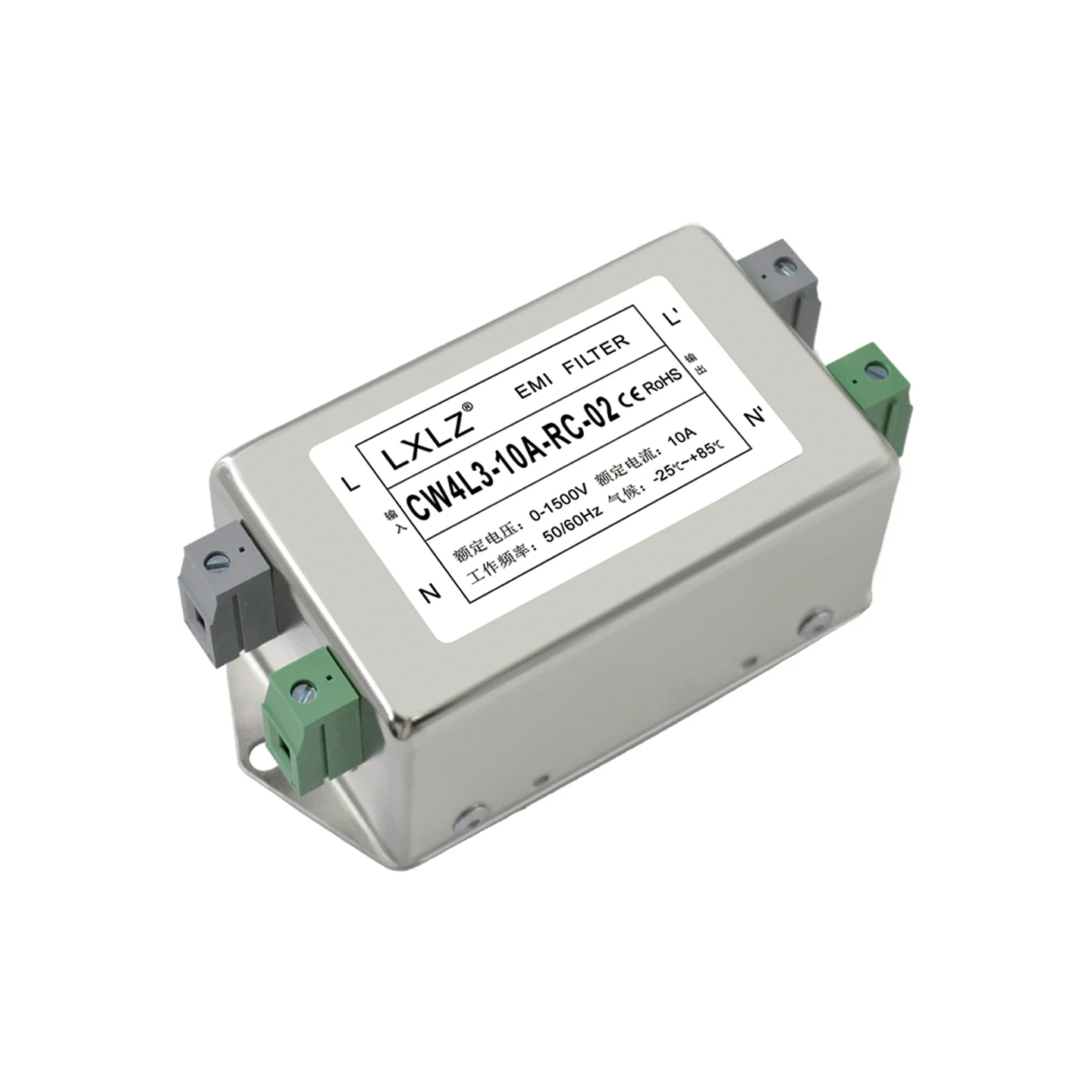
If you're sourcing EMI filters for high-voltage applications — solar inverters, EV charging equipment, industrial drives, or medical power supplies — this is the unit worth a closer look. The CW4L3-RC-02 is a single-phase, 3-stage AC power line EMI filter built to handle up to 1500V rated voltage, covering the current range from 1A to 50A. It ships with European-standard screw terminal blocks (the green Phoenix-style connectors you see in the photo), which makes panel integration straightforward without soldering or crimping adapters.
We manufacture these in-house. No middlemen. That matters when you need consistent quality across a 500-piece run or a 10,000-piece OEM order.
Table of Contents
Key Specifications at a Glance
| Parameter | Specification |
|---|---|
| Model | CW4L3-10A-RC-02 (Series: CW4L3-RC-02) |
| Filter Type | Single-Phase, 3-Stage EMI Filter |
| Rated Voltage | 0 – 1500V AC |
| Current Range | 1A – 50A (multi-spec available) |
| Frequency | 50 / 60 Hz |
| Operating Temperature | -25°C to +85°C |
| Connection Type | European-Standard Screw Terminal Block |
| Compliance | CE, RoHS |
| Enclosure | Stainless Steel / Metal Housing |
| Terminals | L (Input), N (Input) → L' (Output), N' (Output) |
What You're Actually Getting — Feature Breakdown
① True 3-Stage Filtering Architecture
Most budget filters on the market use a single-stage or pseudo-two-stage topology. This unit runs a genuine three-stage LC network, which means significantly better attenuation across both common-mode and differential-mode noise — the two interference types that actually damage downstream equipment or cause EMC test failures. If your product has to pass CE EMC testing, you'll feel the difference.
② 1500V Voltage Rating — Built for Modern High-Voltage Systems
Standard filters cap out at 250V or 480V. The 1500V rating here is specifically designed for:
- Photovoltaic (PV) inverter systems — where DC bus voltages regularly hit 1000–1500V
- EV fast-charging infrastructure
- High-voltage industrial automation equipment
- Battery energy storage systems (BESS)
This isn't an overspec'd marketing claim. The insulation materials and component selection are matched to the voltage class.
③ European Terminal Block Connection — Real Installation Advantage
The green screw terminal connectors (visible on both input and output sides in the photo) follow European DIN/Phoenix terminal standards. For B2B buyers supplying into European markets or building panels for EU-based OEMs, this eliminates the need for connector adapters. Wiring is fast, secure, and field-serviceable without special tools.
④ Wide Operating Temperature: -25°C to +85°C
Industrial environments are not always climate-controlled. Whether it's a rooftop solar installation in summer heat or an outdoor EV charger in northern Europe, this filter stays in spec across the full thermal range. The metal enclosure also acts as a passive heat sink, which helps in high-load continuous operation.
⑤ CE + RoHS Certified — Market Access Ready
Both marks are visible on the unit label. For buyers distributing into the EU, UK, or compliant markets globally, this removes a sourcing headache. You're not getting paperwork that needs re-certification; the product carries the marks on the unit itself.
⑥ Robust Metal Enclosure with Mounting Flanges
From the image, you can clearly see the corner mounting holes on the metal housing. The enclosure is rigid, provides EMI shielding for the filter components inside, and mounts directly onto DIN panels or chassis walls. This is a panel-mount design — not a PCB component — built for cabinet integration in professional electrical assemblies.
Typical Applications
- Solar / PV Inverter Systems (string inverters, central inverters, microinverters)
- EV Charging Stations (AC & DC fast chargers)
- Industrial Variable Frequency Drives (VFDs)
- CNC Machinery & Servo Drive Systems
- Medical Power Supply Equipment
- Telecom & Data Center Power Infrastructure
- Battery Energy Storage Systems
- Test & Measurement Equipment
Best Practice Installation Tips (From Field Experience)
These are real notes from installations we've seen go right — and wrong.
- Keep input and output wiring separated. Running them alongside each other in the same cable duct defeats the filtering. The noise couples straight back in. Minimum 50mm separation, or use shielded conduit on the output side.
- Ground the housing properly. The metal enclosure needs a short, direct ground connection — ideally under 100mm of 16AWG or thicker wire. A poor ground kills common-mode attenuation. This is the #1 installation mistake we see.
- Mount as close to the power entry point as possible. The filter works best when it's the first thing power hits after entering the cabinet. Longer pre-filter cable runs act as antennas.
- Don't over-torque the terminal screws. The European terminal blocks are rated for specific torque values (typically 0.5–0.8 Nm for this size). Strip the wire 6–8mm, insert fully, and torque to spec. Loose connections cause arcing at high voltage.
- Match the current rating conservatively. For continuous industrial loads, select the current variant at 80% of your max load current. A 10A load? Use the 16A or even 20A version. It runs cooler and lasts longer.
- For PV applications above 1000V DC: Verify polarity and system grounding scheme before installation. High-voltage DC behaves differently from AC, and grounding topology on the inverter side affects filter performance.
FAQ
Can this filter be used on the DC side of a solar inverter, not just AC?
Good question — and one we get a lot from solar equipment manufacturers. The 1500V rating technically covers DC voltage levels found in modern PV strings. However, this is an AC power line filter by design, optimized for 50/60Hz AC interference. For DC-side EMI filtering in PV systems, you'd want a dedicated DC EMI filter. That said, we do manufacture DC-rated versions — reach out and we can spec the right unit for your application.
What's the minimum order quantity, and can we get custom current ratings?
We're a manufacturer, so MOQ is negotiable depending on spec. For standard catalog variants (1A, 3A, 6A, 10A, 16A, 20A, 30A, 50A), MOQ typically starts at 50–100 units for first orders, with better pricing at 500+ pieces. Custom current ratings, enclosure sizes, or terminal configurations are available for OEM orders — generally requiring a tooling discussion for non-standard housings. Contact us with your target spec and annual volume for a direct quote.
What certifications does this product carry, and can you provide test reports?
The unit carries CE marking and RoHS compliance, both printed on the product label (visible in our product photo). Full test reports, declaration of conformity (DoC), and component-level compliance documentation are available upon request for qualified buyers. If you need UL or other market-specific certifications, let us know — we can discuss what's feasible for your volume and application.
How does 3-stage filtering compare to single-stage, and why does it matter for my EMC testing?
Single-stage filters attenuate noise once. Three-stage filters run the signal through three cascaded LC sections, which compounds the attenuation — you can realistically achieve 40–60dB of insertion loss in the critical 150kHz–30MHz range where conducted emissions are measured for CE EMC testing. If your equipment is borderline on conducted emissions tests, a 3-stage filter is often the difference between pass and fail without redesigning your power supply. We can share typical insertion loss curves for this series on request.
What's the lead time for bulk orders, and do you offer OEM labeling?
Standard catalog items: 3–7 business days for stock quantities, 2–4 weeks for larger production runs depending on current capacity. OEM labeling (your brand, custom model numbers, specific packaging) is available with minimum order thresholds — typically 200+ units. We can also provide private-label versions with modified housing colors or custom terminal configurations for OEM integration. Send us your product requirements and we'll give you a realistic timeline.
Why Source Direct From Us
We're not a trading company. We design and manufacture these filters ourselves, which means:
- Consistent quality — same components, same process, same test every run
- Faster problem resolution — no middleman to chase when you need a spec change
- Real technical support — our engineers can help you select the right filter or troubleshoot an EMC issue
- Competitive pricing — factory direct, especially meaningful at volume
- OEM flexibility — custom specs, packaging, and documentation are part of what we do
Looking for a specific current rating, custom OEM spec, or bulk pricing? Send us your requirements and we'll respond within 24 hours.