
LXLZ Note: This Product Provides Solutions for Parameter Customization And Application.

Black Switch IEC Inlet Filter Power Entry Module EMI
If you've ever had a piece of equipment fail EMC testing because of line noise, or dealt with a customer complaint about interference humming through their system — you already know why a solid power entry module matters. This isn't just a socket. It's your first line of defense against the electrical noise that kills sensitive electronics and fails compliance audits.
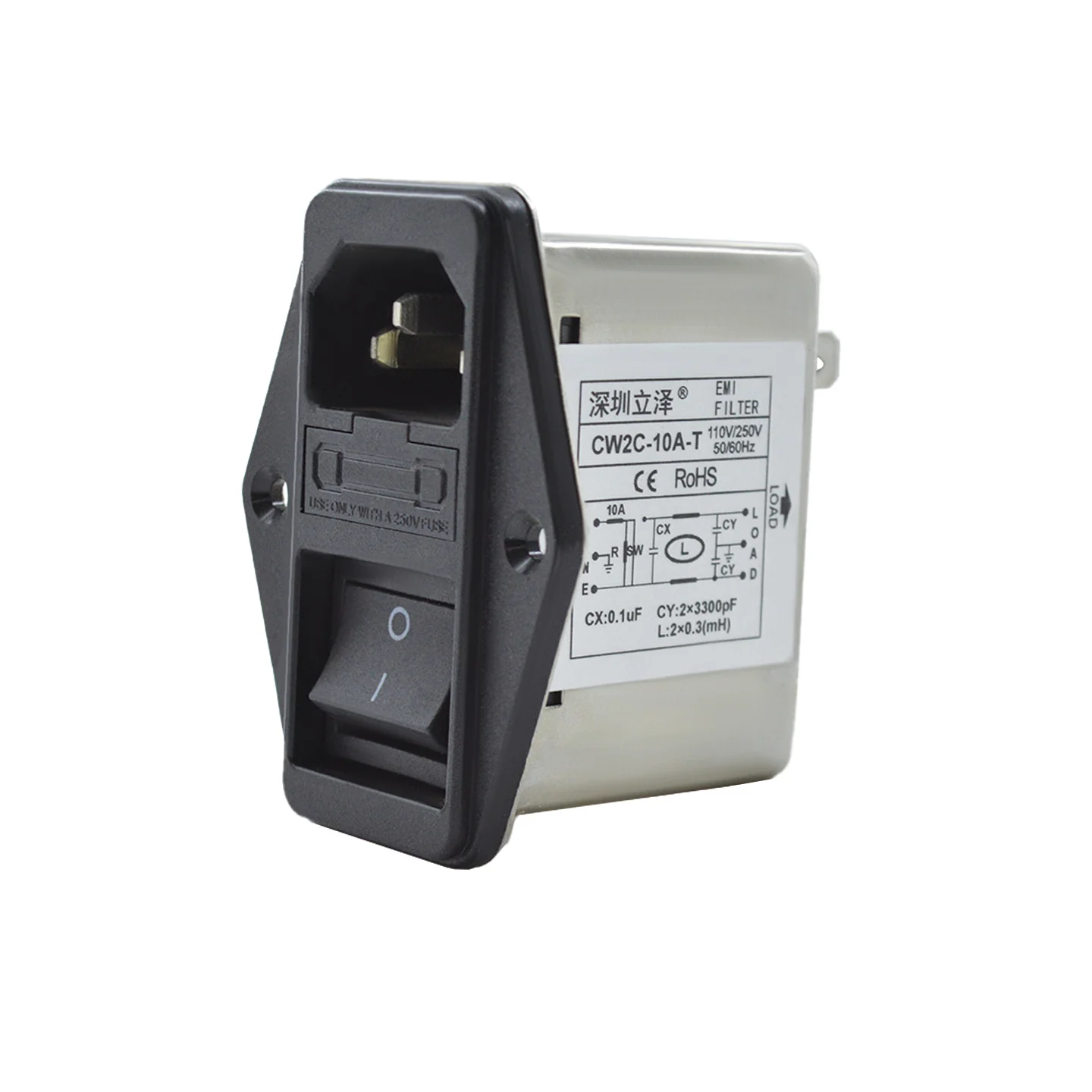
The CW2C-10A-T is a 3-in-1 panel-mount power entry module that combines an IEC C14 inlet, a dual fuse holder, and a large rocker power switch — all integrated with a built-in EMI/RFI filter in a single compact housing. Clean power in, protected equipment out. Simple as that.
Table of Contents
What's Actually Inside (From the Label & Circuit)
From the product image, here's what the internal filter circuit tells us:
- CX capacitor: 0.1µF — suppresses differential-mode noise across Line and Neutral
- CY capacitors: 2 × 3300pF — handles common-mode noise to ground
- Inductor: 2 × 0.3mH — the choke coil that blocks high-frequency interference from traveling either direction
This is a genuine π-type LC filter topology — not a bare-bones single-cap design. That matters when your product has to pass CE or RoHS testing, which this unit already carries.
Key Specifications
| Parameter | Detail |
|---|---|
| Model | CW2C-10A-T (22-CW2C-T) |
| Rated Voltage | 110V / 250V AC |
| Rated Current | 1A – 10A |
| Frequency | 50 / 60 Hz |
| Switch Type | Large rocker switch (no illumination) |
| Fuse Configuration | Single or Dual fuse holder |
| Inlet Type | IEC C14 socket-style (panel mount) |
| Filter Capacitor CX | 0.1µF |
| Filter Capacitor CY | 2 × 3300pF |
| Inductance L | 2 × 0.3mH |
| Color | Matte black front panel |
| Certification | CE, RoHS |
| Connection | Socket / Panel-mount inlet type |
Who Uses This — and Why They Choose It
This module is designed for equipment manufacturers and OEM integrators who need to combine power entry, switching, overcurrent protection, and EMI filtering into one clean panel cutout. Typical applications include:
- Industrial control panels and PLCs — where switching noise from motor drives needs to be kept off the power line
- Medical and lab equipment enclosures — where leakage current and noise floor matter for measurement accuracy
- Audio/AV professional equipment — engineers building rack units or amplifiers who need clean AC input without adding a separate filter board
- Power supply manufacturers — integrating this upstream of the transformer to simplify BOM and pass conducted emissions testing
- Telecom and networking hardware — especially where CE marking is mandatory for EU market entry
- Test & measurement instrument builders — where a noisy power line directly affects reading accuracy
Why This Design Works Better in Real Builds
1. 3-in-1 saves you board space and assembly time. Combining the IEC inlet, fuse protection, and power switch into one module means one panel cutout, one wiring harness, one BOM line item. Assembly workers install it in under a minute. Compare that to sourcing and wiring three separate components.
2. The large rocker switch is a practical choice for operators. No LED means no extra power draw, no LED failure callbacks, and no EMI from the indicator circuit itself. For industrial environments where the switch state is confirmed by the machine running — this is the right call.
3. Dual fuse holder gives you redundancy where it counts. Single-fuse designs protect Line only. A dual fuse holder protects both Line and Neutral — which is important in markets where neutral and line orientation isn't guaranteed, and for equipment that needs to meet stricter safety standards.
4. CE and RoHS certified out of the factory. You're not gambling on whether the component will hold up during compliance testing. The filter values printed on the label are real — CX, CY, and L values are documented, testable, and consistent batch to batch.
5. Wide voltage range (110V–250V) means one SKU covers global markets. Whether your end customer is plugging in at 120V/60Hz in North America or 230V/50Hz in Europe, this unit handles it. That's fewer SKU variants to manage in your warehouse.
Best Practices from Real-World Installations
- Mount as close to the panel entry point as possible. The whole point of an inlet filter is to stop noise before it enters your chassis. Running a long wire from your inlet to a remote filter defeats the purpose.
- Keep the load-side wiring away from the line-side wiring. Even inside the enclosure, routing filtered and unfiltered wires together can allow noise to couple back in.
- Use the correct fuse rating for your load, not the maximum rated current. A 10A fuse in a 3A circuit won't protect your equipment effectively. Size down.
- Ground the filter housing properly. The CY capacitors drain common-mode noise to ground — if your chassis isn't properly grounded, the filter can't do its job.
- For audio applications, pair with a toroidal transformer on the load side for best noise rejection results.
FAQ
Can we get custom current ratings below 10A, like 3A or 6A versions?
Yes. We manufacture across the 1A–10A range. If your application runs at a lower load, we can configure the correct fuse spec and inductor value for your target current. Just tell us your load profile when you inquire.
Do these come with CE and RoHS documentation we can use for our own product compliance filing?
Yes. We provide test reports and certification documentation with bulk orders. If you need specific documentation formats for EU Declaration of Conformity, let us know upfront.
What's the minimum order quantity, and can you do custom labeling or OEM branding?
We're a manufacturer, so MOQ is flexible depending on the model. OEM labeling — including your brand name on the filter module label — is available from a certain volume. Contact us with your expected annual volume for a realistic discussion.
Is the fuse holder designed for standard 5×20mm or 6.3×32mm fuses?
The standard configuration uses 5×20mm fuses, which are the most globally available size. We can confirm or adjust this for your region's standard if needed.
How consistent is the filter performance batch to batch?
We had issues with another supplier where attenuation varied. This is a fair concern. Our filter components — CX, CY caps and inductors — are sourced from controlled suppliers with incoming inspection. The schematic values printed on every unit label are the actual values used. We can provide batch-level test data for large orders, and sample testing before committing to volume is something we actively encourage.
Ready to discuss volume pricing, OEM labeling, or custom current configurations? Send us your application specs and we'll get back to you with a real answer, not a template.