
LXLZ Note: This Product Provides Solutions for Parameter Customization And Application.

IEC Socket EMI Filter Power Entry Module No Fuse
If you're designing equipment that needs to pass EMC compliance testing — or you've already had a product fail it — this is exactly the kind of component that makes the difference. The CW1D-T is a single-stage IEC socket-type EMI filter built for direct panel mounting. It handles both common-mode and differential-mode noise suppression without a fuse holder, keeping your design clean and your BOM simple.
This isn't a generic passthrough connector. It's a purpose-built power entry module that blocks high-frequency electromagnetic interference from entering your equipment through the AC line — and stops your device from pushing noise back into the grid. That matters a lot when you're selling into markets with strict EMC requirements like CE, FCC, or VCCI.
Table of Contents
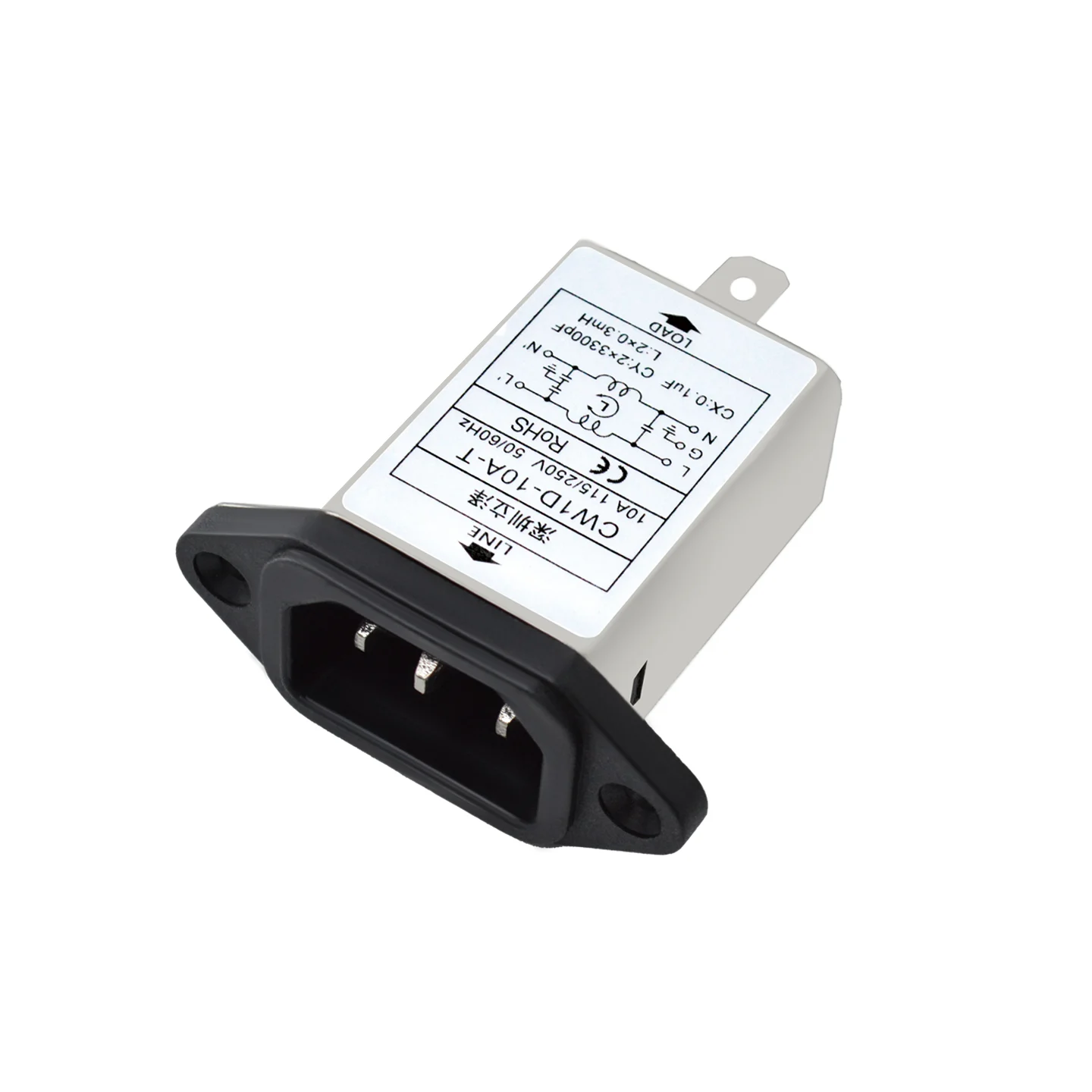
What You're Looking At (From the Image)
From the product image, you can clearly see:
- Compact rectangular housing in a cream/off-white metal shell with black front bezel — typical panel-mount IEC inlet form factor
- Three-pin blade terminals on the output side (Live / Neutral / Earth) for direct PCB or wire connection inside the enclosure
- Front-face IEC C14 inlet (standard male socket) for the power cord connection from outside
- Specification label printed on the body — shows circuit schematic, rating details, and model number (CW1D series), which confirms single-stage LC filter topology
- Tight, flush-mount flange design — seats cleanly into a standard panel cutout with no wasted space
- No fuse compartment — intentional design choice for applications where fusing is handled separately upstream
The build quality visible in the image — the tight metal seam, clean labeling, and solid terminal pins — reflects a component meant for production equipment, not prototype breadboards.
Key Specifications
| Parameter | Detail |
|---|---|
| Model Series | 18-CW1D-T |
| Filter Type | Single-stage EMI Filter |
| Connection Type | IEC Socket (Panel Mount) |
| Current Range | 1A / 3A / 6A / 10A (selectable) |
| Voltage Rating | 250VAC |
| Frequency | 50 / 60 Hz |
| Fuse | No Fuse |
| Inlet Type | IEC C14 (Standard IEC 320) |
| Mounting | Panel cutout, snap-in or screw flange |
| Noise Suppression | Common Mode + Differential Mode |
| Circuit Topology | Single-stage LC |
Who Actually Uses This — and Why
Your engineers and purchasing teams know this better than most: getting EMI filtering right at the power entry point is far cheaper than retrofitting a design late in the development cycle.
This component fits naturally into:
- Industrial control panels & PLCs — where switching power supplies generate noise that interferes with sensors and communication lines
- Medical device enclosures — where strict leakage current and EMC standards demand clean power entry
- Test & measurement equipment — where internal noise floors directly affect product accuracy
- Telecom and networking hardware — cabinets and rack-mount equipment where line noise is a constant concern
- Consumer and commercial appliances — motors, inverters, HVAC controls going into CE-marked markets
- Audio/AV professional equipment — where mains noise translates directly into audible hum or signal degradation
If your product needs to pass EN 55032, EN 61000-4 series, or similar EMC standards in export markets, this filter earns its place at the power entry point.
Why This Design Works Well in Practice
Single-stage filtering keeps insertion loss predictable. Double-stage filters offer more attenuation, but for many applications — especially 1A to 6A loads — a well-designed single-stage LC network is all you need. It's easier to characterize during EMC pre-compliance testing, and less likely to interact badly with your power supply's input stage.
No fuse means no fuse headaches. Some engineers prefer to keep fusing separate — in a dedicated fuseholder on the panel or inline on the PCB — so they can spec the exact fuse rating, type (fast/slow blow), and interrupt capacity independently. This module respects that preference. You're not locked into whatever fuse rating the module was designed around.
IEC C14 inlet is universally serviceable. Power cords are field-replaceable. Your customers in different regions can use their local cord sets. No adapters, no complaints.
Terminal pins are ready for quick-connect or direct wire. The blade terminals visible in the image accept standard fast-on connectors (6.3mm) or can be directly soldered/wired, which speeds up assembly line installation considerably.
Manufacturing & Supply Advantages (Our Factory)
We manufacture these in-house, which means:
- Consistent component sourcing — we control the capacitor and inductor quality that defines filter performance, not a subcontractor
- Custom current ratings available — if your application sits between standard values or needs a slightly different form factor, talk to us before assuming you have to compromise
- OEM/ODM labeling — your brand on the product, your model number in the label field, minimum quantities negotiable
- Batch testing — every production run goes through insertion loss spot-checks and hi-pot testing before shipping
- Lead times that work for production schedules — not the 16-week wait you get from some catalog suppliers
Best Practices — What Experienced Engineers Know
- Mount as close to the panel opening as possible. Every centimeter of unfiltered wire inside your enclosure is an antenna. The whole point of a power entry module is to filter at the point of entry.
- Bond the filter chassis to your enclosure ground properly. A floating ground connection on an EMI filter is worse than useless — the Y-capacitors inside need a solid RF ground to work. Use a star washer or conductive mounting hardware.
- Don't run input and output wires parallel inside the cabinet. Filtered output lines that run next to unfiltered input lines will pick up noise by capacitive coupling and defeat the filter. Route them separately.
- Match your current rating with margin. If your load draws 4A peak, use the 6A variant. Running a filter at its rated maximum reduces its lifespan and can affect the inductors' performance due to saturation.
- Check your leakage current budget before specifying Y-cap values. Medical and some industrial applications have strict limits on earth leakage current. The Y-capacitors in EMI filters are the primary contributor — confirm the spec sheet values fit your safety class.
FAQ
Does "no fuse" mean there's no overcurrent protection at all?
Correct — this module contains no fuse. That's intentional. You're expected to provide overcurrent protection elsewhere in the circuit — upstream breaker, inline fuseholder, or PCB-level protection. Many engineers prefer this because it lets them independently spec the fuse rating and type for their exact load.
What's the attenuation performance, and do you have insertion loss curves available?
Yes. We can provide insertion loss curves measured per CISPR 17 methodology for each current variant. Typical attenuation ranges from 30–50dB in the 100kHz–30MHz range for common-mode noise. Request the datasheet with your inquiry and specify your current rating.
Can we get custom current ratings or modified versions for our specific application?
Yes, within reason. We regularly work with OEM customers on modified versions — different current ratings, alternative terminal configurations, or custom labeling. Minimum order quantities apply for custom runs. Send us your requirements and we'll quote it straight.
What certifications does this filter carry?
The CW1D series is designed to meet UL, CE (LVD + EMC), and RoHS requirements. Specific certification documentation can be provided upon request. If you need a filter with a particular agency mark that's already on the cert, confirm the variant when you inquire.
What's your minimum order quantity, and how do you handle lead times for production orders?
MOQ varies by current rating — typically 100–500 pieces per variant for standard stock items. For larger production orders (1,000+ pcs), we schedule production runs and can commit to delivery timelines in writing. Sample orders for engineering evaluation are available; contact us with your application details.
Ready to discuss quantities, custom specs, or need a sample for evaluation? Send us your application details and we'll respond with pricing and lead time within 24 hours.