
LXLZ Note: This Product Provides Solutions for Parameter Customization And Application.

Potentiometer with Counting Dial Precision Multi-Turn
What You're Actually Getting
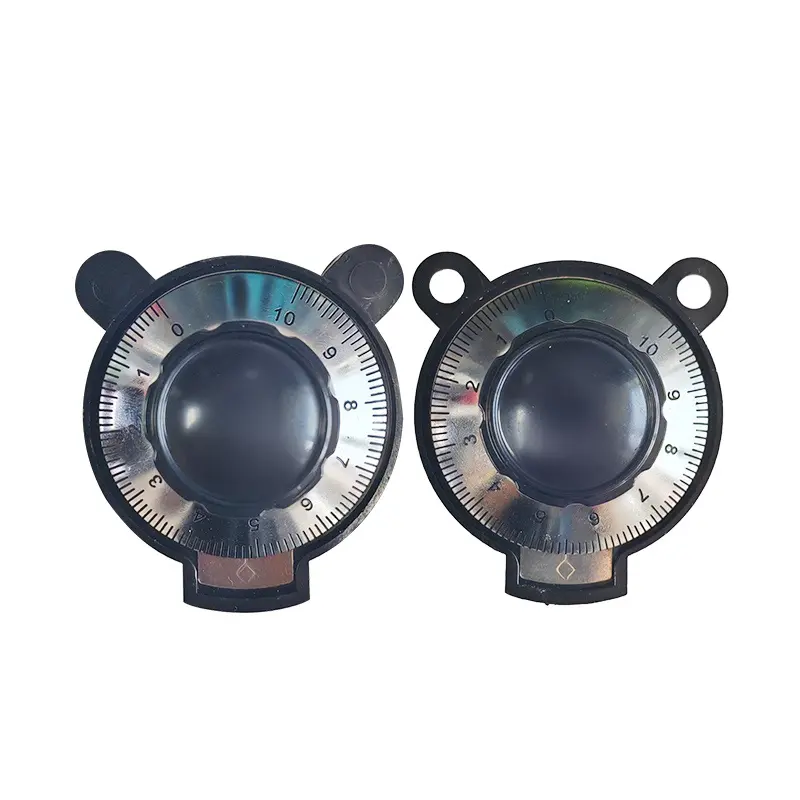
This is a multi-turn precision potentiometer knob built around the RV24YN20S base, paired with a gear-reduction counting dial mechanism. The knob face shows a clear 0–10 graduated scale with fine tick marks, letting operators dial in an exact resistance position and read it back later — no guessing, no drift. The "little panda" silhouette shape (two rounded ear-style mounting tabs flanking a circular body) isn't just aesthetic; those tabs are drilled mounting holes that bolt directly to a panel using standard screws, keeping the unit locked in place under vibration or repeated use.
The outer shell is bakelite — an older material that engineers keep coming back to because it doesn't warp from heat, doesn't conduct electricity if someone accidentally touches it, and resists the kind of mild chemical exposure common on factory floors. The dial ring is metal-finished for durability and scale legibility over thousands of operating cycles.
Table of Contents
Key Specs at a Glance
| Item | Detail |
|---|---|
| Model | 05-RV24YN20S |
| Type | Multi-turn wirewound/cermet potentiometer with counting dial |
| Turns | Multi-turn (gear-reduction drive, typically 10 turns full travel) |
| Scale | 0–10 graduated dial with fine subdivision marks |
| Shell Material | Bakelite (thermosetting phenolic) — non-conductive, heat-resistant |
| Mounting | Dual-hole bracket tabs (panel mount, screw fixed) |
| Surface | Wear-resistant, corrosion-resistant dial face |
| Knob Cap | Domed grip center for comfortable fingertip control |
| Compatibility | Standard multi-turn potentiometer shaft (RV24YN20S series) |
Where This Gets Used — Real Application Scenarios
From what we see buyers actually doing with this part:
- Industrial control panels — speed controllers, tension regulators, temperature setpoint adjusters where operators need to move a value and document where they set it
- CNC and servo drive systems — fine gain adjustment on motor drives; technicians set it once, write down the dial reading, done
- Laboratory and test equipment — resistance decade substitution, signal level trimming
- Power supply calibration — voltage or current limit setpoint that doesn't drift after you walk away
- Medical device assembly — anywhere a precise, repeatable setpoint matters and the operator needs visual confirmation
- Welding equipment / inverter controls — robust enough for environments with heat and mild fumes
The counting dial is the reason engineers specify this over a single-turn knob. When your field tech needs to reset a machine to yesterday's configuration, they just turn the knob back to the logged dial number. That's the whole value proposition.
Why Buyers Keep Coming Back to This Design
1. Readable precision that survives shift changes A single-turn knob with no scale is a liability in production. Someone bumps it, no one knows where it was. The numbered counting dial eliminates that. Your operators can log the setting: "Motor speed: dial at 7.4." Done.
2. Bakelite shell holds up where plastics fail Bakelite doesn't soften in heat, doesn't crack from UV like ABS, and won't melt against a warm resistor bank. For enclosed control panels that see 60–80°C ambient, that matters. We've seen standard plastic knobs deform and jam — this one won't.
3. Panel-mount tabs mean it stays where you put it The two mounting ears aren't decorative. Bolt this to a panel and the whole assembly — knob, dial, potentiometer — becomes mechanically fixed. No rotation of the body, no loosening over time. Critical for vibration-heavy environments like compressors or conveyor drives.
4. Gear reduction gives you real fine control Ten full shaft turns spread across a 0–10 scale means each small movement of the knob equals a tiny resistance change. For a 10kΩ pot, you're adjusting roughly 100Ω per division. That level of granularity is impossible with a single-turn knob.
5. Wear and corrosion resistance The dial face is finished to resist scratching and light chemical exposure (oils, cleaning solvents common in light manufacturing). The markings stay legible for years, not months.
Manufacturing Notes — What We Do Differently
We manufacture these as a matched assembly — the counting dial mechanism is fitted and tested with the potentiometer base before shipping. A common failure point from cheaper sources is dial slip: the knob turns but the gear misses a tooth and the count jumps. Our production process includes a rotation cycle check on each unit before batch packing.
Shell molding uses virgin bakelite compound, not regrind. Regrind bakelite is brittle and shows hairline cracks under stress — something you might not see until your customer's panel is already in the field.
For B2B orders, we support:
- Custom resistance values (matched to RV24YN20S available range)
- Custom scale printing (OEM dial face with your graduation or logo)
- MOQ flexible for initial qualification orders — talk to us before assuming you need 10,000 pieces to start
FAQ — What Our B2B Customers Ask Before They Order
What potentiometer resistance values are available with this dial?
The RV24YN20S series covers a range of standard resistance values (commonly 1kΩ, 2kΩ, 5kΩ, 10kΩ, 20kΩ, 50kΩ, 100kΩ). Tell us your circuit requirement and we'll confirm stock and lead time. We don't assume — we check before confirming.
How many turns does the mechanism actually run?
The gear reduction on this dial is designed for a 10-turn full-range travel, matching the 0–10 scale. Each full revolution of the knob advances the dial by approximately 1 unit. This is a true multi-turn mechanism, not a partial-turn with a false scale.
Can we get custom OEM labeling or a blank dial face?
Yes. For orders above a certain quantity threshold, we can supply units with your graduation scale, company marking, or a clean unlabeled dial for your own silk-screen process. Contact us with your artwork specs.
What's the panel cutout / mounting dimension?
The mounting holes on the bracket tabs fit standard M3 screws. We can provide a mechanical drawing (DXF or PDF) immediately upon request — don't hold up your panel design waiting. Just ask.
What's the typical lifespan under continuous industrial use?
The RV24YN20S base is rated for extended rotational life under normal operating loads. With the bakelite housing protecting the mechanism from contamination, field reports from our existing customers in automation and power equipment indicate 3–5+ years without replacement in typical duty cycles. We'll share actual test data if you need it for qualification documentation.
Need a sample, a datasheet, or a quote for your specific resistance value and quantity? Send us a message — we reply with real answers, not templates.