
LXLZ Note: This Product Provides Solutions for Parameter Customization And Application.

RV24YN20S Carbon Film Potentiometer Industrial Rotary
If you've been sourcing potentiometers for industrial equipment, audio systems, or control panels, you know how frustrating it is to deal with inconsistent quality — scratchy rotation, worn-out carbon tracks after a few thousand cycles, or terminals that just don't hold up in field conditions. That's exactly what we built this unit to solve.
The RV24YN20S is a single-turn carbon film potentiometer designed for serious industrial and commercial applications. We manufacture these in volume for OEM customers across automation, audio, medical instrumentation, and test & measurement industries. Here's what makes ours worth your time.
Table of Contents
Key Features at a Glance
| Feature | Detail |
|---|---|
| Model | RV24YN20S |
| Type | Single-turn Carbon Film Potentiometer |
| Carbon Film Element | Premium Taiwan-sourced carbon film substrate |
| Terminal Type | Solder lug (screw-type, no-weld wire connection available) |
| Contact Pins | Silver-plated solder legs |
| Accessories Included | Knob + Square Scale Dial + Round Scale Dial |
| Structure | Heavy-duty metal housing, panel-mount threaded bushing |
| Shaft | Slotted metal shaft for screwdriver or knob adjustment |
| Rotation | Single-turn (approx. 270° effective travel) |
| Resistance Taper | B (Linear) — as shown in sample B502 |
What You're Actually Getting
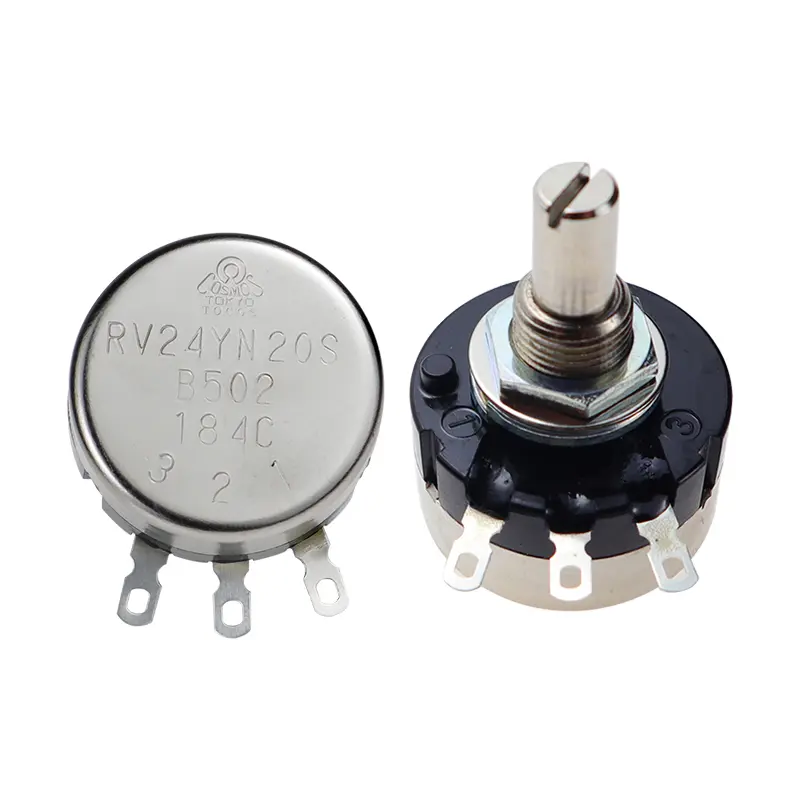
From the image, you can see the unit is built with a full metal back cover stamped with model and batch code (RV24YN20S / B502 / 184C), which matters for traceability in industrial procurement. The front shows a reinforced panel-mount body with a threaded bushing, and three clearly spaced solder-lug terminals — these are the kind of terminals that let your assembly team connect wire leads without a soldering iron, reducing production labor costs significantly.
The shaft is a standard slotted D-type compatible with most off-the-shelf knobs in the market. We include both a square scale dial and a round scale dial, so your engineering team has flexibility in panel layout design without ordering additional components separately.
Where This Gets Used — Typical Application Scenarios
Our B2B customers typically integrate the RV24YN20S into:
- Industrial control panels — speed control, temperature adjustment, motor drive input
- Audio & mixing equipment — volume, tone, balance control (linear taper B type)
- Medical devices — parameter adjustment on diagnostic or therapeutic equipment where smooth, repeatable rotation matters
- Test & measurement instruments — signal level control, calibration dials
- HVAC and building automation — manual override controls, setpoint adjustment
- Power supply units — output voltage or current fine-tuning
If your production line assembles any of the above, this potentiometer fits directly into your BOM without modification.
Manufacturing Advantages — Why Source From Us Directly
We're not a trading company. We manufacture these in-house, which means:
1. Taiwan Carbon Film — Not a Compromise
The carbon film strip is the heart of a potentiometer. Cheaper alternatives use domestic low-grade film that oxidizes faster, creates noise (audio crackle or signal instability), and wears out within 5,000–10,000 cycles. Our Taiwan-sourced substrate consistently delivers low noise, stable resistance curve, and rated lifespan exceeding 15,000+ cycles under standard conditions.
2. Silver-Plated Solder Legs
Silver plating on the terminals isn't cosmetic. It prevents oxidation in humid storage environments, ensures reliable solderability even after 12+ months in warehouse, and reduces contact resistance at the joint. Your QC team will notice fewer cold joint rejects.
3. No-Weld Terminal Option
The solder-lug design means wire can be mechanically fastened without soldering — a real advantage for field-replaceable units or customers with labor cost constraints in their assembly process.
4. Tight Batch Consistency
Each production batch is stamped and traceable. Resistance tolerance, rotation torque, and electrical linearity are checked at production. For procurement managers ordering 5,000–50,000 units per run, this is the consistency that keeps your production line predictable.
5. Full Accessory Kit Ready
Knob + two dial types (square and round) are available as a set or separately. This simplifies your sourcing — one supplier, one PO, fewer logistics headaches.
Best Practices from the Field
Based on feedback from our long-term OEM partners, here's what experienced engineers recommend:
Torque check before panel installation — After mounting, verify shaft rotation torque matches your panel design. If using a knob, ensure set-screw alignment with the shaft slot to avoid wobble over time.
Avoid over-tightening the bushing nut — The panel-mount nut should be snugged firmly but not torqued beyond spec. Over-tightening can distort the housing and affect internal wiper contact.
Store in dry, sealed packaging — Silver-plated legs are corrosion-resistant, but for long warehouse storage (6+ months), keep in moisture-barrier bags. We can provide tape-and-reel or anti-static bag packaging on request.
Match resistance value to your circuit input impedance — For audio applications, B502 (5kΩ linear) is commonly used for volume stages. For motor drive or PWM input, check your controller's recommended pot resistance range before specifying.
Use the round dial for space-constrained panels, square dial for labeled front panels — The round dial suits instrument-style aesthetics; the square dial is easier to print custom legends on for OEM branding.
FAQ — What Our B2B Buyers Ask Most
What resistance values and tapers are available, and can I order mixed specs in one shipment?
We offer a range of resistance values (1kΩ, 2kΩ, 5kΩ, 10kΩ, 20kΩ, 50kΩ, 100kΩ, and more) in both B (linear) and A (audio/log) tapers. Mixed-spec orders are supported with a minimum quantity per SKU — contact us with your BOM and we'll quote accordingly. MOQ and pricing scale with total order volume.
What is the rated lifespan and can you provide test data or a spec sheet?
Standard rated mechanical lifespan is 15,000 cycles minimum under normal operating conditions (room temperature, rated load). We can provide a full technical datasheet including electrical specifications, torque values, temperature range (typically -10°C to +70°C), and dielectric strength data. Request via inquiry form.
Can you do OEM labeling or custom resistance values for our product?
Yes. For orders above a certain volume threshold, we support custom laser marking on the rear housing (your model code, batch number, or brand mark), and we can work with custom resistance values if your engineering specs require it. Lead time for custom runs is typically 3–5 weeks depending on quantity.
What are your packaging options for automated SMT or through-hole assembly lines?
Standard shipment is bulk tray or anti-static bag. For customers with automated insertion lines, we can discuss custom tray formats. These are through-hole components — terminals are suitable for wave soldering or manual soldering. Not SMT compatible by design.
What's your quality control process, and do you have certifications?
Each production batch undergoes incoming material inspection (carbon film, terminal plating), in-process rotation torque and resistance verification, and outgoing QC sampling per AQL standards. We can provide batch test reports on request. Certification availability (RoHS, ISO, etc.) — please inquire directly as documentation varies by product line.
Ready to discuss volume pricing or request a sample batch? Send us your target quantity, resistance specs, and delivery requirements — we'll get back to you within 24 hours.