
LXLZ Note: This Product Provides Solutions for Parameter Customization And Application.

RYK-99 Motor Brake Rectifier 220V Fast Braking Unit
If you're sourcing brake rectifiers for industrial motor applications, you already know how much a slow or unreliable brake response can cost — downtime, mechanical wear, even safety incidents. The RYK-99 is built specifically to solve that.
This is a 220VAC input / 99VDC output motor brake rectifier designed for electromagnetic brake coils on three-phase induction motors. It converts AC power to the DC voltage your brake coil needs — and does it fast, cleanly, and consistently across thousands of cycles.
We manufacture both the standard diode-type and fast-response MOSFET-type versions from the same production line, so you get flexibility without switching suppliers.
What You're Actually Getting
⚡ Two Types, One Source
- Diode Type (Standard) — solid, cost-effective, proven for general braking applications where stopping time isn't critical
- MOSFET Type (Fast Braking) — significantly shorter brake engagement time, ideal for precision machinery, hoists, woodworking equipment, and any application where positioning accuracy matters
🔌 Electrical Specs
| Parameter | Value |
|---|---|
| Input Voltage | 220VAC |
| Output Voltage | 99VDC |
| Conductor Material | Pure copper wire |
| Housing Material | High-grade PBT (flame retardant) |
| Model Reference | ZLKS-99-4 / RYK-99 |
| Circuit Type | Diode / MOSFET (selectable) |
🏗️ Build Quality That Holds Up in the Field
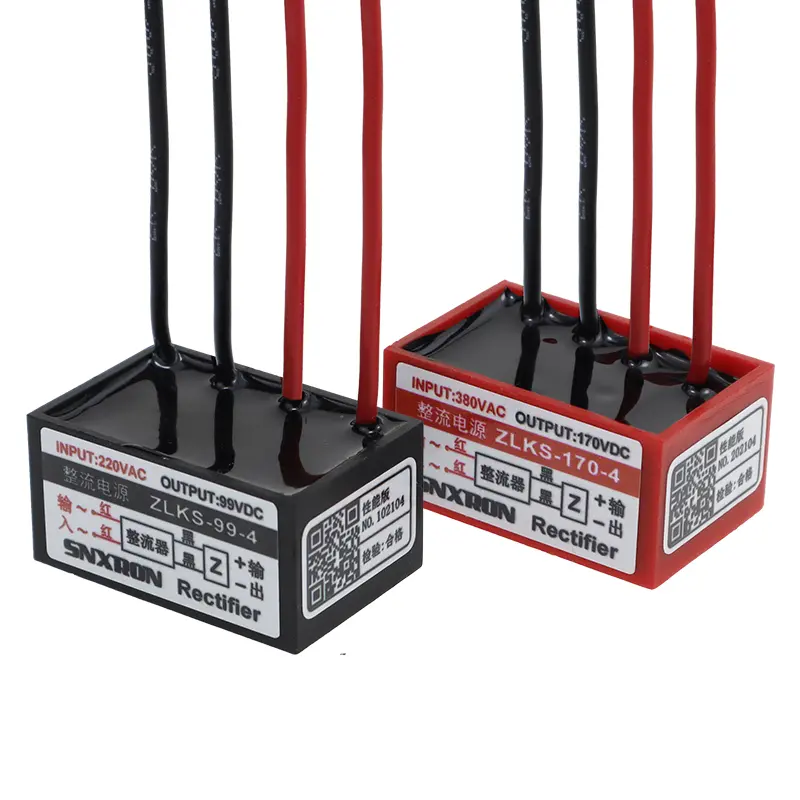
From the image, you can see both units are fully encapsulated with epoxy resin — this isn't just for looks. It locks out moisture, vibration, and contamination. The wiring connections are sealed at the body, which is where cheaper units tend to fail first. The pure copper leads mean lower resistance and better heat dissipation versus aluminum or copper-clad alternatives.
The PBT shell (polybutylene terephthalate) handles heat better than standard nylon housings — it won't warp near motor control panels running in summer. That matters when you're mounting dozens of these in an electrical cabinet.
Labels are clean, clearly printed, and include QC batch numbers — something your incoming inspection team will appreciate.
Application Scenarios
These rectifiers are widely used in:
- Three-phase motor electromagnetic brakes (YEJ series and similar)
- Crane & hoist systems — where precise stopping position is non-negotiable
- CNC machinery and woodworking equipment — fast stop = better cut quality, less blade/tool wear
- Conveyor systems — controlled stopping prevents product spillage or misalignment
- Packaging and textile machinery — cycle speed depends on how fast your brake re-engages
- Elevator auxiliary braking — where safety compliance requires reliable DC excitation
Why Buyers Choose the Fast-Type Over Standard
Here's something we hear from OEM customers regularly: they spec the standard diode type, run it for a year, then switch to MOSFET after dealing with brake lag complaints from their end users. The fast-type costs slightly more upfront but reduces warranty callbacks and improves machine cycle efficiency — especially above 20 brake cycles per minute.
If your motors are running more than 10 stops per minute, or if positioning accuracy is part of your machine's selling point, quote the fast version. We can supply both in the same order for A/B evaluation if you need it.
Manufacturing Advantages
- Direct factory supply — no trading company markup, consistent batch quality
- Flexible MOQ — we work with OEM equipment builders and panel assemblers alike
- Custom labeling / OEM branding available on request
- Both circuit types manufactured in-house — consistent QC across your entire brake rectifier BOM
- Epoxy encapsulation done in controlled environment — no air voids, no partial fills
- Each unit QC-stamped (visible on label: 检验合格 / Inspection Passed)
FAQ
What's the actual braking time difference between the diode type and MOSFET type?
The standard diode type typically achieves brake engagement in 80–150ms depending on coil inductance. The MOSFET fast type brings this down to 20–50ms in the same circuit. For high-cycle or precision applications, that gap is significant.
Can this work with my existing YEJ motor brake coil without modification?
Yes, in the vast majority of cases. The 99VDC output is matched to the standard electromagnetic brake coil rating on YEJ-series and compatible motors fed by 220VAC systems. No rewiring needed — wire in parallel with the motor starter contactor.
What's your minimum order quantity, and do you support OEM labeling?
We're a manufacturer, not a distributor. MOQ is flexible based on model mix. OEM labeling, custom color coding, and private branding are all available — contact us with your spec sheet and we'll quote accordingly.
How do I know which type to order — diode or MOSFET?
If your application runs fewer than 10 brake cycles per minute and stop position tolerance is ±a few degrees — standard diode is fine and more cost-effective. If you're running high-frequency cycles, hoists, servo-assist systems, or precision tooling — go MOSFET. When in doubt, tell us your motor power and stop frequency and we'll recommend directly.
What's the expected service life, and what causes early failure in the field?
Under normal operating conditions, these units are rated for 5–8 years in panel-mounted environments. The most common cause of early failure we see returned from the field: incorrect input voltage (connecting 380V units to 220V circuits or vice versa), or coil short circuits that back-feed into the rectifier. Both are installation errors, not product defects. Each unit is clearly labeled with input/output specs — match them before installation.
Ready to discuss volume pricing or technical compatibility? Send us your motor specs and annual usage volume — we'll get back to you within 24 hours.