
LXLZ Note: This Product Provides Solutions for Parameter Customization And Application.

Stud Terminal EMI Filter Single Phase AC Power Filter
If you're building equipment that needs to stay clean on the power line — whether that's industrial machinery, medical devices, automation controllers, or power supplies — you already know how much a noisy AC line can mess things up. This is exactly what the CW3-S Series Single-Phase EMI Power Line Filter is designed to handle.
Built for AC 115V/250V systems at 50/60Hz, with current ratings covering 1A through 20A, this filter suppresses both common-mode and differential-mode interference before it reaches your load. The result? Cleaner power, more stable equipment operation, and a much easier path through CE/RoHS compliance testing.
We manufacture these in-house. No middlemen. That means tighter quality control, better pricing on volume orders, and the flexibility to discuss custom configurations when your project needs something a little different.
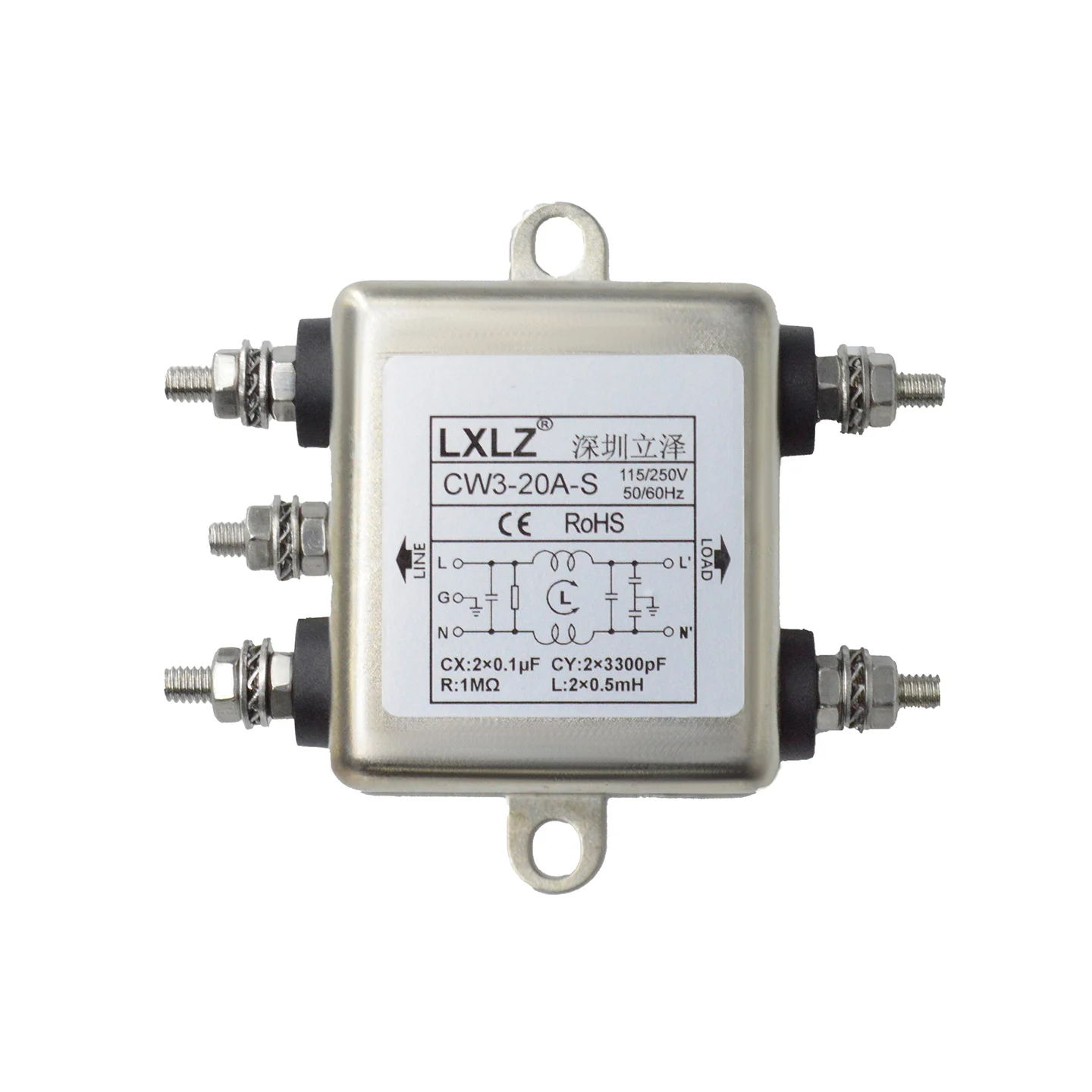
What the Image Tells You (From the Label)
From the product label on the unit itself:
- Brand: LXLZ® (registered)
- Model shown: CW3-10A-T (same series, stud terminal variant)
- Voltage: 115/250V
- Frequency: 50/60Hz
- Certifications: CE ✔ | RoHS ✔
- Internal circuit components:
- CX capacitors: 2 × 0.1μF (differential-mode suppression)
- CY capacitors: 2 × 3300pF (common-mode leakage control)
- Bleed resistor: 1MΩ (discharge safety)
- Common-mode choke inductors: 2 × 0.5mH
- Terminals: Stud-type (bolt-on) on both LINE and LOAD sides
- Mounting: Four corner mounting holes — panel or chassis mount
The circuit topology is a classic single-stage LC filter with both CX and CY capacitors plus a common-mode choke. This is a well-proven layout that delivers reliable attenuation across a broad frequency range without over-engineering the BOM.
Key Specifications
| Parameter | Detail |
|---|---|
| Series | CW3-S / CW3-20A-S |
| Phase | Single Phase |
| Filter Stage | Single Stage |
| Rated Voltage | AC 115V / 250V |
| Frequency | 50 / 60 Hz |
| Current Range | 1A — 20A (multiple models) |
| Connection Type | Stud Terminal (Bolt-on) |
| Capacitors (CX) | 2 × 0.1μF |
| Capacitors (CY) | 2 × 3300pF |
| Inductance (L) | 2 × 0.5mH |
| Bleed Resistor | 1MΩ |
| Certifications | CE, RoHS |
| Mounting | Chassis / Panel Mount (4 corner holes) |
| Model Code | 14-CW3-S |
Where This Filter Gets Used
B-end buyers sourcing this product typically drop it into:
- Industrial automation panels — servo drives, VFDs, PLCs
- Power supply units (PSU) — switching power supplies for OEM equipment
- Medical equipment enclosures — where leakage current and EMI limits are strict
- CNC machinery and motion control systems
- Audio/AV equipment racks — noise-sensitive signal chain protection
- Telecommunications power infrastructure
- EV charging equipment — AC input filtering stage
- Test & measurement instruments
If your equipment needs to pass EN 55032, EN 55011, FCC Part 15B, or similar EMC standards, installing a properly rated line filter is almost always part of the solution.
Why the Stud Terminal Design Matters
Screw-terminal and quick-connect filters have their place, but stud terminals (bolt-on connections) are a different story when it comes to production reliability:
- ✅ Higher current carrying capacity per connection point — less resistance, less heat at the joint
- ✅ Vibration resistance — critical in industrial and automotive-adjacent applications
- ✅ Lower contact resistance over time — press-fit and spade connectors can loosen; bolted connections don't
- ✅ Easier field replacement — technicians can swap the unit without special tooling
- ✅ Better suited for high-cycle production wiring — assembly line workers close the connection once and it stays closed
For any application where the filter is inside a panel or enclosure that vibrates, or where the installation needs to last 10+ years without maintenance, stud terminal is the right cal
Manufacturing Advantages — Why Buy Direct From Us
We're not a trading company reselling someone else's product. Here's what that means for you as a procurement buyer:
1. Consistent Component Sourcing We control what goes inside. CX/CY capacitors, the common-mode choke core, and the housing materials are sourced from qualified suppliers we've vetted over years of production. You won't get a batch that suddenly performs differently because someone swapped a cheaper cap.
2. Volume Flexibility Whether you need 500 pieces or 50,000, our production lines can scale without forcing you into a distributor's minimum order structure. Talk to us about your annual forecast.
3. OEM/ODM Available Need your own brand label? Different terminal configuration? A specific current rating we don't list? We can discuss it. Many of our long-term clients started with a standard product and moved to a customized version within 6–12 months.
4. CE & RoHS Documentation We provide full compliance documentation with every order — test reports, declarations of conformity, and component-level RoHS certificates if your compliance team needs them for product registration in Europe or other regulated markets.
5. Competitive Lead Times Standard models from the CW3-S series are kept in production stock. We're not building to order on a 12-week lead time. Contact us to confirm current availability.
Best Practices — Getting the Most From This Filter
From production experience and customer feedback across multiple industries:
Match the current rating with real load current, not just nameplate rating. A filter running near its maximum current rating will run warmer and may have slightly higher insertion loss degradation over time. If your load peaks at 15A, consider the 20A model even if average draw is lower.
Mount the filter as close to the power entry point as possible. The whole point is to stop noise from getting in (or out). Mounting it 30cm away from the inlet with an unshielded wire run between them gives conducted interference a path to bypass your filter entirely.
Ground the chassis properly before trusting the CY capacitors to work. CY capacitors shunt common-mode noise to ground. If your chassis ground is floating or poorly bonded, those capacitors aren't doing their job.
Don't run LINE and LOAD wiring in the same cable bundle. This is one of the most common mistakes. If filtered and unfiltered wiring share the same conduit, you're coupling noise back across the filter through mutual inductance.
Check leakage current against your end-market requirements. The 3300pF CY caps produce a defined leakage current to ground. For medical applications (IEC 60601), verify this falls within allowable limits for your device class — or request a low-leakage variant.
FAQ
Q1: Can this filter handle both 110V and 220V systems without modification?
Yes. The CW3-S series is rated for 115V/250V AC, which covers both North American and European/Asian mains voltages within the same unit. No internal switching or jumper changes required. This makes it convenient for OEMs shipping equipment to multiple markets.
Q2: What certifications come with the product, and can you provide test reports?
Every unit in this series carries CE marking (covering LVD and EMC directives) and is RoHS compliant. We can provide Declaration of Conformity documents and third-party test reports upon request. If your compliance team or a certification body needs specific documentation, just let us know when you inquire.
Q3: Do you support OEM labeling or custom configurations
Yes, both. OEM labeling (your brand, your model number on the unit) is available from certain minimum quantities. Custom configurations — different current ratings, terminal styles, or filter topology — are possible through our ODM process. Lead times and MOQs for custom work vary; contact us with your requirements and we'll give you a straight answer.
Q4: What is the minimum order quantity, and what are your lead times for standard models?
Standard CW3-S series models are produced in regular runs and we maintain working stock. MOQ for standard models is negotiable depending on the specific current rating. Lead time for in-stock items is typically 3–7 business days for shipment preparation. For larger volume orders requiring production scheduling, we'll confirm lead time at the time of inquiry. We recommend contacting us with your annual volume estimate so we can offer appropriate pricing tiers.
Q5: How do I select the right current rating for my application?
Choose a model rated at at least 125% of your maximum continuous load current. For example, if your equipment draws up to 12A peak, the 16A or 20A model is a safer long-term choice than the 12A. Running a filter at its rated limit continuously shortens component lifespan and can cause the filter's performance to drift over time. We're happy to review your application specs and recommend the right model — just send us your load profile.
Ready to discuss quantities, custom specs, or certification documents? Send us an inquiry and we'll get back to you within one business day.