
LXLZ Note: This Product Provides Solutions for Parameter Customization And Application.

ZLD Elevator Brake Rectifier Lift Motor Control Unit
What This Module Actually Does
If you're sourcing brake rectifiers for elevator systems, you already know how critical this component is. The brake rectifier sits between your AC power supply and the electromagnetic brake coil — it converts AC input into a stable DC output to engage and release the brake precisely when the controller commands it. A slow or inconsistent brake response isn't just a maintenance headache; it's a safety liability.
Our ZLM series rectifier module is built specifically for this job. Fast response, stable output, and a housing that holds up in real-world machine room conditions — not just lab settings.
Table of Contents
Key Specifications at a Glance
| Parameter | ZLM-99V | ZLM-170V |
|---|---|---|
| Model No. | 23-ZLM-99V | 23-ZLM-170V |
| AC Input | AC 220V | AC 380V |
| DC Output | DC 99V | DC 170V |
| Application | Elevator electromagnetic brake | Elevator electromagnetic brake |
| Braking Type | Fast braking (rapid response) | Fast braking (rapid response) |
| Housing Material | Flame-retardant (UL94 V-0 class) | Flame-retardant (UL94 V-0 class) |
| Encapsulation | Epoxy resin filled | Epoxy resin filled |
| Terminal Block | 6-pin screw terminal (green, tool-free wire swap) | 6-pin screw terminal |
| Environmental Protection | Anti-corrosion, moisture-resistant | Anti-corrosion, moisture-resistant |
| Eco Material | High-performance polypropylene casing | High-performance polypropylene casing |
What You're Actually Getting — From the Factory
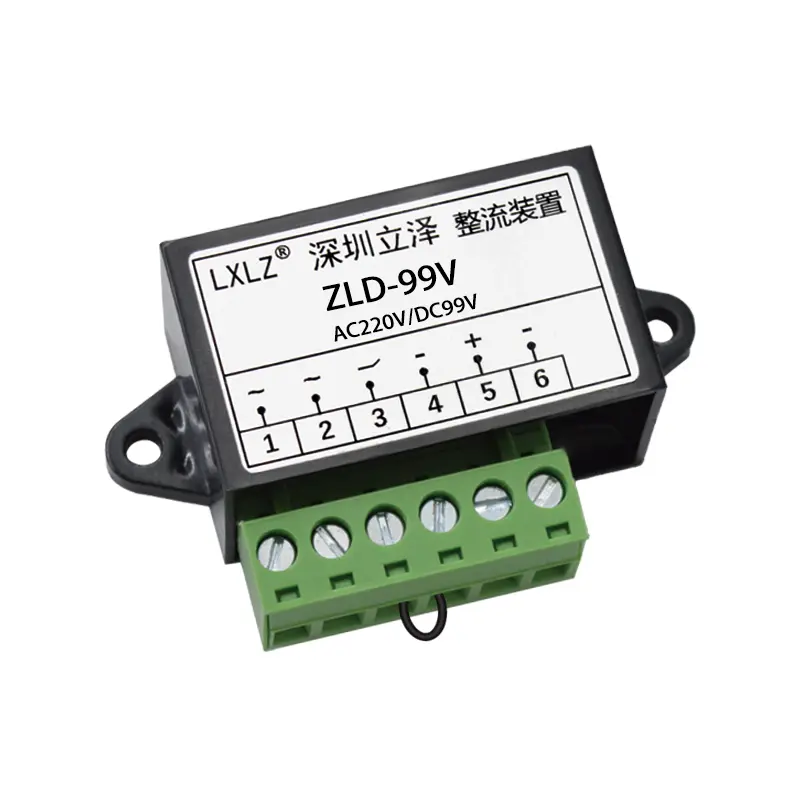
Looking at the unit itself: compact black housing, clearly labeled terminal pins (1–6, with polarity marked), and a sturdy green screw terminal block that's easy to wire on-site. The label shows brand, model, and voltage rating right on the face — straightforward for your installation teams in the field.
Here's what's inside and why it matters to your procurement decision:
Epoxy Resin Encapsulation
The internal circuit board is fully potted with epoxy resin. This isn't just for looks — it seals out humidity, dust, and minor condensation that's common in elevator pits and machine rooms. Units without this protection tend to corrode internally over 12–18 months in humid climates. Ours don't.
Flame-Retardant Housing
The outer shell uses flame-retardant material. In an elevator machine room where thermal events can escalate quickly, this matters. Many cheaper alternatives cut costs here. We don't.
High-Performance Polypropylene
We've moved away from conventional plastics on the casing components. The PP material we use is both more durable under thermal cycling and more environmentally compliant — which increasingly matters for buyers in EU markets or those sourcing for green-certified building projects.
Fast Brake Response
This module is specifically rated for fast braking — meaning the DC output collapses quickly when power is cut, allowing the brake spring to engage without delay. In elevator safety terms, this is non-negotiable. Slow-release rectifiers cause brake dragging and premature lining wear.
Clean Terminal Layout
The 6-terminal screw block (visible in product photos) uses a standard pitch that's compatible with most elevator control cabinet wiring. No proprietary connectors, no adapters needed. Your technicians will appreciate it.
Who Buys This Module — And Why
Our B2B buyers typically fall into a few categories:
- Elevator OEMs looking for a reliable, cost-stable rectifier to spec into new machines
- Elevator maintenance contractors stocking replacement parts for Kone, Otis, Schindler, and local-brand systems
- Wholesale distributors in Southeast Asia, Middle East, and Eastern Europe building SKU depth in elevator components
- Engineering procurement teams for building management companies managing large elevator fleets
If you're buying in volume, we support custom labeling, bulk packaging, and can provide documentation packages for local market compliance review.
Best Practices From the Field
After years of supplying this module across markets, here's what experienced engineers and procurement teams have told us works best:
- Always match output voltage to brake coil rating. Using a 170V module on a 99V-rated coil will burn the coil. Confirm your brake coil nameplate before ordering.
- Check cabinet mounting space first. This unit is compact, but confirm you have clearance for the terminal block and wire bend radius.
- In high-humidity environments (tropical climates, coastal cities), our epoxy-filled version significantly outperforms open-board alternatives. Specify this when requesting quotes from other suppliers and compare.
- For retrofits, the 6-pin terminal layout is backwards-compatible with most standard Chinese elevator control boards from major domestic OEMs.
- Stock at least 10–20% buffer inventory if you're running a maintenance fleet. These are wear-consumables over a 3–5 year horizon in high-cycle elevators.
FAQ — What B2B Buyers Ask Us Most
Can this module replace OEM brake rectifiers from brands like Kone, Otis, or Mitsubishi elevator systems?
Yes, in most cases. As long as the input voltage and DC output voltage match the original spec, our ZLM module is a direct functional replacement. We recommend your technician verify the brake coil voltage rating on-site before swapping. We can also provide cross-reference support if you share the original part number.
What's your MOQ and lead time for bulk orders?
Our MOQ starts at 50 units per model for standard orders. For orders above 500 units, we offer priority production scheduling. Standard lead time is 7–15 business days depending on order volume. We maintain buffer stock for the ZLM-99V and ZLM-170V models specifically to support fast-turnaround maintenance procurement.
Do you provide CE, RoHS, or other compliance documentation?
We can provide product test reports and support documentation for your compliance review process. For buyers in the EU or targeting green-certified projects, our polypropylene casing material and epoxy encapsulation comply with RoHS material restrictions. Please contact us directly to discuss specific certification needs for your market.
What's the actual service life of this module under normal elevator operating conditions?
Under standard commercial elevator conditions (150–200 cycles/day, indoor machine room, normal temperature range), our modules are designed for 5+ years of continuous operation. Harsh environments — high humidity, wide temperature swings, high-cycle freight elevators — will affect this. The epoxy encapsulation is specifically there to extend service life in tougher conditions.
Can you support OEM/private label orders with our brand on the module?
Yes. We support private labeling for qualified buyers with consistent order volume. Label customization, custom packaging, and documentation in your brand name are all available. Reach out with your volume requirements and we'll give you a straightforward answer on feasibility and pricing.
Ready to discuss volume pricing or need a sample for technical evaluation? Send us your specifications and we'll respond within 24 hours.