
LXLZ Note: This Product Provides Solutions for Parameter Customization And Application.

High Current EMI Filter 50A Bolt Type AC Power Filter
If you're sourcing EMI filters for industrial equipment, CNC machines, servo drives, or power conversion systems, you already know that line noise isn't just an annoyance — it causes real problems. Erratic machine behavior, failed certifications, fried control boards. This filter is built to stop that from happening.
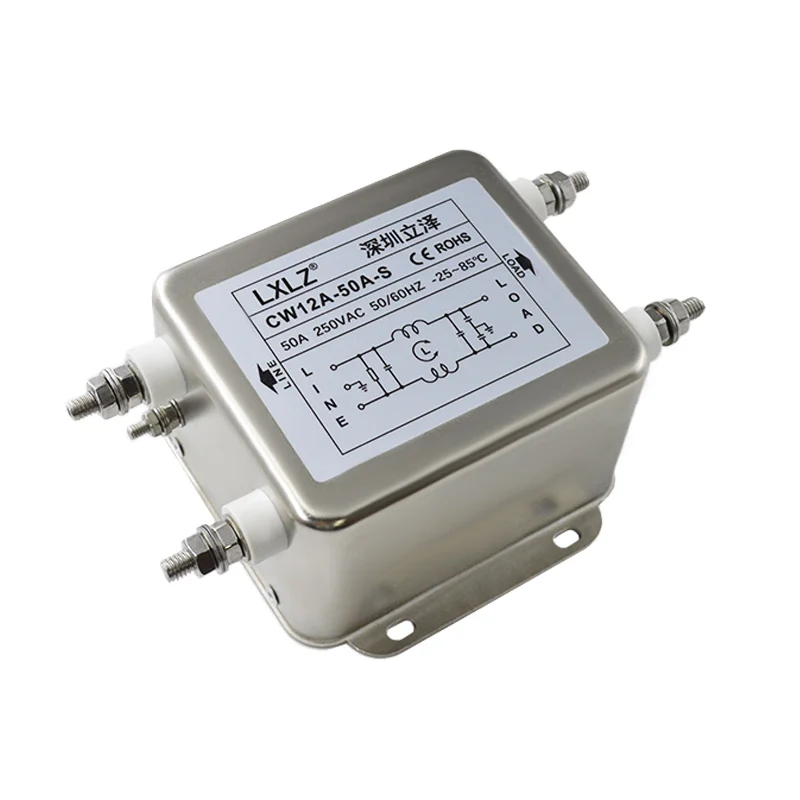
The CW12A-50A-S is a single-phase, single-stage EMI power line filter designed for high-current AC lines up to 50A at 250VAC. The bolt-type (stud) terminal connection makes it the right choice when you need a solid, vibration-resistant connection in demanding environments — not a push-in connector that rattles loose over time.
Table of Contents
Key Specifications at a Glance
| Parameter | Value |
|---|---|
| Model | CW12A-50A-S |
| Filter Type | Single-Phase, Single-Stage |
| Rated Voltage | 250VAC |
| Rated Current | 50A (also available: 1A–50A range) |
| Frequency | 50 / 60 Hz |
| Operating Temp | -25°C to +85°C |
| Connection Type | Bolt / Stud Terminal |
| Certifications | CE, RoHS |
| Housing | Stainless steel enclosure |
| Brand | LXLZ |
What You're Looking At — From the Product Itself
From the unit in the image, a few things stand out that matter to buyers who have been burned before:
- Stainless steel enclosure — not painted sheet metal that corrodes in humid factory environments. This holds up.
- Stud-type terminals with ceramic insulators — proper mechanical contact, rated for high current. These don't arc or loosen under thermal cycling the way cheaper screw-block terminals do.
- Circuit diagram printed directly on the label — L, N, E (input) and LOAD clearly marked. Installation errors go down. That saves you warranty headaches if you're building panels or reselling integrated equipment.
- Compact, panel-mount footprint — mounting tabs integrated into the base, so it drops straight into a standard DIN enclosure or control cabinet floor.
Who Buys This and Why
This product is not for home use. Your typical buyer is:
- Industrial equipment OEMs needing to pass CE/EMC certification on machines shipped to Europe
- Control cabinet integrators building panels for automation lines, compressors, or HVAC systems
- Servo drive and VFD system builders where switching noise on the AC line is a known issue
- Power supply manufacturers adding input-side EMI suppression to their designs
- EV charging equipment makers where conducted emissions compliance is mandatory
If you're in one of these spaces, you already know that skimping on input filtering is how you end up re-spinning a PCB or failing a certification audit.
Why Single-Stage Is the Right Call Here
Single-stage filtering covers most real-world conducted emission problems in the 150kHz–30MHz range. For 50A load applications — think large servo amplifiers, industrial power supplies, or motor drives — a single-stage design gives you:
- Lower insertion loss across the whole frequency range compared to a misapplied two-stage filter
- Better thermal performance at sustained high current
- More predictable behavior when impedance-matching to your specific source and load
A two-stage filter isn't always better. If your application is already close to compliance and you just need the last few dB of suppression, a properly spec'd single-stage unit will get you there without adding bulk or cost.
Best Practices From Real Application Experience
Ground it properly or don't bother. The filter's common-mode performance depends entirely on a low-impedance chassis ground connection. A long, thin wire ground defeats the purpose. Use a short braid or direct metal-to-metal contact.
Match the current rating with real headroom. Running a 50A filter at 48A continuous in a hot cabinet is asking for shortened lifespan. If your load is 40A, 50A is your minimum spec — not your target.
Input/output orientation matters. The LINE side goes toward the mains; LOAD goes toward your equipment. Reversing them reduces filter effectiveness — the circuit diagram on the label shows this clearly.
Keep input and output wiring separated. Running filtered and unfiltered cables in the same conduit wipes out your attenuation through coupling. This is the most common installation mistake we see.
Check leakage current requirements. Single-phase filters at this current rating have measurable leakage to ground. Verify this is acceptable for your application, especially in medical-adjacent or portable equipment contexts.
FAQ
Can you supply across the full 1A–50A range with the same bolt-terminal style?
Yes. The CW12A-S series covers 1A through 50A in standard configurations. Same housing style, same terminal type. If you need multiple ratings for different product lines, we can quote them together.
Do these carry CE certification, and can you provide test reports?
The filters carry CE marking and are RoHS compliant. We can provide documentation for your supplier audit or compliance file. If you need specific third-party test reports for a particular market, let's talk — we can work through what's needed.
What's your MOQ, and can you do custom labeling or private label?
MOQ depends on the current rating and quantity mix. We work with OEMs on private labeling and custom packaging regularly. Send us your volume and we'll give you a straight answer on MOQ and lead time.
How does this perform against conducted emissions standards like EN 55011 or CISPR 32?
The CW12A series is designed with insertion loss characteristics targeting the 150kHz–30MHz conducted emission window. For specific attenuation curves or insertion loss data at your frequency of concern, request our datasheet — we'll send it.
What's the lead time for bulk orders, and do you stock?
Standard ratings are stocked for short-run and sample orders. For production quantities (typically 500+ pcs), lead time is 2–4 weeks depending on the current rating. We'll confirm exact availability when you send your inquiry.
Ready to discuss volume pricing or request a datasheet? Send us your application specs and target quantity — we'll get back to you within 24 hours.