
LXLZ Note: This Product Provides Solutions for Parameter Customization And Application.

KZL-170-4 Motor Brake Rectifier 380V Fast Braking
If you're sourcing brake rectifiers for three-phase motor applications — cranes, hoists, conveyors, machine tools, or any equipment that demands precise, repeatable stopping performance — the KZL-170-4 is built to do exactly that, reliably, batch after batch.
This is a motor electromagnetic brake rectifier designed to convert 380V AC power into 170V DC output to energize the brake coil on AC motors. When the motor cuts power, the rectifier triggers rapid DC release to the brake — stopping the load fast and holding it safely. That's the core job, and we've engineered every component around doing it well.
Key Specifications at a Glance
| Parameter | Details |
|---|---|
| Model | KZL-170-4 (also listed as ZLKS-170-4) |
| Input Voltage | 380V AC (3-phase compatible) |
| Output Voltage | 170V DC |
| Circuit Type | Diode type / MOSFET (FET) type available |
| Braking Mode | Standard / Fast braking — both available |
| Winding | 100% pure copper wire |
| Housing Material | High-grade PBT engineering plastic |
| Encapsulation | Full epoxy potting (moisture & vibration proof) |
| Application | AC motor electromagnetic brake coil power supply |
| Quality Mark | Factory inspected, QC pass label on each unit |
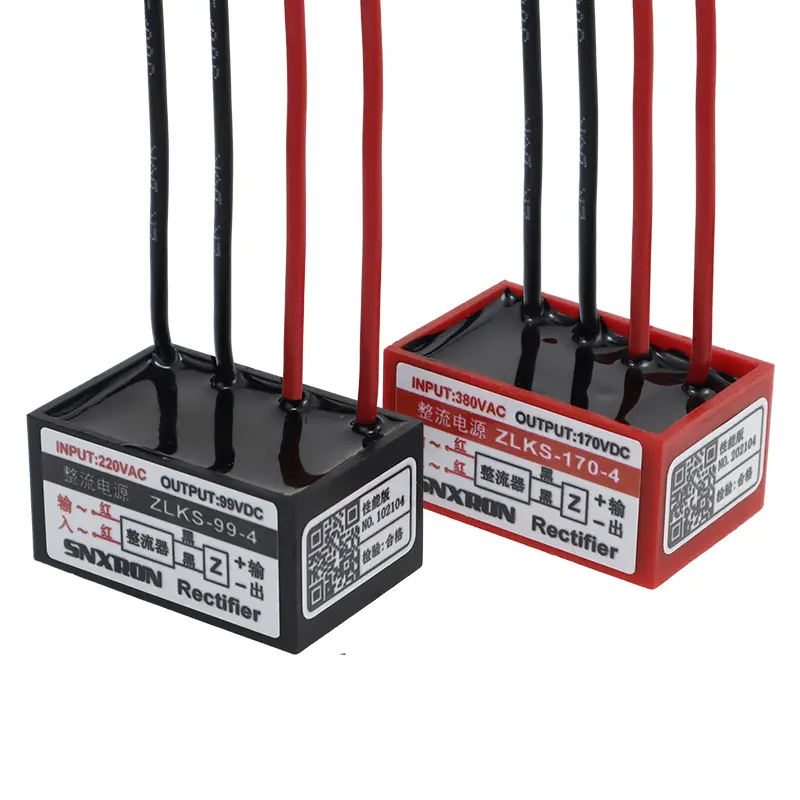
What You're Actually Looking At — From the Product Image
The image shows two rectifier units side by side:
- Left unit (black): ZLKS-99-4, 220VAC input / 99VDC output
- Right unit (red): ZLKS-170-4, 380VAC input / 170VDC output ← This is the one
Both share the same robust construction. You'll notice:
- Color-coded lead wires — red for AC input lines, black for DC output, making installation straightforward and reducing wiring mistakes on the shop floor
- Full epoxy potting — the entire circuit is sealed. No exposed components, no dust ingress, no moisture risk
- Compact block form factor — small footprint, easy to mount inside motor junction boxes or control panels
- Clear labeling — input/output specs printed directly on the unit. No guessing, no documentation hunting during installation
- QC pass sticker — every unit carries a batch-traceable quality inspection label before it leaves the factory
Why This Rectifier Matters in Real Applications
Motor brakes don't just "stop" things — they hold loads, protect equipment, and keep workers safe. A brake rectifier that's slow, unstable, or fails early creates real operational problems: coasting loads on hoists, positioning errors on CNC equipment, excessive brake pad wear, downtime.
Here's what the KZL-170-4 addresses directly:
✅ Fast Braking Response
The fast-braking version uses MOSFET (field-effect transistor) circuit design that significantly reduces brake release/engage delay compared to standard diode-only designs. For applications like hoist brakes, CNC spindles, or automated production lines, this translates to tighter stopping accuracy and less mechanical stress on brake discs.
✅ Stable 170V DC Output
Many motors with 380V-rated brake coils require exactly 170V DC (half-wave rectified equivalent). Running the wrong voltage — too high or too low — shortens coil life or causes weak braking. This unit is factory-calibrated to deliver consistent output, not just "approximately" right.
✅ Pure Copper Windings (Not Aluminum)
We use 100% pure copper wire — not copper-clad aluminum. This isn't a marketing claim; it's a manufacturing decision that affects heat resistance, current carrying capacity, and long-term reliability. Buyers who've been burned by aluminum-wound units know exactly why this matters.
✅ PBT Housing — Not Generic Plastic
The shell is PBT (polybutylene terephthalate) — a glass-fiber reinforced engineering thermoplastic. It handles higher temperatures, resists deformation, and performs in industrial environments where cheap ABS housings start cracking or warping. If your customer's equipment runs hot, this is the difference.
✅ Full Epoxy Encapsulation
The circuit board and components inside are completely potted. This means:
- Vibration resistance (important for machinery-mounted applications)
- No corrosion from humidity or condensation
- No accidental contact with internal components during handling
Available Configurations — Tell Us What You Need
| Variant | Description | Best For |
|---|---|---|
| Diode Type | Standard rectification, simple & cost-effective | General industrial motors, light-duty brakes |
| MOSFET (FET) Type | Fast-acting, reduced brake delay | Hoists, precision positioning, high-cycle applications |
| Standard Braking | Normal brake engage/release timing | Standard production equipment |
| Fast Braking | Shortened stop time, less overshoot | Safety-critical or high-cycle equipment |
Both types available at the same 380V / 170V specification. Let us know your application and cycle frequency — we'll recommend the right version.
Best Practices From Field Experience
After supplying these units to industrial equipment manufacturers and MRO distributors for years, here's what we consistently see from installations that perform well:
- Match the rectifier output to your brake coil rated voltage — don't assume 170V works for all 380V motor brakes. Check the coil nameplate. Most are 170V DC, but some older designs differ.
- Use the fast-braking (MOSFET) version for hoist and crane applications — regulatory standards in many markets require stopping within a defined time window. Standard diode rectifiers often can't meet this.
- Don't daisy-chain multiple brake coils off one rectifier — size your rectifier to the coil current draw. We can help you select the right current rating for your specific motor.
- Check lead wire routing — the color-coded wires are intentional. Red = AC in, Black = DC out. Reversed connections will damage the unit immediately. Label your harnesses during assembly.
- Mount away from direct heat sources — while the PBT housing handles elevated temperatures well, sustained exposure above rated conditions shortens any electronic component's life. Keep the rectifier in the motor terminal box away from heat-generating resistors or contactors where possible.
FAQ
Can we get OEM labeling or custom branding on the units?
Yes. We're a manufacturer, not a trader. For qualified order volumes, we support private label, custom color housing, and tailored packaging. Send us your requirements and MOQ target.
What's the difference between the diode type and the MOSFET (fast) type — and when does it actually matter?
The diode type uses a basic rectifier bridge — reliable, affordable, works fine for most standard motor brake applications. The MOSFET type adds active switching that cuts the residual voltage to the brake coil faster after power-off, resulting in quicker mechanical brake engagement. If your application is a vertical hoist, a crane, or any machine where the load must stop within a specific time, choose the fast type. For horizontal conveyors or low-cycle equipment, the standard type is cost-effective and performs well.
What's the typical failure mode, and how does your product address it?
The most common failure in cheap rectifiers is capacitor degradation or diode breakdown from heat and moisture. Our full epoxy potting eliminates moisture ingress entirely. We use industrial-grade components rated for the thermal environment inside motor enclosures, not consumer-grade parts. We also QC-test every unit before it ships — not sample testing, unit-level testing.
Do you have CE, RoHS, or other certifications?
Our products are manufactured to comply with RoHS material standards. CE certification status and available documentation — please contact us directly. For specific market certifications needed by your end customers, let's discuss what your market requires and we'll advise accordingly.
What's your MOQ and lead time for bulk orders?
MOQ is flexible depending on the model and configuration. Standard configurations typically have stock available for fast shipment. Custom variants (OEM label, special voltage, modified lead length) have production lead times — usually 2–3 weeks depending on volume. Contact us with your annual usage estimate and we'll work out pricing that makes sense for ongoing procurement.
Ready to discuss specifications, volume pricing, or sample orders? Send us your motor brake coil specs and application details — we'll get back to you with the right solution.