
LXLZ Note: This Product Provides Solutions for Parameter Customization And Application.

KZS-99 Brake Rectifier Module Rapid Braking Controller
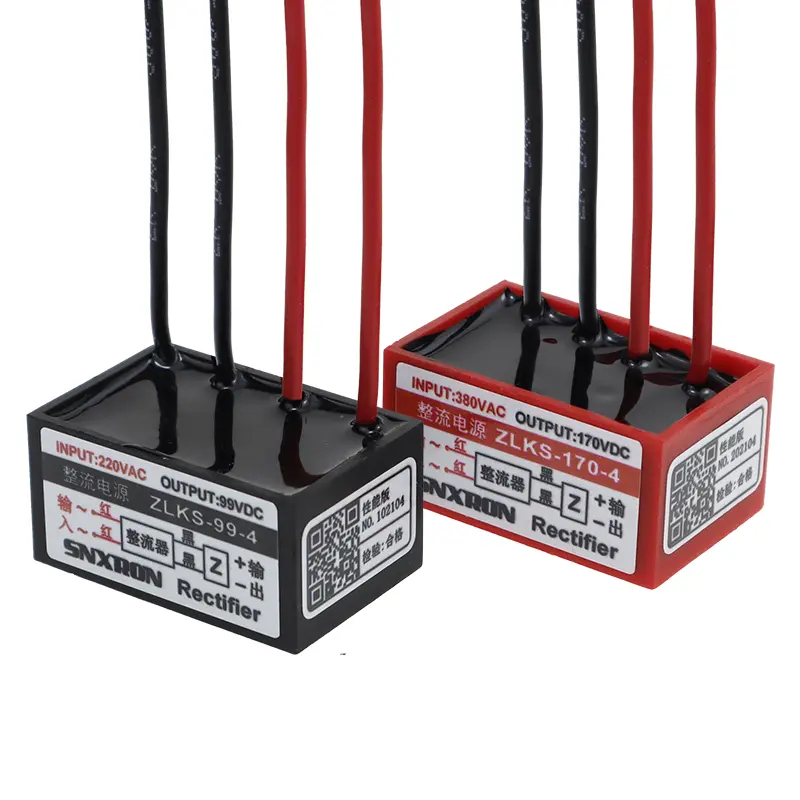
If you're sourcing brake rectifiers for industrial motor applications, you already know how much a slow or unreliable brake response can cost — in downtime, in safety incidents, and in equipment wear. The KZS-99 (ZLKS-99-4) is built specifically to solve that. It's a compact, hardwired brake rectifier module designed for electromagnetic brake (motor holding brake) systems, converting AC 220V input to DC 99V output for precise, fast-acting brake engagement and release.
We manufacture this in-house, and we've put the details where they count.
What This Module Actually Does
This rectifier sits between your motor control circuit and the electromagnetic brake coil. When power cuts — intentionally or not — it converts the AC supply into a clean DC signal that drives the brake electromagnet to engage fast and hold firm. The result: your machinery stops where it's supposed to, every time.
It's widely used in:
- Crane & hoist systems (overhead bridge cranes, gantry cranes)
- Elevator & lift mechanisms
- CNC machining centers & automated lathes
- Conveyor & material handling lines
- Packaging and textile machinery
- Any application using a three-phase motor with electromagnetic holding brake
Key Specifications
| Parameter | Details |
|---|---|
| Model | KZS-99 / ZLKS-99-4 |
| Input Voltage | AC 220V |
| Output Voltage | DC 99V |
| Circuit Type | Diode type / MOSFET (FET) type — available |
| Braking Response | Rapid braking (fast-acting design) |
| Wire Material | Pure copper conductors |
| Housing Material | High-grade PBT (flame-retardant engineering plastic) |
| Encapsulation | Full epoxy potting (waterproof, vibration-resistant) |
| Lead Configuration | 4-wire: 2× AC input (red), 1× DC+ output, 1× DC- output |
| Inspection | 100% factory QC pass-checked (label marked "合格") |
Also available: ZLKS-170-4 (380VAC input / 170VDC output) for three-phase systems — ask us about your full voltage range requirements.
Why Buyers Choose Our Module Over Generic Alternatives
1. Pure Copper Wiring — Not Copper-Clad
A lot of what's on the market uses CCA (copper-clad aluminum) to cut costs. We don't. Every lead wire is pure copper, which means lower resistance, better current handling, and longer service life — especially in high-cycle industrial environments where heat buildup matters.
2. PBT Shell, Not Standard Polycarbonate
Our enclosure uses PBT (polybutylene terephthalate) — a flame-retardant engineering-grade thermoplastic. It holds its shape under heat, resists chemical exposure from common industrial fluids, and won't crack from mechanical vibration the way cheaper ABS housings do.
3. Full Epoxy Potting
Look at the image — the internals are fully encapsulated in epoxy resin. This isn't just aesthetic. It locks out moisture, prevents vibration-induced solder joint failure, and adds a layer of electrical insulation. For equipment running in foundries, workshops, or outdoor crane applications, this matters.
4. Diode Type & MOSFET Type — Both Available
Different brake coil designs respond better to different rectifier circuits. We offer both diode-bridge and FET-based versions, so you can match the rectifier to your actual brake coil spec — not just the closest thing on the shelf.
5. Fast Brake Response by Design
The circuit is optimized for rapid DC discharge to the brake coil, cutting mechanical stop time versus conventional half-wave designs. In crane and hoist applications, that difference is measurable — and it's the difference between acceptable and safe.
Installation Best Practices (From Field Experience)
- Match voltage carefully. This unit is rated for 220VAC input. If your system runs on 380VAC three-phase, use the ZLKS-170-4 variant instead. Overvoltage will damage the rectifier within a short period.
- Wire polarity on DC output matters. The labeled +/− output leads must connect correctly to the brake coil terminals. Reversed polarity won't typically damage the coil but will affect brake engagement timing.
- Keep lead lengths short on the DC side. Long DC wire runs to the brake coil increase inductance and can slow brake engagement. Aim to mount the rectifier close to the brake unit.
- Don't share the rectifier across multiple brake coils unless current draw is confirmed within spec. Use dedicated units per brake.
- Inspect epoxy seal before installation. Any cracks in potting compound — from shipping damage — can allow moisture ingress. We package these protected, but check before commissioning.
FAQ
Q1: Can this module work with both single-phase and three-phase motor brake systems?
The KZS-99 takes a single-phase 220VAC input. It's typically tapped from one phase of a three-phase motor circuit or from a dedicated 220V control line. It does not require three-phase input. If your brake coil operates on a 170VDC supply from 380VAC, we have the ZLKS-170-4 for that.
Q2: What's the difference between the diode type and the MOSFET (FET) type — which should I order?
The diode type is simpler, more robust, and handles higher surge currents well. It's the standard choice for most crane hoists and general industrial brakes. The MOSFET type offers faster switching and slightly lower heat generation under continuous cycling — better suited for high-frequency brake-release applications like automated production lines. If you're unsure, tell us your brake coil spec and duty cycle and we'll recommend the right one.
Q3: What's your MOQ and can you do OEM labeling or custom voltage specs?
We're a direct manufacturer. MOQ is flexible depending on model — typically starts at 50–100 pcs per model for standard spec. OEM labeling, custom voltage output (we produce a full range), and private branding are all available for qualified volume orders. Contact us with your target spec and annual volume for a factory quote.
Q4: How do I know the output voltage is stable? What's the tolerance on the 99VDC output?
Output voltage is a function of input AC voltage and the rectifier circuit. At rated 220VAC input, output sits at approximately 99VDC ±5% under normal load. Every unit goes through output verification at our factory before labeling (the "合格/pass" marking you see on the label is our QC stamp — not just a sticker). If your brake coil is voltage-sensitive, let us know and we can discuss tighter tolerance batches.
Q5: What's the expected service life, and do you offer warranty or replacement support?
Under normal operating conditions — proper voltage, reasonable ambient temperature, no physical damage — these units routinely last 5+ years in continuous industrial service. The full epoxy potting significantly extends life compared to open-board designs. We offer warranty coverage and will work with you on replacements for any confirmed manufacturing defects. We also keep stock for consistent repeat orders, so you're not chasing a part that's been discontinued.
Ready to source? Send us your brake coil spec, voltage requirements, and target quantity — we'll get back to you with pricing and lead time within 24 hours.