
LXLZ Note: This Product Provides Solutions for Parameter Customization And Application.

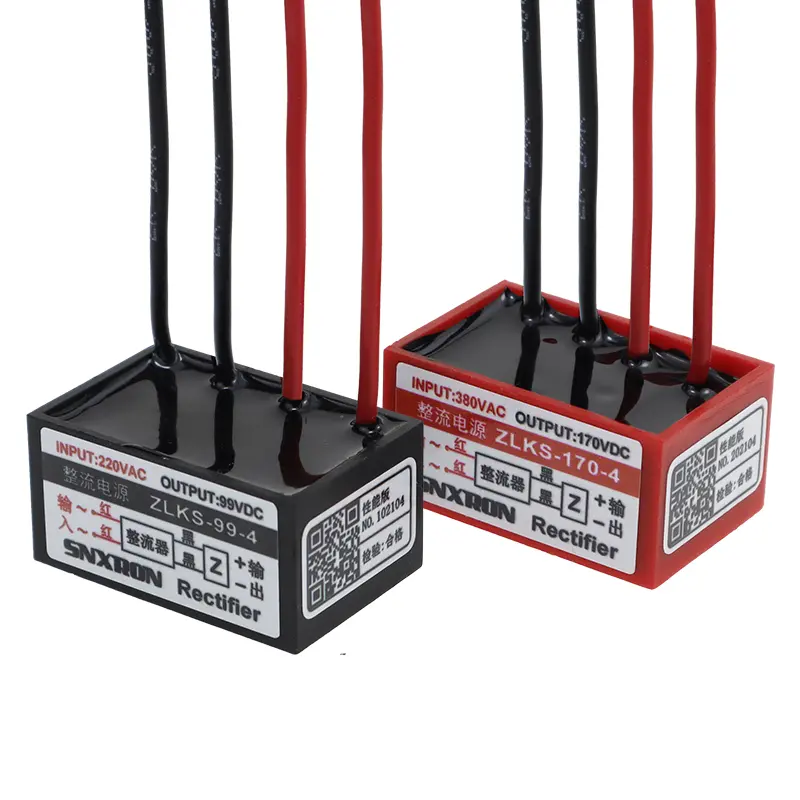
ZKL1-99 Brake Rectification Device Motor Holding Brake
If you're running AC motors with electromagnetic brakes — cranes, hoists, conveyors, machine tools — you already know the brake coil needs DC to hold and release cleanly. That's exactly where this rectifier sits in your system. It takes your 220V AC line and converts it to a stable 99V DC output, giving the brake coil exactly what it needs to engage and disengage with precision.
No relay delays, no coil burnout from wrong voltage feeding — just clean, reliable rectification built into a compact, potted module you can wire in once and forget.
Key Specifications at a Glance
| Parameter | Details |
|---|---|
| Model | ZKL1-99 (ZLKS-99-4) |
| Input Voltage | 220VAC |
| Output Voltage | 99VDC |
| Circuit Type | Diode Type / MOSFET (FET) Type |
| Response Mode | Standard / Fast-Acting |
| Conductor Material | Pure Copper Wire |
| Housing Material | High-Grade PBT |
| Application | Motor Electromagnetic Holding Brake |
| Encapsulation | Full epoxy potting |
What Makes This Unit Stand Out — From a Manufacturing Standpoint
✅ Pure Copper Lead Wires — Not CCA
A lot of rectifier modules in this price range quietly use copper-clad aluminum wire. We don't. Every unit ships with pure copper conductors. Under load cycling, CCA wire develops resistance creep and connection issues. Copper holds its conductivity and crimps clean — something your field engineers will notice immediately.
✅ High-Grade PBT Shell
The housing is PBT (Polybutylene Terephthalate) — not generic ABS. PBT handles heat, has better dimensional stability, and resists the oils and moisture common in motor control enclosures. The color coding (black for 220V/99V output) helps your assembly techs install the right unit the first time without double-checking labels.
✅ Full Epoxy Potting
The entire circuit is encapsulated. Vibration, condensation, dust — none of it gets to the internal components. This matters particularly for crane and hoist applications where the rectifier lives in a control panel that moves constantly.
✅ Two Circuit Options: Diode vs. MOSFET
- Diode type — proven, cost-effective, handles standard brake cycles well
- MOSFET (FET) type — lower power dissipation, faster switching, better suited for high-frequency brake-engage cycles
If your customer's equipment does frequent start-stop cycles (packaging machines, automated assembly lines), push them toward the MOSFET version. It runs cooler and lasts longer under that kind of duty.
✅ Standard vs. Fast-Braking Response
The fast-acting version cuts the DC discharge time significantly when the motor is commanded to stop. In safety-critical or precision positioning applications, the difference between standard and fast response is measured in millimeters of overshoot. We offer both — your OEM customers can spec whichever fits their application without sourcing from two suppliers.
Typical Applications (Where Your Buyers Are Using These)
- Overhead cranes & hoists — brake must hold load instantly on power cut
- CNC machine tool spindles — quick stop on E-stop command
- Conveyor systems — controlled deceleration, prevent rollback
- Elevator door motors — holding brake when doors are at rest
- Packaging and labeling machines — precise stop positioning
- Industrial robots / servo axes with external brakes
Installation & Best Practices (From Field Experience)
1. Match output voltage to your brake coil rating — don't eyeball it. The most common wiring mistake is feeding a 170V-rated coil with a 99V unit or vice versa. The brake will either slip (undervoltage) or burn the coil (overvoltage). Confirm the coil's DC rated voltage on the motor nameplate before ordering.
2. Wire the input phase correctly. Both red wires on the input side are AC — phase sequence doesn't matter for single-phase AC input, but make sure your 220V feed is consistent. Fluctuating supply voltage causes inconsistent brake engagement.
3. For fast-acting models, use shielded cable on the DC output if runs exceed 1 meter. High-speed switching can induce noise on adjacent signal lines in sensitive control panels.
4. Don't mount the rectifier directly against heat sources. Despite the epoxy potting, sustained ambient temps above 70°C will degrade the internal components over time. Leave airflow clearance or use a DIN-rail mounted unit with spacing.
5. Inspect the output DC voltage under load during commissioning. No-load output and under-load output differ. Use a meter on the brake coil terminals with the brake engaged to confirm you're in spec.
FAQ
Can we get custom output voltage versions — for example, 170VDC output for 380VAC input systems?
Yes. We manufacture the full range including 170VDC output for 380VAC input (see ZLKS-170-4 in our lineup). Both voltage configurations are standard production items. We can also discuss custom voltage outputs for OEM projects with sufficient volume — typically MOQ 500 pcs for non-standard specs.
What's the minimum order quantity, and can you support our ongoing production schedule with blanket orders?
We're a direct manufacturer, not a trading company. We support scheduled blanket orders with staggered delivery — common for panel builders and OEM equipment manufacturers who need consistent supply without holding large inventory. Contact us to discuss lead times and warehouse stock programs.
Diode type vs. MOSFET type — which one should we specify for our application, and is there a price difference?
Diode type is lower cost and fully adequate for brakes that cycle less than ~20 times per hour. MOSFET type is preferred for high-cycle applications — it dissipates less heat and the faster switching reduces coil wear over time. There is a moderate price difference. We recommend MOSFET for conveyors, packaging lines, and any application doing continuous short cycles.
Do these units carry CE, RoHS, or other certifications relevant to European or North American markets?
Our products are manufactured to CE marking requirements and comply with RoHS directives — documentation available upon request. If you need specific third-party test reports or country-of-origin documentation for customs or compliance purposes, we can provide that as part of the order package.
What's the failure rate in the field, and do you offer warranty terms for bulk purchases?
We run 100% output voltage testing before shipment — every unit, not batch sampling. Field return rates from our OEM partners are consistently under 0.5%. Standard warranty is 12 months from shipment. For volume accounts, extended warranty and replacement stock arrangements can be negotiated. We'd rather resolve a problem fast than lose a long-term customer over a handful of units.
Ready to spec this into your next project? Send us your motor brake coil voltage, cycle frequency, and annual volume — we'll confirm the right model and get you a quote within 24 hours.