
LXLZ Note: This Product Provides Solutions for Parameter Customization And Application.

KZS-99 Brake Rectifier Fast Response Motor Brake
If you're sourcing brake rectifiers for industrial motor applications, you know how critical stopping time is — whether it's a crane holding a load mid-air or a conveyor line that needs to halt precisely. The KZS-99 is built specifically for those demands. This is a fast-response brake rectifier designed to convert AC input into stable DC output to energize electromagnetic brakes on three-phase induction motors. It's compact, reliable, and engineered for the kind of continuous-duty industrial environments where failure isn't an option.
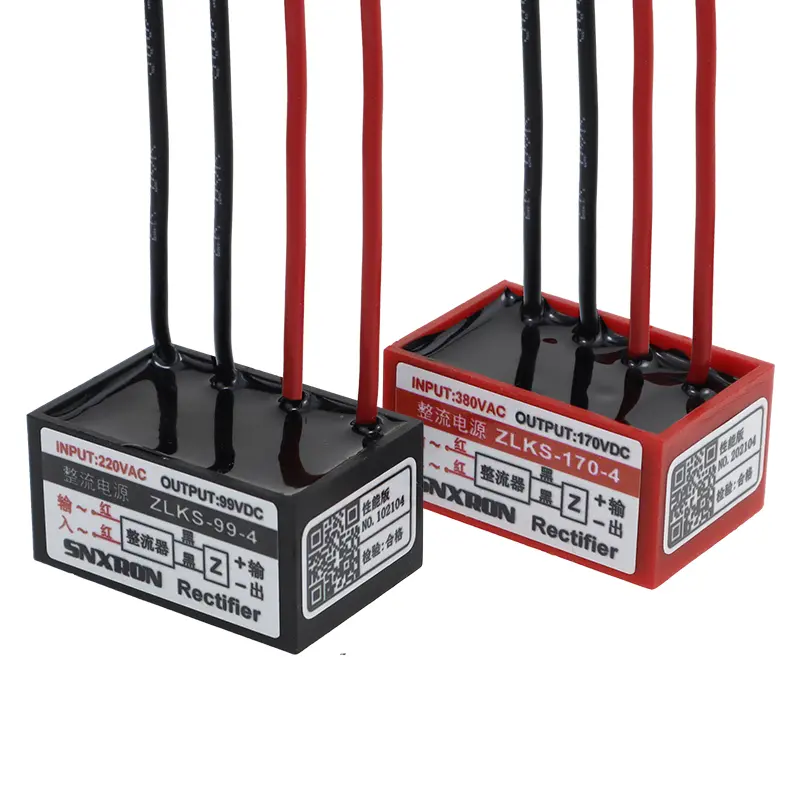
From the image, you can see both the 220VAC/99VDC version (ZLKS-99-4, black housing) and the 380VAC/170VDC version (ZLKS-170-4, red housing) — clearly labeled, color-coded by voltage class, and potted with epoxy resin for protection. The wiring is pre-terminated with pure copper conductors, and the housing is molded from premium-grade PBT thermoplastic. This isn't a generic commodity part. It's a purpose-built component for motor brake control.
Table of Contents
Key Technical Specifications
| Parameter | Details |
|---|---|
| Model | KZS-99 / ZLKS-99-4 |
| Input Voltage | 380VAC (also available: 220VAC) |
| Output Voltage | 170VDC (99VDC for 220V input version) |
| Circuit Type | Diode type / MOSFET type (selectable) |
| Response Type | Fast-acting brake response |
| Conductor Material | Pure copper wire leads |
| Housing Material | Premium PBT (Polybutylene Terephthalate) |
| Protection | Epoxy-potted internal components |
| Color Coding | Black = 220V input / Red = 380V input |
| Connection | Pre-wired leads (Input: Red×2, Output: Z+/Z-) |
| Application | AC motor electromagnetic brake systems |
| QC Standard | Factory inspection passed |
What This Product Actually Does
Electromagnetic brakes on AC motors need DC power to engage and hold. When the motor cuts power, the brake coil needs to de-energize fast — that's where the rectifier design matters. A standard half-wave or full-wave diode rectifier will release the brake, but it does so slowly because residual magnetic energy dissipates gradually.
The KZS-99 fast-response design addresses this directly:
- Diode type — Reliable, cost-effective, suits standard brake cycles
- MOSFET (FET) type — Active discharge path, dramatically faster brake engagement, better suited for high-cycle applications or safety-critical stopping
Both versions are available from our factory. If your customer's application involves vertical loads, precision positioning, or high-frequency start-stop cycles, the MOSFET version is worth specifying.
Application Scenarios
This rectifier is widely used across:
- Overhead cranes & hoists — Load holding safety
- Packaging machinery — Precise stop positioning
- Woodworking & metal cutting machines — Blade/spindle braking
- Conveyor systems — Controlled stopping under load
- Elevators & lifts — Holding brake control
- CNC and servo-adjacent motor systems — Fast-stop requirements
- Industrial fans & compressors — Overrun prevention
Manufacturing Advantages — Why Source From Us
1. Pure Copper Conductors
We don't cut corners on wiring material. Pure copper leads ensure lower resistance, better current handling, and longer service life compared to copper-clad aluminum alternatives common in lower-cost units.
2. Premium PBT Housing
PBT is the right material for this environment — high heat deflection temperature, excellent electrical insulation, chemical resistance, and dimensional stability. The color-coded housing (black/red) also helps your customers' electricians avoid wiring mistakes in the field, which reduces warranty claims for you.
3. Epoxy Potting
Internal components are fully encapsulated. This protects against moisture, vibration, and contamination — all real-world conditions in factory environments. It also prevents tampering and reverse-engineering.
4. Dual Circuit Options from One Factory
Diode type and MOSFET type under the same product family, same housing form factor. You can standardize your BOM and adjust circuit type per application without changing your installation design.
5. Factory QC Inspection
Every unit carries an inspection batch number and passed-QC marking. We support batch traceability — important for OEM customers and system integrators who need to document component sourcing.
6. Direct Manufacturer Pricing
No middlemen. We manufacture these in-house, so MOQ, lead time, and custom labeling (OEM branding) are all negotiable.
Best Practices From Field Experience
Matching output voltage to brake coil rating is critical.
A 170VDC rectifier on a coil rated for 99VDC will burn out the coil quickly. Always verify brake coil voltage before ordering. We can supply both versions — just specify your motor brake model.
For high-cycle applications (>30 cycles/hour), specify the MOSFET version.
The active discharge circuit handles thermal stress better and gives you consistently faster brake engagement over time.
Mount the rectifier away from high-heat sources.
Even with PBT housing and epoxy potting, sustained ambient temperatures above 55°C will shorten component life. Panel mounting with adequate ventilation is standard practice.
Check input phase compatibility.
The 380VAC input uses two phases of a three-phase supply — this is standard for brake rectifier wiring in China and most IEC-standard markets. Confirm your customer's local wiring convention if exporting to non-IEC regions.
Pre-wire testing before panel assembly.
Apply input voltage and verify DC output with a multimeter before final installation. It takes 30 seconds and eliminates field troubleshooting.
FAQ — What B2B Buyers Ask Most
Can you supply both 220V and 380V input versions? What's the MOQ?
Yes. We manufacture both the ZLKS-99-4 (220VAC → 99VDC) and ZLKS-170-4 (380VAC → 170VDC) versions in-house. MOQ is flexible depending on total order volume. Contact us with your estimated monthly or annual quantity and we'll work out pricing tiers.
What's the difference between the diode type and the MOSFET type — and how do I choose?
The diode type uses a standard rectification bridge — reliable, lower cost, suitable for normal brake cycles. The MOSFET type adds an active freewheeling path that rapidly dissipates the brake coil's stored energy when power cuts, resulting in significantly faster mechanical brake engagement. Choose MOSFET when your application is safety-critical, high-frequency cycle, or requires tighter stopping precision.
Can you support OEM / private label orders?
Yes. We can produce with your brand name, custom label layout, and packaging. Minimum volumes apply — reach out to discuss specifics. We've done OEM production for customers in Europe, Southeast Asia, and the Middle East.
What's the typical lead time for bulk orders?
Standard stocked configurations typically ship within 3–7 business days. Custom configurations or larger volumes (5,000+ units) usually require 2–4 weeks production lead time. We'll confirm lead time at order confirmation.
How do you ensure consistent quality across batches?
Each unit is individually inspected and carries a batch number (as shown on the label). We maintain production records by batch. For customers requiring third-party inspection or factory audits, we're open to that process.
Request a quote or product sample — tell us your input voltage, brake coil rating, and monthly volume.