
LXLZ Note: This Product Provides Solutions for Parameter Customization And Application.

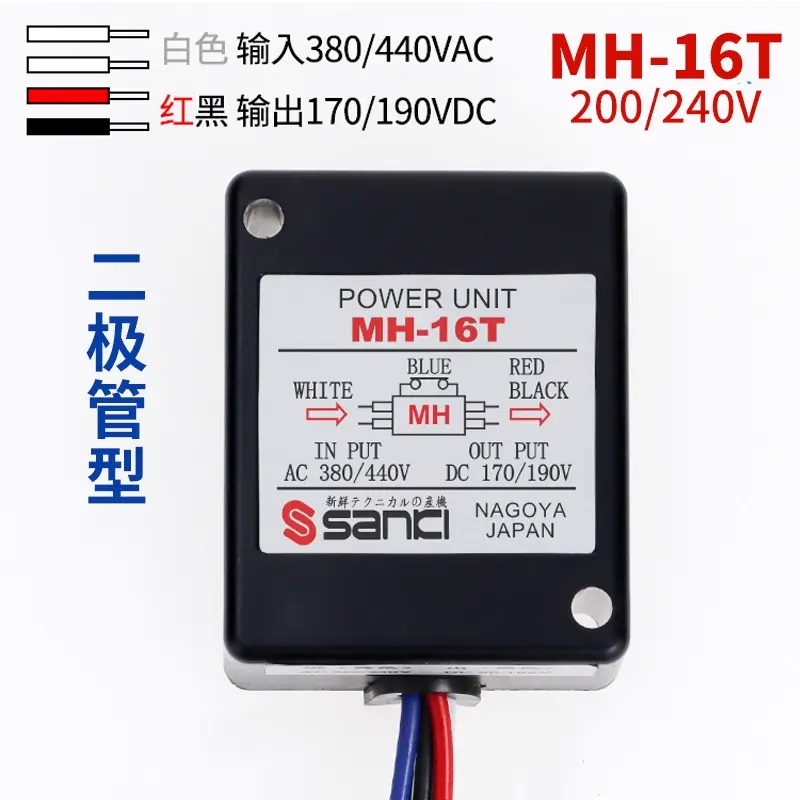
MH-16T Brake Rectifier 380V 6-Wire Motor Brake Module
If you're sourcing brake rectifiers for three-phase motor brake systems, you already know how much a reliable power unit matters on the production floor. The MH-16T is a diode-type electromagnetic brake rectifier built for exactly that — converting AC input into the stable DC output your brake coils actually need, without the headaches of inconsistent stopping, overheating modules, or messy wiring jobs.
This unit takes AC 380/440V input (white wires) and delivers a clean DC 170/190V output (red/black wires), making it directly compatible with the majority of three-phase motor electromagnetic brake systems running on standard industrial voltage. The 6-wire design gives installers flexibility for different circuit configurations right out of the box — no adapter, no rework.
Key Selling Points
- Diode-Type Rectification — Uses a diode bridge circuit for half-wave or full-wave rectification depending on wiring configuration. This means faster brake engagement response compared to resistor-type units, which directly translates to shorter stopping distances and better machine cycle control.
- Input: AC 380/440V → Output: DC 170/190V — Dual-range compatibility on both input and output side. Works seamlessly across different regional grid standards, which matters when your customers are running mixed equipment lines or sourcing machines internationally.
- Built-in Aluminum Heat Sink Plate — We integrated a dedicated aluminum heatsink into the housing. In continuous-duty environments where brakes cycle frequently, heat buildup kills rectifiers fast. This design keeps operating temperature in check without adding bulk.
- Compact, Lightweight, Solid Structure — The enclosure is designed for tight control cabinet installations. Light enough that it doesn't add unnecessary load to panel assemblies, rigid enough that vibration from motor operation doesn't loosen connections over time.
- 6-Wire Pre-Wired Design, Weld-Mount Installation — Wires are color-coded and pre-configured: white for AC input, blue for neutral/control, red and black for DC output. Electricians on the install side spend less time tracing wires and more time finishing the job. Weld-mount base keeps it fixed securely in high-vibration environments.
- Wide Application Compatibility — Suitable for electromagnetic brakes on crane hoists, conveyor drives, machine tool spindles, packaging machinery, and elevator traction motors. Essentially any application where a three-phase motor needs a controlled, reliable stop.
Technical Specifications
| Parameter | Value |
|---|---|
| Model | MH-16T |
| Type | Diode-Type Brake Rectifier |
| Input Voltage | AC 380V / 440V |
| Output Voltage | DC 170V / 190V |
| Wire Count | 6-Wire |
| Installation Method | Weld Mount |
| Cooling | Aluminum Heat Sink Plate |
| Compatible Brake Type | Electromagnetic (AC Motor Brake) |
| Part Number | 04-MH-16T |
Where This Gets Used
From what we see across our B2B customer base, the MH-16T ends up in a few consistent application scenarios:
- Overhead cranes and hoists — where brake holding precision directly affects load safety
- CNC machine tools — where spindle or axis brake modules need fast, repeatable stopping
- Conveyor and material handling systems — high-cycle environments where heat resistance matters
- Packaging and food processing equipment — where compact panel space is always at a premium
- Elevator and lift machinery — requiring stable DC output under varying load conditions
Best Practice Notes (From Field Experience)
1. Match output voltage to your brake coil rating. The MH-16T outputs DC 170V or 190V depending on whether you're on a 380V or 440V supply line. Before installation, always confirm your brake coil's rated DC voltage. Mismatched voltage is the #1 cause of premature coil burnout we hear about from field teams.
2. Don't skip the heat sink mounting contact. If you're panel-mounting this unit, make sure the aluminum heat sink plate has proper thermal contact with a metal surface or has adequate air clearance. Enclosing it in a sealed plastic cavity without airflow will shorten service life significantly.
3. Check wire color coding before energizing. The 6-wire layout is intuitive, but in retrofit situations where old units had different color conventions, double-check with a meter before powering up. White = AC input, Blue = neutral/control, Red/Black = DC output.
4. Inspect connections after first 100 operating hours. Vibration from heavy machinery can work loose even well-tightened terminals early in service life. A quick check after initial run-in prevents most field failures.
5. For high-cycle applications, consider ambient temperature. In environments where brakes engage more than 60 cycles per hour, ensure the panel ambient temperature stays under 40°C. The built-in heatsink handles normal load well, but sustained high-frequency cycling in a hot cabinet will stress any rectifier.
FAQ
Is this a direct replacement for Sanki / Sanci MH-16T units?
Yes. The MH-16T we manufacture follows the same electrical specifications and physical dimensions as the original Sanki MH-16T power unit. It's a compatible aftermarket replacement and fits existing mounting positions without modification.
What's the difference between diode-type and resistor-type brake rectifiers? Which should I specify?
A: Diode-type units like the MH-16T provide faster DC response and are more energy-efficient. Resistor-type units introduce intentional resistance to slow the DC rise — useful in applications needing softer brake engagement. For most standard motor brake applications, diode-type is the right choice. If your customer's equipment originally used a diode-type, stick with diode-type.
What's your MOQ and lead time for bulk orders?
A: We're a manufacturer, so MOQ is flexible depending on order volume. Standard production lead time runs 7–15 business days for regular quantities. For large or recurring orders, we can discuss stocking arrangements. Contact us directly for a volume quote.
Can you do OEM labeling or custom packaging?
A: Yes. We support OEM branding, custom label printing, and customized packaging for qualified buyers. This is a common request from distributors and equipment OEMs who want a branded component supply chain.
How do I verify the unit is working correctly after installation?
A: With the motor brake engaged and AC power applied, measure the output terminals (red/black) with a DC voltmeter. You should read approximately 170VDC on a 380V supply or 190VDC on a 440V supply. If output reads zero or is significantly lower, check input connections first, then verify the brake coil isn't shorted — a shorted coil will drag down output voltage.
Looking for a reliable long-term supplier for brake rectifiers? Send us your monthly volume and we'll work out pricing that makes sense for your business.