
LXLZ Note: This Product Provides Solutions for Parameter Customization And Application.

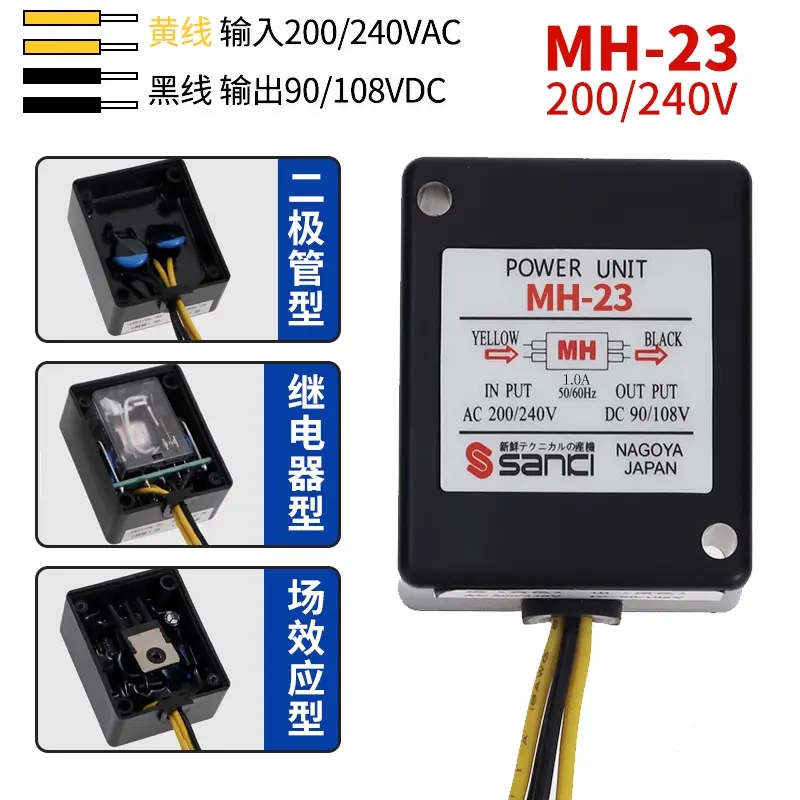
MH-23 Brake Rectifier Module Fast Braking Motor Control
If you're running electromagnetic brake motors on your production line, you already know the pain — slow stopping, coil heat buildup, inconsistent braking response. The MH-23 solves exactly that. It converts AC 200/240V supply into a clean DC 90/108V output to drive the electromagnetic brake coil, giving you fast, reliable motor stops every single time.
This isn't a generic rectifier block. It's purpose-built for electromagnetic brake control, with four circuit variants so your engineering team can match the right type to the application — whether that's a simple diode setup or a high-efficiency FET configuration for duty-cycle-heavy equipment.
Four Circuit Types — Pick What Your Application Needs
| Type | How It Works | Best For |
|---|---|---|
| Diode Type | Basic half-wave rectification, passive components only | Low-frequency cycling, simple machinery, budget-sensitive builds |
| Relay Type | Relay-switched DC output, clean cut-off | Applications needing clear electrical isolation between brake signal and power |
| Economy FET Type | MOSFET switching, reduced power consumption | General industrial use where energy saving matters |
| Performance FET Type | High-speed MOSFET with optimized gate drive | High-cycle automation, servo-adjacent systems, demanding duty cycles |
Factory note: We manufacture all four variants in-house. OEM configurations and custom circuit tuning are available for volume orders.
Electrical Specifications at a Glance
- Input: AC 200V / 240V, 50/60Hz
- Output: DC 90V / 108V
- Rated Current: 1.0A
- Wiring: Yellow leads — AC input | Black leads — DC output
- Mounting: Direct weld / bolt-down installation
- Heatsink: Integrated aluminum heat-dissipation plate
- Build: Compact enclosure, lightweight yet structurally solid
- Wiring Access: Pre-terminated leads, straightforward connection — no special tooling needed
Why Buyers Keep Coming Back to This Design
Aluminum heatsink built in. Not an afterthought — it's part of the housing. In brake applications, the coil sees repeated energize/de-energize cycles. Heat is your enemy. The integrated aluminum plate keeps the module running cool under continuous duty without adding bulk or requiring external cooling hardware.
Weld-mount installation. For OEM machine builders and panel assemblers, this matters. You get a fixed, vibration-resistant mount that doesn't loosen over time on equipment that shakes, moves, or runs 24/7. No bracket sourcing, no secondary hardware.
Pre-wired, color-coded leads. Yellow in, black out. Simple. Your assembly line technicians wire these in minutes, not half an hour. Reduces installation errors, speeds up production, and lowers your labor cost per unit.
Compact and light. It fits in tight electrical cabinets, motor junction boxes, and OEM control enclosures without redesigning your panel layout.
Four types, one supplier. Consolidating your brake rectifier sourcing under a single manufacturer simplifies your supply chain, keeps your BOM clean, and gives you real leverage on pricing at volume.
Typical Applications
- Three-phase electromagnetic brake motors — machine tools, conveyor drives, hoists
- Packaging machinery — where precise stop positioning is critical
- CNC and industrial automation panels — integrated into motor control circuits
- Crane and hoist systems — safety-critical stops requiring fast response
- Textile and printing equipment — high-cycle, continuous-duty environments
- General factory automation — wherever an AC-powered electromagnetic brake coil needs DC excitation
Best Practices — From the Production Floor
- Match output voltage to your brake coil rating. The MH-23 outputs 90VDC on 200VAC input and 108VDC on 240VAC input. Confirm your brake coil is rated accordingly before specifying.
- Choose FET type for high-cycle duty. If your motor starts and stops more than 20–30 times per hour, skip the diode type. The FET variants handle switching losses far better and will outlast a diode module significantly in that environment.
- Mount on a clean, flat surface. The aluminum heatsink needs good thermal contact with the mounting surface. A warped or painted-over bracket undermines the heat dissipation you're paying for.
- Don't exceed 1.0A continuous. The module is rated at 1.0A. If your brake coil draws close to or above this, look at a higher-current model. Undersizing kills rectifiers faster than anything else.
- Keep wiring short on the DC side. Long DC leads to the brake coil add resistance and inductance, which can slow brake engagement. Keep DC runs as short as your panel layout allows.
FAQ
Can we get this with our own branding or label?
Yes. We support OEM/ODM labeling for qualified volume orders. Custom label printing, modified documentation, and co-branding are all on the table. Contact us with your quantity and requirements.
What's the minimum order quantity, and do you offer sample units?
MOQ varies by type and configuration. We do offer sample units for engineering evaluation before you commit to a production order — this is standard practice for us with new customers. Reach out and we'll sort out the details.
How do we know which of the four types to specify?
Send us your motor specs (brake coil voltage, current draw, switching frequency, duty cycle). Our technical team will recommend the right variant. We'd rather get you the right module than have you return the wrong one.
What's your quality control process? Are these tested before shipment?
Every unit goes through electrical function testing before it leaves the facility — input/output voltage verification, continuity check, and visual inspection. We can provide batch test records for OEM customers on request.
What are your lead times for volume orders, and can you support blanket orders?
Standard production lead time is [X weeks] depending on type and volume. We support blanket purchase orders with scheduled releases — useful if you want supply security without carrying inventory yourself. Talk to us about your annual demand and we can structure something workable.
Ready to discuss quantities, OEM options, or technical requirements? Send us your specs and we'll get back to you within 24 hours.