
LXLZ Note: This Product Provides Solutions for Parameter Customization And Application.

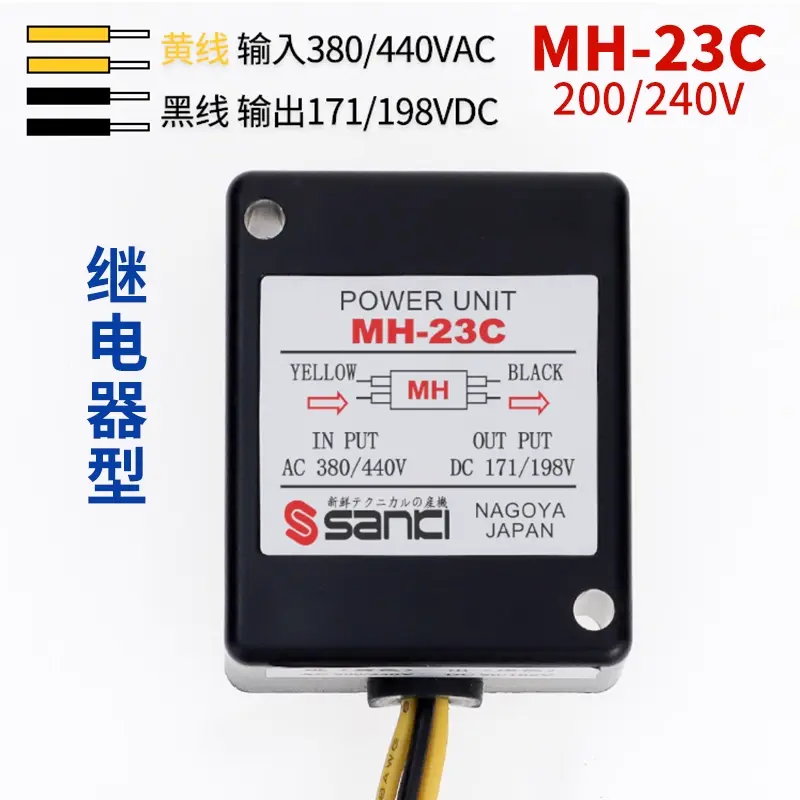
MH-23C Brake Rectifier 380V Input Relay Type Module
If you're sourcing electromagnetic brake rectifiers for industrial motor control applications, the MH-23C is the kind of unit that your maintenance engineers will actually thank you for. Built for real-world industrial environments, this relay-type brake rectifier converts AC input to the DC voltage your electromagnetic brakes need — cleanly, reliably, and without the headaches that come with cheaper alternatives.
What This Unit Does
The MH-23C takes AC 380/440V input (yellow wires) and converts it to DC 171/198V output (black wires) to power electromagnetic braking systems on industrial motors. It's the power bridge between your three-phase power supply and the brake coil — and getting this part right means your brakes engage and release precisely every single time.
This is a relay-type rectifier, meaning it uses an internal relay switching mechanism for brake release control, which gives you a clean on/off response that's well-suited for standard crane hoists, conveyor systems, machine tool spindles, and packaging line drives.
Key Specifications at a Glance
| Parameter | Detail |
|---|---|
| Model | MH-23C |
| Type | Relay-Type Electromagnetic Brake Rectifier |
| Input Voltage | AC 380V / 440V |
| Output Voltage | DC 171V / 198V |
| Input Wiring | Yellow Leads |
| Output Wiring | Black Leads |
| Installation | Weld-mount / Fixed Plate Installation |
| Enclosure | Aluminum Heat Sink Base Plate |
| Part Code | 05-MH-23C |
Why Buyers Actually Choose This Over Alternatives
1. Relay-Type Design — Proven in Heavy Cycle Applications The relay switching structure gives a decisive brake engage/disengage signal. In applications where brakes cycle frequently — hoists, automated lines, elevator doors — this matters more than specs on paper. No ambiguous half-states, no coil burnout from prolonged half-wave energizing.
2. Integrated Aluminum Heat Sink Plate Heat is the number one killer of rectifier modules in enclosed control panels. The aluminum base plate dissipates heat passively and keeps operating temperatures within safe limits even during high-frequency switching cycles. We build the heatsink directly into the unit — you don't need to source or fabricate a separate mounting bracket.
3. Compact, Weld-Mountable Housing The solid enclosure is designed for welded installation directly onto control cabinet panels or motor frames. It's not going to rattle loose under vibration. For OEM manufacturers building motor control panels at volume, this saves assembly time and keeps your cabinet layout clean.
4. Pre-Wired Color-Coded Leads Yellow in, black out. Your electricians don't need to read a datasheet to wire this correctly. In a production line installation or field service scenario, that simplicity reduces wiring errors and speeds up commissioning. Small detail — real-world value.
5. Lightweight but Structurally Solid The aluminum construction keeps the unit light without compromising rigidity. For motor-mounted or panel-edge installations where weight distribution matters, this is the right balance.
Best Practices From Field Experience
Don't skimp on the rectifier when your brake is doing the heavy lifting.
Here's what experienced procurement and electrical engineers have learned over years of working with electromagnetic brake systems:
- Match your brake coil voltage to rectifier output. The MH-23C outputs DC 171V/198V depending on your AC supply (380V or 440V). Always verify your brake coil's rated DC voltage before ordering. Mismatched voltage is the #1 cause of premature coil failure.
- Mount with adequate airflow around the heatsink. Even with the integrated aluminum plate, don't box this unit in completely. A 20–30mm clearance around the heatsink side keeps thermal performance optimal in continuous-duty installations.
- Use the relay-type in standard duty cycles; consider half-wave types for ultra-fast response needs. The MH-23C relay type is ideal for standard crane, hoist, and conveyor braking. If you're running servo-controlled high-frequency brake cycles (>60 cycles/min), discuss your application with us — we can advise the right variant.
- Inspect lead connections periodically in high-vibration environments. The color-coded leads are durable, but in heavy vibration applications (quarrying, heavy press lines), adding a strain relief clamp at the panel entry point extends service life.
- Always fuse the input side. Protect the rectifier with an appropriately rated fuse on the AC input. This protects both the unit and your brake coil in the event of a downstream short.
FAQ
Can this unit work on both 380V and 440V systems?
Yes. The MH-23C is rated for AC 380V/440V input. At 380V input, the DC output is approximately 171V. At 440V input, output is approximately 198V. This dual-voltage compatibility makes it suitable for export projects and facilities with mixed supply standards.
What brake coil ratings is this rectifier compatible with?
The MH-23C is designed for electromagnetic brake coils rated at DC 170V–200V range, which covers the majority of standard three-phase motor-mounted brakes in the 0.1kW–7.5kW range. For specific coil resistance or power ratings, contact us with your motor/brake model and we'll confirm compatibility before your order.
What's your MOQ and can you supply OEM labeling?
We manufacture these units directly, so MOQ is flexible — we work with both sample orders for evaluation and bulk OEM contracts. Custom labeling, packaging, and voltage variants are available for qualified OEM buyers. Contact us to discuss your volume requirements.
How does the relay-type differ from half-wave or full-wave bridge rectifier types?
A relay-type brake rectifier uses full-wave rectification combined with an internal relay to rapidly reduce voltage across the brake coil after the motor stops — this enables faster brake engagement. Half-wave types are simpler but slower to engage. The relay-type MH-23C is the preferred choice for hoisting and crane applications where brake response time directly affects safety and load control.
What's the expected service life and are replacement units easy to source?
Under normal operating conditions and correct installation, these units are designed for long-term industrial service. As the manufacturer, we maintain consistent production runs of the MH-23C, so supply continuity is not a concern for your maintenance stock planning. We recommend keeping 2–3 units as on-site spares for critical equipment, which is standard practice for plant engineers running continuous operations.
📩 Ready to source? Send us your application details — brake coil specs, installation quantity, and supply voltage — and we'll get you a quote within 24 hours.