
LXLZ Note: This Product Provides Solutions for Parameter Customization And Application.

ZLKS-170-4 Brake Rectifier 380V Input 170V Output
If you're sourcing brake rectifiers for three-phase motor applications, you already know how much riding on a reliable braking response — downtime, safety, equipment wear. The SNXRON ZLKS-170-4 is a dedicated electromagnetic brake rectifier built specifically for industrial motor braking systems. It takes 380VAC input and delivers a stable 170VDC output, giving your motor's electromagnetic brake coil exactly what it needs to engage and release cleanly, every single cycle.
We manufacture these in-house, with full control over winding, encapsulation, and QC — so what you're getting isn't a re-labeled generic module. It's a purpose-built component designed for real industrial environments.
Table of Contents
What You're Looking At (From the Unit Itself)
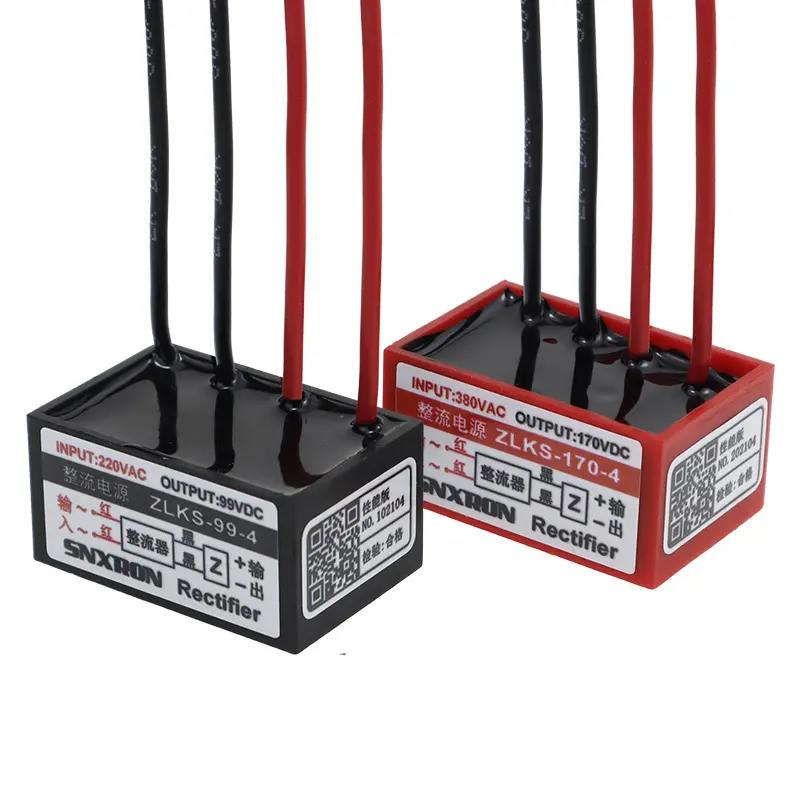
From the product image, you can see two units side by side — the black unit (ZLKS-99-4, 220V input) and the red unit (ZLKS-170-4, 380V input) — clearly labeled with input/output specs, terminal polarity markings (红/Red = AC input, 晶/Z = DC output), and a QC pass sticker. The epoxy-potted body is compact, sealed, and wired with pure copper leads — pre-stripped and ready for direct connection. No loose terminals rattling around. No guesswork on polarity.
The premium PBT shell (the red housing you see) isn't just cosmetic — PBT is flame-retardant, dimensionally stable under heat, and resistant to the kind of chemical exposure you see in factory environments.
Key Specifications
| Parameter | Details |
|---|---|
| Model | ZLKS-170-4 |
| Application | Motor electromagnetic brake (抱闸) rectifier |
| Input Voltage | 380VAC (3-phase motor compatible) |
| Output Voltage | 170VDC |
| Circuit Type | Available in Diode type / MOSFET (FET) type |
| Response Type | Standard / Fast-brake version available |
| Winding Material | Pure copper wire |
| Enclosure Material | High-grade PBT (flame retardant, heat stable) |
| Potting | Full epoxy encapsulation (moisture & vibration resistant) |
| Lead Wire | Pre-wired pure copper conductors, color-coded |
| QC | 100% inspection before shipment |
Why This Design Works in the Field
Full epoxy encapsulation
The entire circuit is potted solid. Moisture, dust, vibration — none of it gets inside. We've seen open-frame rectifiers fail within months on factory floors. Potted units simply last longer.
Pure copper leads, not aluminum-clad
Copper handles heat cycling better and maintains lower contact resistance over time. On a component that switches under load, this matters for long-term reliability.
PBT housing — Not generic ABS. PBT holds its shape at higher ambient temperatures and doesn't get brittle after years of heat exposure. In motor control cabinets where temperatures climb, this is the right material choice.
Diode vs. MOSFET option
Standard diode type is cost-effective and proven. The MOSFET (FET) version offers faster switching response, which directly shortens brake engagement time. If your application involves frequent stop-start cycles or positioning accuracy, the fast-brake version is worth specifying.
Fast-brake version
Significantly reduces the time between power cut and full brake engagement. Critical in overhead cranes, hoists, CNC axes, or any load-holding application where a slow brake response creates safety risk or positioning error.
Typical Applications
- Three-phase AC motor electromagnetic brakes (most common use case)
- Overhead cranes and hoists
- CNC machine tool spindle braking
- Conveyor and packaging line motors
- Elevator traction motor brake coils
- Industrial gearmotor brake modules
- Any 380V motor system with an integrated electromagnetic brake
Best Practices (From Real Installation Experience)
These are things we hear from engineers and maintenance teams who've been using brake rectifiers for years:
- Always match the rectifier output to your brake coil's rated DC voltage. A 170VDC rectifier on a coil rated for 99VDC will burn the coil. Double-check the nameplate on your brake before ordering.
- For fast stop-start cycles (>20 cycles/hour), go with the MOSFET fast-brake version. The standard diode type handles normal duty well, but high-frequency cycling generates more heat — the FET version manages this better.
- Mount the rectifier where ambient temperature stays below 50°C. Even with epoxy potting, sustained high temperatures shorten component life. Avoid mounting directly against motor housings.
- Use the color-coded leads as-is — don't extend with undersized wire. The pre-wired copper leads are sized for the load. If you need longer runs, match the cross-section.
- Inspect leads for chafing annually in high-vibration installations. The potted body is robust; the leads at the exit point are the most vulnerable spot over years of operation.
FAQ
What's the difference between the diode type and the MOSFET (FET) type? Which should I order?
The diode type uses a standard half-wave or full-wave bridge circuit — simple, robust, lower cost, proven in millions of installations. The MOSFET type adds active switching that significantly cuts the release/engage time of the brake coil. If your priority is cost and the application runs moderate duty cycles, diode type is fine. If you need fast, precise braking — cranes, CNC, positioning — go FET. We can advise based on your specific motor and duty cycle if you share the details.
Can this be used directly with a standard three-phase 380V motor that has an integrated brake?
Yes, that's exactly what it's designed for. The 380VAC input taps directly from your motor's supply (typically two phases), and the 170VDC output feeds the brake coil. Most Chinese and many European/Asian 380V motors with electromagnetic brakes use 170VDC brake coils — this is the standard pairing. Confirm your brake coil's rated voltage before installation.
What's your MOQ and can you do custom labeling or packaging for OEM orders?
We're a manufacturer, so MOQ is flexible depending on the model and version. Standard orders typically start from small quantities for sampling, with better pricing on volume. OEM labeling, custom packaging, and model-specific configurations (voltage, response type) are available — just let us know your requirements and we'll put together a quote.
How long is the service life, and what's the warranty?
Under normal operating conditions (within rated load, proper mounting, ambient temp ≤50°C), these units are designed for long-term continuous use — field feedback from our clients commonly reports 5+ years of service without replacement. We offer a standard warranty on manufacturing defects. Because these are potted/sealed units, they're not field-repairable, so our focus is on getting the unit right before it ships — hence 100% QC inspection on every piece.
Do you have units for other input/output voltages? We have motors running on 220V.
Yes. As you can see in the product photo, we also manufacture the ZLKS-99-4 (220VAC input / 99VDC output) and other variants. We produce a range covering common industrial voltages. If you have a specific input voltage or output requirement that's not listed, contact us — custom voltage configurations are something we handle for volume orders.
Ready to discuss specifications, samples, or bulk pricing? Send us your motor brake voltage requirements and annual usage volume — we'll respond within 24 hours.