
LXLZ Note: This Product Provides Solutions for Parameter Customization And Application.

110V DC EMI Filter High Voltage DC Power Line Filter
If you're dealing with EMI noise issues on a 110V DC power line — whether it's causing sensitive equipment to malfunction, tripping protection circuits, or just failing compliance tests — this filter is built to solve that problem directly.
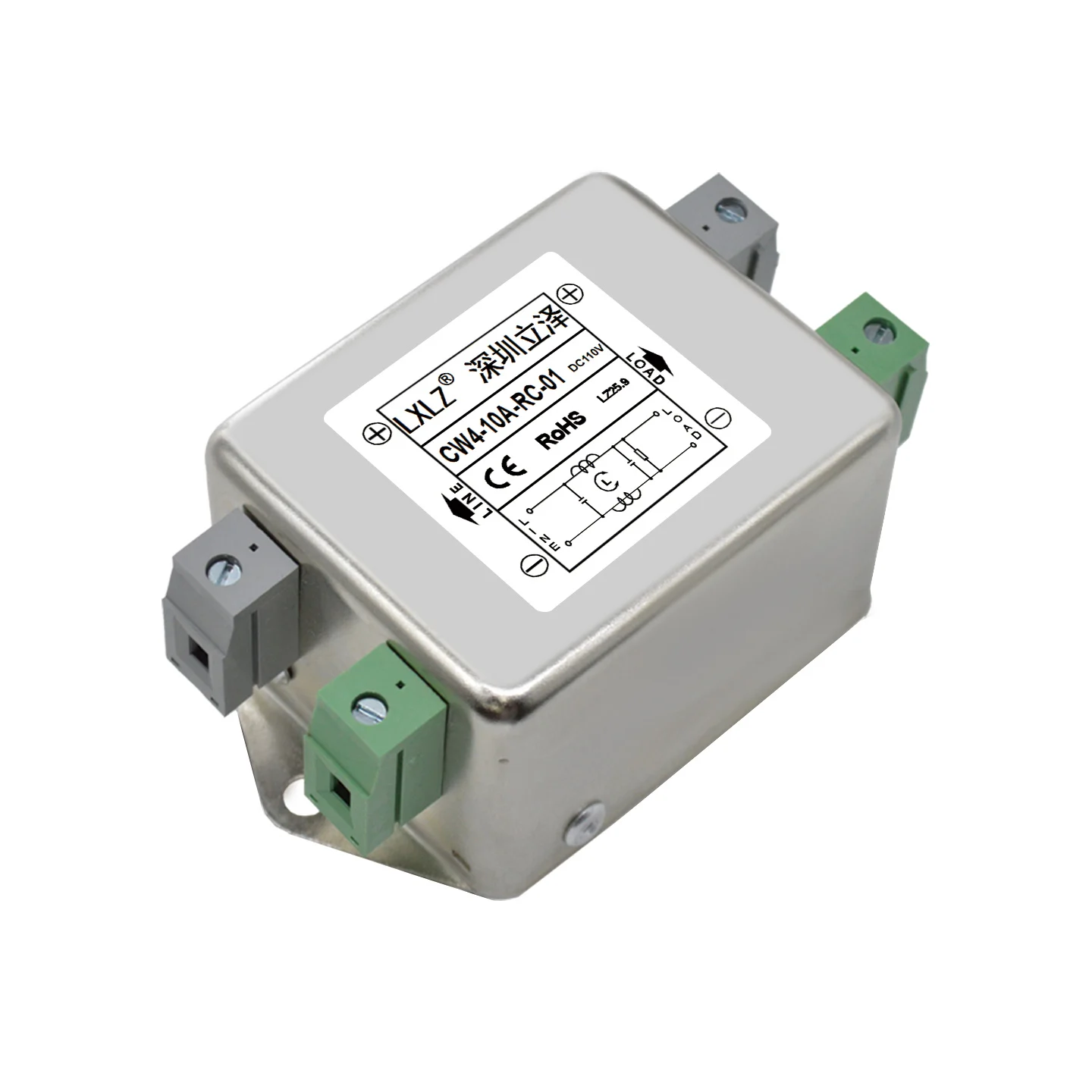
The CW4-RC-01 is a single-phase DC EMI power line filter rated at 110VDC, designed for panel-mount or chassis integration in industrial and commercial equipment. It uses a European-style screw terminal block connection (as you can see in the images — those green and grey plug-in terminals), which makes wiring clean, fast, and field-serviceable without soldering. The stainless steel / tin-plated steel enclosure gives it solid shielding performance and durability in real cabinet environments.
This isn't a generic AC filter repurposed for DC. It's specifically engineered for DC applications, which matters — a lot. Many AC filters have Y-capacitors and inductor configurations that don't perform correctly on DC lines. This one does it right.
Key Specifications at a Glance
| Parameter | Details |
|---|---|
| Rated Voltage | 110V DC |
| Current Range | 1A, 3A, 6A, 10A, 16A, 20A, 30A (selectable) |
| Phases | Single Phase |
| Connection Type | European Screw Terminal (plug-in style) |
| Filter Function | EMI / RFI suppression, both conducted & radiated |
| Frequency Reference | 50–60Hz system compatibility |
| Certifications | CE, RoHS |
| Model Series | CW4-RC-01 (e.g., CW4-10A-RC-01 shown) |
| Enclosure | Metal shielded housing, panel/chassis mountable |
| Circuit Topology | LC filter with common mode & differential mode attenuation |
What's It Actually Used For?
From the label on the unit and the circuit diagram visible on it, this filter uses a classic LC network topology combining common-mode chokes and X/Y capacitors — which gives it dual suppression capability:
- Common-mode noise — the kind that travels on both lines simultaneously, often picked up from switching power supplies, motor drives, or inverters nearby
- Differential-mode noise — noise between the positive and negative lines, typical of PWM signals and SMPS ripple
Typical application scenarios our B2B customers use this in:
- ✅ Industrial automation panels with 110VDC bus systems
- ✅ Telecom and datacom cabinet power distribution
- ✅ EV charging infrastructure internal power modules
- ✅ Railway and transportation onboard electronics (aux power)
- ✅ Medical device power conditioning (noise-sensitive environments)
- ✅ Solar / battery storage systems running on 110VDC rails
- ✅ Military and defense ground support equipment
- ✅ Test & measurement equipment power input protection
Why the Terminal Block Design Actually Matters
A lot of procurement engineers overlook connection type until they're in the middle of production. Here's the practical difference:
The plug-in European terminal block (those green connectors you see in the photo) means:
- Wire once, plug many times — great for production lines where filters need to swap out during maintenance without rewiring
- No soldering required — reduces assembly time per unit significantly
- Secure screw-lock contact — won't vibrate loose in industrial environments
- Clearly marked L / E / LOAD terminals — reduces wiring errors on the factory floor
For OEMs doing volume assembly, this detail alone can save meaningful labor hours over a production run.
Build Quality — What You're Actually Getting
Looking at the unit closely:
- Metal enclosure with proper grounding tab — this isn't a plastic shell with a label slapped on. The housing itself contributes to shielding effectiveness
- Circuit schematic printed on label — a small thing, but engineers appreciate being able to verify the topology without hunting for a datasheet in the middle of installation
- CE marked and RoHS compliant — means it's cleared for European market integration, and you won't have hazardous materials headaches in your supply chain audits
- Compact footprint — fits in tight DIN rail adjacent spaces or panel cutouts without requiring redesign of your enclosure layout
Best Practice Installation Tips (From Field Experience)
These are things customers often learn the hard way — we're sharing them upfront:
- Mount as close to the power entry point as possible. Every inch of unfiltered cable between the filter output and your sensitive load is an antenna. Keep that run short.
- Ground the filter enclosure properly. The metal housing only works as a shield if it's bonded to your chassis ground with low impedance. Use a short, fat ground strap — not a thin wire.
- Don't route input and output cables in the same bundle. Parallel runs will couple noise right back across the filter and reduce your attenuation by 20–30dB in practice.
- Match current rating with some headroom. If your load peaks at 8A, go with the 10A version — don't run a filter at its rated limit continuously, especially in warm enclosures.
- For very noisy environments (VFDs, servo drives nearby), consider adding a ferrite ring on the output side as a second stage — the filter handles the heavy lifting, and the ferrite catches residual HF noise.
FAQ
Can I use this on an AC line? It says 50-60Hz on the spec.
No — this is a DC-rated filter. The 50–60Hz reference is for system frequency compatibility context (many DC systems are derived from AC mains at those frequencies). The filter circuit is optimized for DC, including correct capacitor polarization and inductor core selection. Using an AC filter on DC can cause capacitor failure or degraded performance.
Do you support custom current ratings or voltage ratings beyond what's listed?
Yes. As a manufacturer, we can accommodate custom specifications — different voltage ratings (24V, 48V, 72V, 110V, 270V DC), current ratings, terminal types, or enclosure modifications. MOQ applies for custom runs. Contact us with your technical requirements and we'll quote accordingly.
What certifications does this filter carry, and can you provide test reports?
The CW4-RC-01 carries CE marking and is RoHS compliant. We can provide CE declaration of conformity and test reports upon request. For customers requiring additional certifications (UL, TÜV, etc.), please discuss with our team — we work with third-party labs on a project basis.
What's the attenuation performance? Do you have insertion loss curves?
Yes, we have insertion loss data for each current variant. Typical attenuation is 40–60dB in the 150kHz–30MHz range depending on load impedance. Please reach out and specify which current rating you're evaluating — we'll send the relevant test data sheet.
What are your lead times and minimum order quantities for standard models?
Standard models (1A–30A, 110VDC, CW4-RC-01 series) are kept in stock or have short production cycles. MOQ is flexible — we work with both engineering sample quantities for design validation and volume production orders. Lead time for standard parts is typically 7–15 business days. Custom versions are quoted case by case.
Ready to validate for your application? Send us your voltage, current, and installation environment — we'll recommend the right variant and can arrange samples for engineering evaluation.