
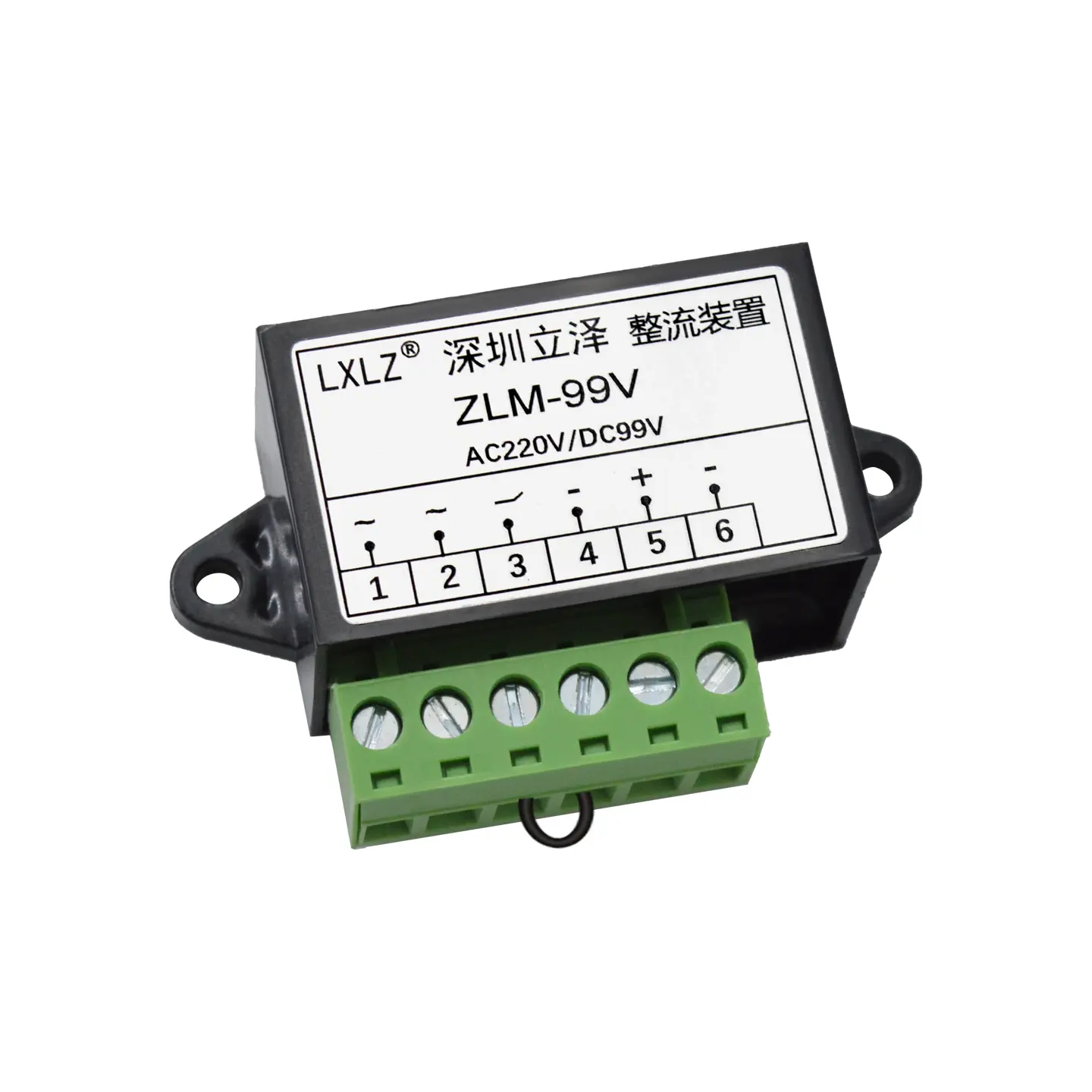
LXLZ Note: This Product Provides Solutions for Parameter Customization And Application.

Elevator Brake Rectifier Module ZLM Series 99V/170V
What This Module Actually Does
If you're sourcing brake rectifiers for elevator systems or industrial motor brakes, you already know how critical this small component is. It converts AC power into the precise DC voltage your electromagnetic brake coil needs — releasing the brake cleanly when the motor runs, and cutting off fast enough to stop the load without lag or coasting.
The ZLKS series does exactly that, reliably, across thousands of switching cycles. We've built these for elevator OEMs, motor manufacturers, and industrial machinery integrators who can't afford brake hesitation or early component failure on-site.
Table of Contents
Key Specifications at a Glance
| Parameter | ZLKS-99-4 | ZLKS-170-4 |
|---|---|---|
| AC Input Voltage | 220VAC | 380VAC |
| DC Output Voltage | 99VDC | 170VDC |
| Circuit Type | Diode type / MOSFET type | Diode type / MOSFET type |
| Braking Response | Fast-release / Fast-stop | Fast-release / Fast-stop |
| Conductor Material | Pure copper wire | Pure copper wire |
| Housing Material | Premium PBT (flame-retardant) | Premium PBT (flame-retardant) |
| Model Code | ZLKS-99-4 | ZLKS-170-4 |
| Application | Universal motor brake coil | Universal motor brake coil |
| Encapsulation | Full resin-potted body | Full resin-potted body |
Both variants available in diode type (standard, cost-effective) and MOSFET/FET type (faster switching, lower heat, longer service life). We ship both from stock.
What We Observed From the Product
From the unit itself, a few things stand out that B2B buyers will care about:
- Resin-potted body — The entire PCB and components are sealed inside epoxy resin. That means moisture, dust, and vibration don't get in. This matters a lot in elevator machine rooms and factory floor environments.
- Color-coded housings — Black for 220V/99V output, Red for 380V/170V. Simple, but it eliminates wiring errors during installation. Your maintenance crews will appreciate it.
- Pre-wired pure copper leads — Wires are pre-attached and labeled (input red, ground, output). No guessing, no stripped terminals. Pure copper means lower resistance and less heat at the connection points.
- Compact block design — Fits into existing brake controller panels without reworking the enclosure. Drop-in compatible with most standard elevator brake coil circuits.
- Clear labeling — Input/output specs, polarity, and QC batch number are printed directly on the unit. Traceability matters when you're managing large procurement volumes.
Why Buyers Prefer the Fast-Brake Version
Standard rectifiers bleed voltage slowly after power cuts — the brake drags instead of biting clean. In elevators, that's a safety concern. In production machinery, it's wasted cycle time.
The fast-brake circuit in this module actively collapses the magnetic field in the brake coil within milliseconds. The brake engages hard and fast, exactly when it's supposed to. For elevator applications especially, this is often a code compliance issue, not just a performance preference.
Two Circuit Types — Know Which One You Need
Diode Type
- Lower cost
- Simple, robust circuit
- Good for standard brake response requirements
- Long-proven reliability in elevator and crane applications
MOSFET (FET) Type
- Active switching — faster release and faster brake engagement
- Runs cooler under high-frequency switching
- Better for high-cycle applications (automated production lines, frequent-start motors)
- Slightly higher unit cost, but longer service intervals in heavy-duty use
If you're not sure which fits your application, send us the motor brake coil specs and we'll recommend the right one. That's what we do every day.
Manufacturing Advantages — What Makes Our Product Competitive
We manufacture these in-house. That's not just a talking point — it means:
- Consistent quality control — Every batch goes through electrical testing before shipping. The QC pass number is printed on the unit (visible on the label in the photo).
- Flexible MOQ — We work with elevator component distributors, OEM motor manufacturers, and MRO procurement teams. Whether you need 500 pieces or 50,000 pieces, production scheduling is flexible.
- OEM/ODM capability — Custom output voltages, custom wire lengths, custom labeling or branding — we've done this for multiple overseas customers. Lead time and tooling depend on spec.
- Pure copper wiring as standard — Some manufacturers cut costs with CCA (copper-clad aluminum) wire. We don't. Pure copper only, because connection reliability over years of use actually matters.
- Premium PBT housing — UL94 V-0 rated flame retardant material. Not generic plastic. This matters for product certifications your customers may require downstream.
Typical Applications
- Elevator & escalator brake coils (most common use case)
- Three-phase motor electromagnetic brakes
- Crane and hoist brake systems
- Industrial automation machinery with motor brake control
- Conveyor drive units with holding brakes
Best Practices From Field Experience
After working with elevator and industrial motor customers for years, here's what experienced procurement and maintenance teams tell us works best:
- Match output voltage to coil rating with 5% headroom — Don't run a 99V coil at 99V continuously if your input fluctuates. Know your line voltage stability.
- Use the fast-brake version for elevators rated above 1.0 m/s — Slower brake response at higher speeds creates leveling error and wear issues.
- Replace rectifiers proactively at maintenance intervals, not after failure — These are low-cost components. Waiting for failure in an elevator or crane brake circuit is a false economy.
- In high-humidity environments, verify the resin seal is intact before installation — Check for any cracks in the potting compound, especially on units that have been stored long-term.
- For high-cycle machinery, go MOSFET type — Diode type units generate more heat per cycle. In applications switching 100+ times per hour, MOSFET type runs cooler and lasts longer.
FAQ — What B2B Buyers Usually Ask Us
Can you supply both 99V and 170V versions together in one order?
Yes. We regularly ship mixed orders. Just specify the quantity breakdown for each model when you request a quote. Both are standard stock items.
Do these units carry CE or other certifications? What documentation can you provide?
We can provide test reports and product quality documentation. CE marking requirements depend on your destination market and end application. Contact us with your compliance requirements and we'll tell you exactly what we have and what we can arrange.
What's the minimum order quantity, and can we get samples first?
Sample orders are available for qualified buyers — typically 2 to 5 pieces to verify fit and function before committing to volume. MOQ for production orders is flexible based on model and quantity mix. Reach out and we'll work out what makes sense for your sourcing plan.
Can you do custom output voltages or custom wire configurations?
Yes, within practical limits. We've produced variants for specific OEM brake coil voltages outside the standard 99V/170V range. Custom wire length and connector termination are also possible. Share your technical requirements and we'll assess feasibility and lead time.
How do we know the quality is consistent batch to batch?
Each unit carries a QC batch number and passes electrical output testing before leaving the factory. We can provide batch test records with shipments. For ongoing supply relationships, we're open to discussing incoming inspection coordination or third-party QC if your procurement process requires it.
Ready to discuss pricing, samples, or custom specs? Send us your application details and target volume — we'll get back to you with a straight answer.