
LXLZ Note: This Product Provides Solutions for Parameter Customization And Application.

Half/Full Wave Rectifier Module Motor Brake Control
If you're sourcing rectifier modules for electromagnetic brake applications, you already know how much the quality of this one small component affects the whole braking system's reliability. This is exactly where we focus.
Our MH-23C series electromagnetic brake rectifier (also available as ZLQ-4DZ-QB) is a dedicated half/full-wave rectifier designed specifically for three-phase 380V AC motor brake circuits. It converts AC input into a stable DC output to energize the electromagnetic brake coil — giving you fast, precise, and repeatable braking response every single time.
Built for industrial environments. Designed for easy integration. Manufactured for high-volume B2B procurement.
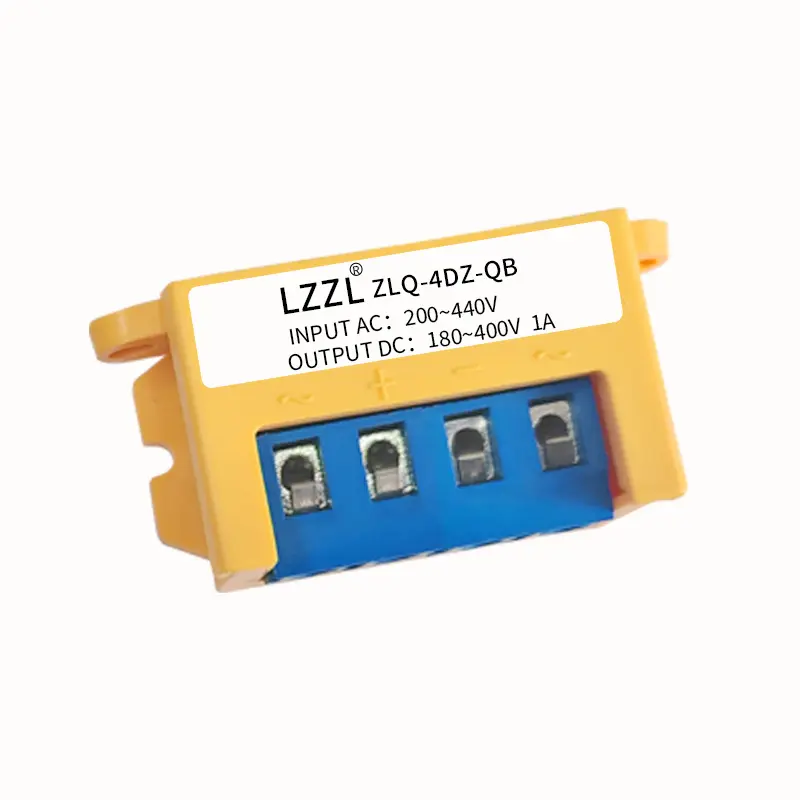
What You're Looking At (From the Unit Itself)
From the product image, this is a compact molded rectifier module with:
- Brand: LZZL® — ZLQ-4DZ-QB
- Input: AC 200~440V (covers both 220V and 380V systems globally)
- Output: DC 180~400V, 1A
- Terminal block: 4-position screw terminal (clearly marked ~, +, −, ~ for foolproof wiring)
- Housing: High-impact yellow ABS enclosure — compact, insulated, ready for panel or DIN mounting
- MH-23C relay type with integrated aluminum heat-dissipation plate inside the assembly
This wide input voltage range (200–440V) is a real practical advantage — it means one SKU can serve multiple markets without modification. That matters when you're kitting or distributing across regions.
Table of Contents
Key Specifications
| Parameter | Value |
|---|---|
| Model | MH-23C / ZLQ-4DZ-QB |
| Input Voltage | AC 200~440V |
| Output Voltage | DC 180~400V |
| Output Current | 1A |
| Rectifier Type | Half Wave / Full Wave selectable |
| Installation Method | Welding mount / screw terminal |
| Heat Dissipation | Built-in aluminum heat sink plate |
| Relay Type | Electromagnetic brake relay (MH-23C) |
| Wiring | Screw terminal block, clearly labeled |
| Housing | Compact ABS molded, high insulation |
| Application Voltage | 380V three-phase motor brake systems |
Why This Design Works Well in the Field
We've been making these units long enough to know what causes problems on the customer's end — and we've engineered around most of them.
The aluminum heat sink plate matters more than people think.
Brake rectifiers cycle on and off constantly in real applications. Without proper thermal management, the rectifier diodes degrade fast. The integrated aluminum plate keeps operating temperature stable, which directly extends service life. Customers running multi-shift operations tell us this is the difference between replacing units every six months versus running them for years.
Wide voltage input (200–440V) reduces your sourcing complexity.
If you're a panel builder or OEM serving multiple countries, you don't want to stock different SKUs for 220V and 380V markets. This unit handles both — and everything in between.
The screw terminal block is labeled clearly on the unit.
Sounds simple, but it prevents wiring mistakes during installation. The ~, +, −, ~ markings are molded and printed directly on the terminal housing. Electricians in the field appreciate this. It reduces callbacks.
Compact form factor fits tight control panels.
The footprint is small enough to mount inside a standard motor control cabinet without redesigning the layout. The weld-mount option also allows it to be fixed directly to a bracket or backplate.
Half wave vs. full wave — both available.
Half-wave rectification gives softer brake engagement (preferred in some conveyor and textile applications). Full-wave gives faster, harder stops (preferred in machine tools and hoists). We manufacture both configurations — you specify what your application needs.
Typical Applications
- Industrial motor brake control panels (most common use case)
- Crane and hoist systems — where precise stopping is a safety requirement
- CNC machine tool spindles — fast stop, minimal coast
- Conveyor lines and packaging machinery
- Textile machinery and winding equipment
- Elevator traction motor brakes
- Agricultural and construction equipment motors
If your customers are buying three-phase motors with electromagnetic brakes, they need this module. It's that straightforward.
Manufacturing Advantage — Why Source From Us
We manufacture these units in-house, which means:
- Consistent quality control — every batch tested before shipment
- OEM/ODM support — we can put your brand label on the unit, adjust voltage specs, or modify terminal configuration for your market
- High-volume capacity — no MOQ issues for serious B2B buyers
- Competitive lead times — we're not a trading company adding margin; you're talking directly to the factory
- Custom packaging available — retail-ready box, bulk industrial pack, or custom kit configuration
We supply to motor manufacturers, electrical panel builders, MRO distributors, and equipment OEMs across Southeast Asia, Europe, the Middle East, and South America. If you have a regular procurement volume, we can discuss blanket order pricing.
Best Practices From Field Experience
Based on feedback from customers who've been using this module for years:
- Always match the rectifier output voltage to your brake coil rating. A mismatch is the #1 cause of premature coil burnout. If your brake coil is rated 180V DC, use the half-wave configuration. If it's rated 200V+, full-wave is appropriate.
- Mount the module in a ventilated enclosure — even with the built-in heat sink, airflow in the cabinet helps. Don't pack it against heat-generating components.
- Use the correct wire gauge for the 1A output circuit — undersized wire adds resistance and heat at the terminal connection.
- Inspect terminals annually in high-vibration environments — screw terminals can work loose over time on machinery with significant vibration. A small dab of thread-locking compound on the terminal screws solves this.
- For crane/hoist applications, always use full-wave configuration — faster brake engagement is a safety requirement, not just a preference.
FAQ
Can this module work with 220V single-phase input instead of 380V three-phase?
Yes — the input range is AC 200~440V, so it accepts 220V single-phase on the AC input terminals. The DC output will be lower (proportional to input), so confirm your brake coil voltage requirement before ordering. We can advise on the right configuration for your application.
What's the difference between the MH-23C relay type and the ZLQ-4DZ-QB module — are they the same product?
They are related but serve slightly different configurations. The MH-23C refers to the relay-integrated brake rectifier assembly (with the relay coil control built in), while the ZLQ-4DZ-QB is the standalone rectifier module shown in the image. Both are used in electromagnetic brake circuits. If you're unsure which fits your panel design, send us your schematic and we'll recommend the right one.
Can you do OEM labeling or custom voltage specs?
Absolutely. We do OEM branding regularly for distributors and panel builders. Custom voltage output ranges are possible with minimum order quantities. Lead time for OEM versions is typically 2–3 weeks depending on order size.
What is the expected service life of this module under normal operating conditions?
Under normal industrial duty (proper mounting, correct voltage matching, ambient temperature below 40°C), these modules typically run 3–5 years without issues. The integrated aluminum heat sink is specifically designed to extend diode service life. Harsh environments (high ambient temp, heavy cycling frequency) may shorten this — we can advise on derating if needed.
Do you provide test reports or certifications for customs/import compliance?
Yes. We can provide factory test reports with each batch. CE documentation is available for European market imports. For specific certifications required in your country, contact us with your requirements and we'll confirm what we can provide before you commit to an order.
Ready to discuss your procurement needs? Send us your application details or current motor brake specs — we'll get back to you with a recommendation and quote within 24 hours.