
LXLZ Note: This Product Provides Solutions for Parameter Customization And Application.

Solder Lug EMI Filter Single Phase AC Noise Suppressor
If you've ever dealt with equipment failures, signal interference, or compliance headaches caused by dirty power lines, you already know how much a reliable EMI filter matters. This is the CW1B-L single-phase AC line filter — a compact, wire-lead type EMI filter built for OEM integration and industrial equipment manufacturing. It's straightforward, solid, and does exactly what it's supposed to do without overcomplicating your BOM or your assembly process.
Rated for 1A to 10A across a 115V/250V dual-voltage range at 50/60Hz, this filter covers the vast majority of single-phase application scenarios — from control panels and medical devices to industrial automation and consumer appliance OEM builds.
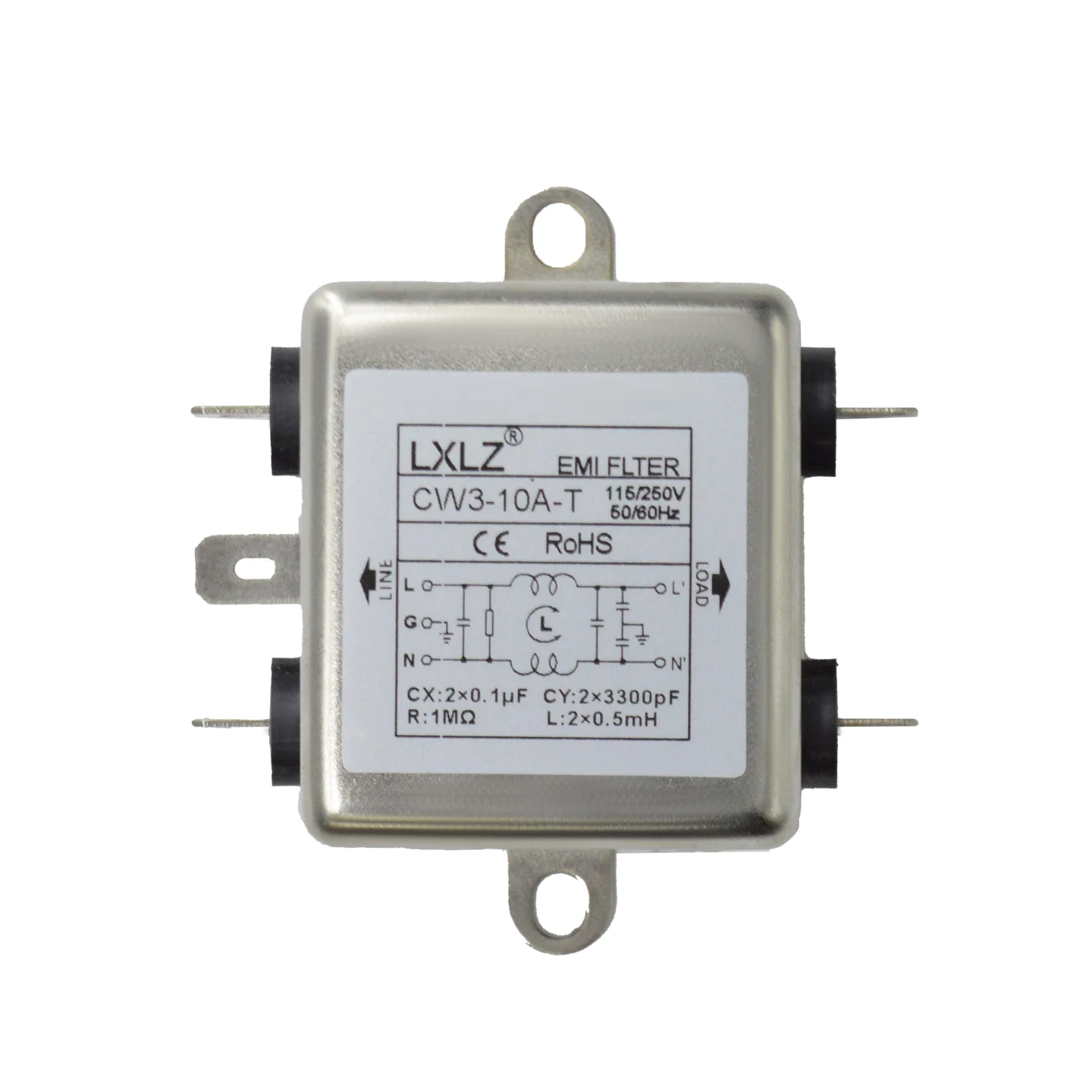
What the Image Tells You
From the product label, here's what we can confirm:
- Brand: LXLZ® (registered trademark, manufacturer-direct)
- Model shown: CW3-10A-T (same series, same internal architecture as CW1B-L)
- Rated Voltage: 115/250V AC
- Frequency: 50/60Hz
- Certifications: CE ✔ | RoHS ✔
- Internal circuit components visible on label:
- CX: 2 × 0.1µF (X-capacitors for differential mode suppression)
- CY: 2 × 3300pF (Y-capacitors for common mode suppression)
- R: 1MΩ (discharge resistor for safety)
- L: 2 × 0.5mH (common mode choke inductors)
- Housing: Metal enclosure with mounting ears (top and bottom), pin-through wire lead connections on both LINE and LOAD sides
- Connection Type: Wire leads (solder/terminal-ready for PCB or panel integration)
The circuit diagram printed directly on the label is a nice touch — your engineers don't need to pull up a datasheet just to verify the topology during assembly.
Key Specifications at a Glance
| Parameter | Details |
|---|---|
| Filter Type | Single-Phase, Single-Stage EMI Filter |
| Model Series | CW1B-L / CW3-10A-T |
| Rated Current | 1A – 10A (multiple variants available) |
| Rated Voltage | 115V / 250V AC |
| Frequency | 50 / 60 Hz |
| Connection | Wire Lead (Line-in / Load-out) |
| X Capacitor | 2 × 0.1µF |
| Y Capacitor | 2 × 3300pF |
| Common Mode Choke | 2 × 0.5mH |
| Discharge Resistor | 1MΩ |
| Housing | Steel metal shell, surface mounting ears |
| Certifications | CE, RoHS |
| Topology | Single-stage π-type LC network |
Where This Filter Gets Used — Real Application Scenarios
This isn't a niche component. B-end buyers typically integrate this into:
- Industrial control panels — suppressing switching noise from VFDs, PLCs, servo drives
- Medical equipment — meeting EMC standards for class I/II devices
- Power supplies & SMPS — reducing conducted emissions back into the mains
- Laser & CNC machines — protecting sensitive motion control electronics
- EV charging equipment — filtering input side noise before rectification
- Audio/AV professional gear — keeping ground noise and hum out of signal chains
- Automation & robotics — ensuring stable power delivery to sensors and actuators
- Test & measurement instruments — preventing interference from corrupting readings
If your product needs to pass EN 55032, CISPR 22, FCC Part 15B, or similar conducted emission standards, integrating a line filter like this is often the fastest path to compliance — cheaper than a redesign, faster than trying to fix it in firmware.
Why This Design Works — Engineering Perspectiv
The single-stage π-type LC filter topology used here is a proven workaround for most common conducted interference scenarios:
- The X-capacitors (line-to-line) knock down differential mode noise — the kind generated by switching regulators and motor drives
- The Y-capacitors (line-to-ground) handle common mode noise — radiated pickup and ground-referenced interference
- The common mode choke adds impedance to common-mode currents while leaving the power signal untouched
- The 1MΩ discharge resistor safely bleeds the X-capacitor charge when power is removed — this is a safety code requirement in most markets, and it's already built in
For most general-purpose applications in the 1–10A range, a single-stage design like this hits the sweet spot: enough attenuation to pass compliance testing without adding unnecessary cost, bulk, or insertion loss.
Manufacturing Advantages — Why Source Direct From Us
We're the factory. Not a trading company. Here's what that actually means for your procurement:
✅ Consistent build quality — same production line, same QC process, same components batch after batch. No middleman substitutions.
✅ CE & RoHS certified — documents available on request. We support your compliance audit process.
✅ Flexible order quantities — whether you're sampling 50 units or placing a 50,000-unit blanket order, we can accommodate your production schedule.
✅ Custom ratings on request — need a 6A version with different lead lengths, or a slightly different housing footprint? We can quote custom runs with reasonable MOQ.
✅ Competitive lead times — standard stock models ship within days. Custom versions typically 3–5 weeks depending on volume.
✅ OEM labeling supported — your brand, your part number, your packaging. We do it regularly.
✅ Transparent component sourcing — we can share component spec sheets (capacitors, choke cores) if your engineers need to validate them during qualification.
Best Practices — Getting the Most From This Filter
Based on real-world integration experience:
- Mount as close to the power entry point as possible. The whole point of a line filter is to clean the power before it reaches your circuitry. If you mount it downstream, you're filtering noise that's already inside your enclosure.
- Keep LINE and LOAD wiring separated. Running them parallel defeats the filter. Crossed or bundled wires allow noise to couple back around the filter inductors.
- Ground the filter housing properly. The Y-capacitors only work if the chassis ground connection is solid. A floating or high-impedance ground reference will significantly degrade common-mode attenuation.
- Derate current in high-ambient-temperature environments. If your enclosure runs hot (above 40°C), size up to the next current rating. Running a 10A filter at 10A continuous in a sealed 60°C cabinet is asking for trouble.
- Check leakage current requirements for your target market. Y-capacitors create leakage current to ground — this matters in medical applications (IEC 60601) and some consumer safety standards. Let us know your application and we'll help you select the right Y-cap value.
FAQ — What Our B2B Buyers Ask Most
Q1: Can I get test reports or compliance documentation before placing a bulk order?
Absolutely. CE test reports, RoHS compliance declarations, and product datasheets are available upon request. We recommend all new customers qualify with a sample order first — we actively support that process.
Q2: What's the minimum order quantity, and can you handle small pilot runs?
We work with buyers at various stages. Sample quantities are available for qualification. MOQ for standard models is flexible — contact us with your volume forecast and we'll give you a straight answer on pricing tiers.
Q3: Can you customize current ratings, lead length, or housing dimensions for our design?
Yes. We handle custom specifications regularly — different current ratings (within the series), lead length adjustments, modified mounting hole patterns, or alternative housing finishes. Share your drawings or requirements and we'll evaluate feasibility and quote accordingly.
Q4: How do I know this filter will help my product pass EMC conducted emission testing?
The filter's attenuation curve is available in our datasheet. That said, EMC compliance depends on your full system design — the filter is one part of the solution. We're happy to discuss your specific application and recommend the right current rating and topology. Many of our customers have used our filters successfully in CE-marked products across industrial, medical, and consumer categories.
Q5: What's your delivery time, and how do you handle supply chain consistency for ongoing production?
Standard models are typically available from stock or with short lead times. For ongoing production, we recommend setting up a blanket purchase order or scheduled delivery arrangement — this locks in pricing and ensures component consistency across your production batches. We'll assign you a dedicated account contact to manage it.
Ready to request samples or a bulk quote? Send us your application details and target volume — we'll get back to you with pricing within one business day.