
LXLZ Note: This Product Provides Solutions for Parameter Customization And Application.

AC Power Line Filter Wire Leads Single Phase EMC Filter
If you've ever dealt with equipment malfunction caused by electrical noise — flickering controls, unexplained resets, or failed EMC compliance tests — you already know how critical a reliable power line filter is. The CW3-10A-R is built for exactly those real-world headaches.
This is a single-phase, single-stage EMI/EMC power line filter designed for direct terminal block (screw terminal) wiring. No connectors to fail, no plug compatibility issues — just solid, field-proven wire-termination that integrates cleanly into control panels, industrial enclosures, and OEM equipment builds.
Table of Contents
What the Filter Actually Does
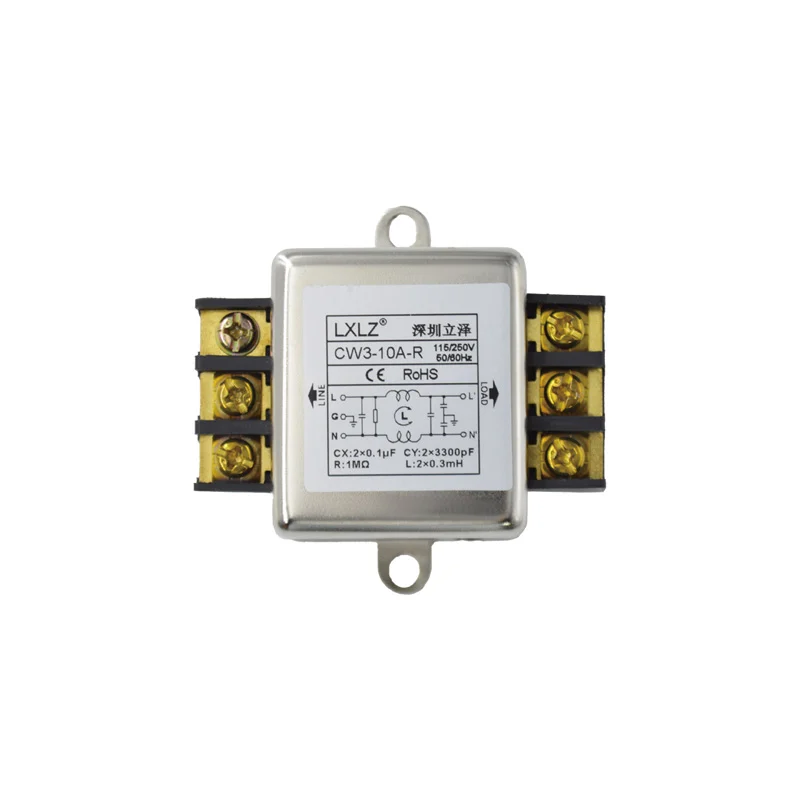
The CW3-10A-R suppresses both conducted emissions and incoming line interference across the AC power path. Looking at the circuit diagram printed on the unit itself, you can see the topology clearly:
- CX capacitors: 2 × 0.1µF — differential mode noise suppression
- CY capacitors: 2 × 3300pF — common mode noise to ground
- Inductors: 2 × 0.3mH — common mode choke for high-frequency attenuation
- Bleed resistor: 1MΩ — safe discharge of X capacitors after power-off
This LC ladder network targets the 150kHz–30MHz frequency range where switching power supplies, VFDs, and motor drives generate the most problematic interference — the exact range regulators scrutinize during CE/FCC testing.
Key Specifications
| Parameter | Value |
|---|---|
| Model | CW3-10A-R |
| Filter Type | Single Phase / Single Stage |
| Rated Voltage | 115V / 250V AC (50/60Hz) |
| Current Range | 1A – 20A (series available) |
| Connection Type | Terminal Block (Screw Terminal) |
| CX Capacitor | 2 × 0.1µF |
| CY Capacitor | 2 × 3300pF |
| Inductance | 2 × 0.3mH |
| Bleed Resistor | 1MΩ |
| Certifications | CE, RoHS |
| Housing | Steel, panel-mount with screw holes |
| Brand | LXLZ |
Who Uses This and Why
This filter fits into the workflow of:
- Control panel builders integrating PLCs, HMIs, or servo drives who need to pass CE emissions testing without redesigning the PCB
- OEM equipment manufacturers (CNC machines, laser equipment, medical devices, HVAC controllers) adding a last line of defense at the power inlet
- Electronics assembly factories sourcing reliable, CE-marked components for products destined for EU/UK markets
- System integrators who need a screw-terminal solution because their enclosure wiring doesn't accommodate IEC inlet connectors
The terminal block interface is the key differentiator here. Unlike inlet-style filters, this unit drops into any wiring scheme — you run your wire, you torque the screw, done. No panel cutout dimensions to worry about, no connector gender mismatches. That flexibility matters when you're building dozens of different machine variants on the same production line.
Manufacturing Advantages — What You're Actually Getting
From the image, you can see this isn't a stripped-down budget component:
- Full metal enclosure with corner mounting holes — mechanically stable in vibrating environments
- Gold-contact screw terminals on both LINE and LOAD sides — lower contact resistance, better long-term reliability than plain brass terminals
- Printed circuit schematic on the label — your engineers don't have to guess the topology or dig for a datasheet during installation
- Compact footprint — fits into tight DIN-rail adjacent spaces without forcing a panel redesign
- Dual voltage rating (115V/250V) — one SKU covers North American and European voltage systems, simplifying your global supply chain
We manufacture these in-house in Shenzhen. That means consistent production quality, controlled component sourcing (no substitute capacitors from unverified lots), and the ability to handle custom current ratings, modified terminal orientations, or private-label requirements for volume orders.
Best Practice Installation Notes
Based on field experience, here's what actually makes a difference:
- Keep input and output wiring physically separated. Running LINE and LOAD cables in the same bundle defeats the filter — the noise couples straight back in.
- Ground the chassis firmly. The CY capacitors dump common-mode noise to ground — a poor ground connection means those capacitors are doing nothing useful.
- Mount as close to the power entry point as possible. Every centimeter of unfiltered wire inside the enclosure is an antenna.
- Don't oversize the current rating excessively. A 10A filter on a 1A load still works, but the inductive impedance is optimized around rated current — matching the rating to actual load gives you best attenuation performance.
- Torque the terminal screws properly. Loose connections generate their own interference and create hot spots under load.
FAQ
Can I use this filter for both 110V and 220V applications?
Yes. The CW3-10A-R is dual-rated at 115V/250V, 50/60Hz. One part number works across North American, European, and most Asian AC systems. This is intentional — it simplifies sourcing for OEMs selling into multiple markets.
What current rating do I need?
Select based on your equipment's maximum rated input current, not average draw. If your machine pulls 6A at peak, use the 10A rated unit — it gives you headroom without compromising filter performance. We offer 1A, 3A, 6A, 10A, 15A, and 20A variants in the CW3-R series. Contact us with your load specs and we'll confirm the right model.
Does this filter carry CE certification? Can you provide documentation?
Yes, CE and RoHS compliance are standard on all CW3-R series units — you can see the markings on the label in the product image. Test reports and declaration of conformity are available for qualified buyers. If you need specific EN 55011 or EN 55032 test data for your own CE technical file, request it during inquiry.
What's your MOQ and lead time for volume orders?
MOQ varies by model — typically 100 pcs for standard current ratings from stock. Custom configurations (modified terminals, alternative ratings, OEM labeling) have higher MOQs and 2–4 week lead times. Sample orders are supported for engineering evaluation before you commit to production quantities.
Can the terminal block connection handle my wire gauge?
We use 2.5mm² wiring in our panels. The terminal blocks on the CW3-10A-R accommodate wire sizes suitable for the rated current — 2.5mm² is within standard range for the 10A version. If you're working with larger gauges for higher-current variants, confirm with us during ordering. We can also advise on terminal torque specs to meet your internal production standards.
Ready to discuss your specific application or request a sample? Send us your load specs and installation requirements — we'll respond within 24 hours.