
LXLZ Note: This Product Provides Solutions for Parameter Customization And Application.

Dual Gang Potentiometer RV24YG20S Stereo Volume Pot
If you're sourcing a reliable dual gang carbon film potentiometer for stereo audio equipment, industrial control panels, or electronic instrumentation, the RV24YG20S is worth a serious look. We manufacture this in-house, and it's been a steady go-to for OEM buyers and equipment assemblers who need consistent performance across large production runs.
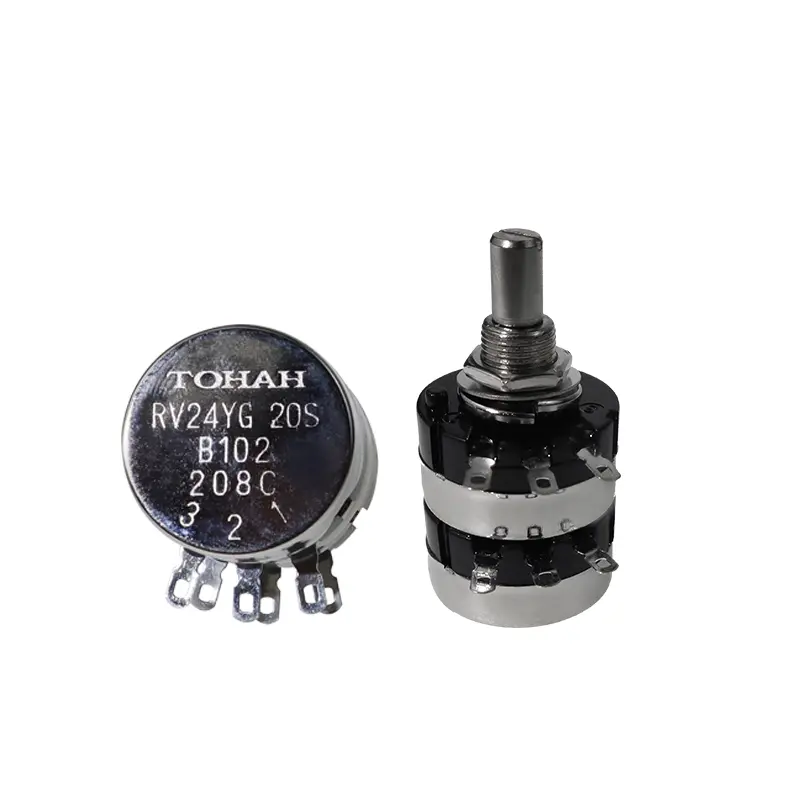
The unit in the image shows exactly what you get — a TOHAH-branded RV24YG20S with clear laser-etched markings (model, resistance code, and date code visible), a metal threaded bushing for secure panel mounting, a D-shaft or round shaft for knob fitment, and solder-free screw terminal connections that genuinely save time on the assembly line. The dual-deck (dual gang) construction is clearly visible in the side profile shot — two independent resistive elements, one shared shaft. That's your left and right channel controlled simultaneously without any mechanical linkage hassle.
Table of Contents
Key Specifications at a Glance
| Parameter | Details |
|---|---|
| Model | RV24YG20S |
| Type | Dual Gang Carbon Film Potentiometer |
| Resistance Range | 1KΩ / 2KΩ / 5KΩ / 10KΩ / 20KΩ / 50KΩ / 100KΩ / 200KΩ / 500KΩ |
| Standard Resistance | 100Ω – 1MΩ available |
| Power Rating | 2W |
| Taper | Linear (B-taper) / Log (A-taper) available on request |
| Connection Type | Solder-free screw terminal (no soldering required) |
| Accessories | Knob + graduated dial / scale disc included |
| Shaft | Metal shaft, panel-mount threaded bushing |
| Body Marking | Model + resistance code + date code laser-stamped |
| Application | Stereo volume control, audio amplifiers, industrial control |
What Makes This Unit Stand Out (From a Manufacturer's Perspective)
1. Solder-Free Terminal Design — Real Line Efficiency
The screw-type terminal block means your assembly workers can wire this in seconds. No soldering iron, no flux, no rework on cold joints. For high-volume lines, that's a meaningful labor cost reduction. We've had customers report 30–40% faster wiring cycle time compared to traditional solder-lug pots.
2. Dual Gang Tracking Consistency
This is where a lot of cheaper dual gang pots fall apart — channel imbalance at low rotation angles. Our RV24YG20S is manufactured with matched carbon film elements, and we hold tight tracking tolerance between the two gangs. For stereo applications, that means left/right balance stays true across the sweep, not just at mid-position.
3. Knob + Scale Dial Included
The package comes with a matching knob and graduated dial. For panel builders and equipment OEMs, this removes one BOM line and one supplier relationship. You're getting a ready-to-mount assembly, not just a bare pot.
4. Metal Bushing, Threaded for Panel Mount
The threaded metal bushing you can see in the image is a proper M10-class fitting — it won't strip out, won't crack under torque, and gives a secure, rattle-free panel installation. This matters in equipment that ships internationally or gets handled in the field.
5. Wide Resistance Value Coverage
From 1KΩ to 500KΩ in nine standard values — audio amplifier designers, mixer engineers, and control panel manufacturers can consolidate supplier sourcing. One manufacturer, multiple values, consistent quality across the board.
Typical Applications
- Stereo audio amplifiers — home hi-fi, car audio amps, PA amplifiers (the most common use case for this form factor)
- Mixing consoles and DJ equipment — channel volume, gain staging
- Industrial control panels — speed controllers, process parameter adjustment
- Test & measurement equipment — manual calibration controls
- Educational electronics kits and lab instruments — where a panel-mount pot with a readable dial is practical
- Guitar amplifiers and effects units — volume/tone stacks where dual-gang tracking is critical
Best Practices From the Field
These are things our long-term OEM customers have figured out — worth passing along.
- Match your taper to the application. For volume controls, log taper (A-taper) feels more natural to the human ear. For balance or pan controls, linear (B-taper) gives predictable center-detent behavior. We can supply either — just specify when ordering.
- Torque the panel nut properly. Finger-tight plus a quarter turn with a wrench is enough. Over-torquing the bushing nut on thin aluminum panels can distort the housing and affect shaft feel.
- Leave a small service loop on your wiring. With screw terminals, if a wire needs replacing, you want a little slack. 50–80mm from the terminal to the first cable tie is usually enough.
- For high-humidity environments, consider requesting our sealed or semi-sealed variant. Standard RV24YG20S is open-construction — fine for indoor electronics, but worth discussing if your end product operates in coastal or industrial outdoor environments.
- Batch consistency matters more than you think. Sourcing from a single manufacturer for your full production run (vs. mixed suppliers) keeps your QC baseline stable. We stamp date codes on every unit — makes traceability straightforward if you ever need it.
FAQ — What B2B Buyers Ask Most
Can we get custom resistance values outside the standard range, or custom tapers?
Yes. We support OEM custom resistance values and taper curves (linear, log, anti-log, custom law). MOQ for custom specs is typically 500–1,000 pcs depending on configuration. Send us your spec sheet or describe your application and we'll advise the right taper.
What's the MOQ for standard stock items, and what are the lead times?
Standard values (10KΩ, 50KΩ, 100KΩ are highest-runners) are available from stock with no minimum for sample orders. Production orders — MOQ is typically 100 pcs per value. Lead time for in-stock items is 3–7 business days for shipping; for production orders, 2–4 weeks depending on quantity. Contact us for current inventory status.
Do you provide test reports or quality documentation?
Yes. We can provide incoming QC reports, resistance tolerance test data, and batch-level traceability documentation. If your procurement process requires IQC data sheets or ROHS/REACH compliance declarations, we have those ready on request.
How consistent is the tracking between the two gangs across a production batch?
We test dual gang tracking tolerance at ±3dB across the rotation sweep as a standard production pass criterion. For audio-critical applications where tighter tracking is needed, we can discuss 100% tracking-tested batches — worth discussing on larger orders.
Can you supply the matching knob and dial separately, or in different colors/styles?
The standard package includes a black knob and silver/white graduated dial as shown. We can supply knobs and dials separately, and we have a range of knob styles (round, pointer, D-shaft grip). For OEM branded dials with your scale markings or logo, that's available with a reasonable setup cost on tooling — common for equipment manufacturers who want a finished-looking panel.
Ready to discuss your volume requirements or request samples? Send us your application details and we'll get back to you within 24 hours.