
LXLZ Note: This Product Provides Solutions for Parameter Customization And Application.

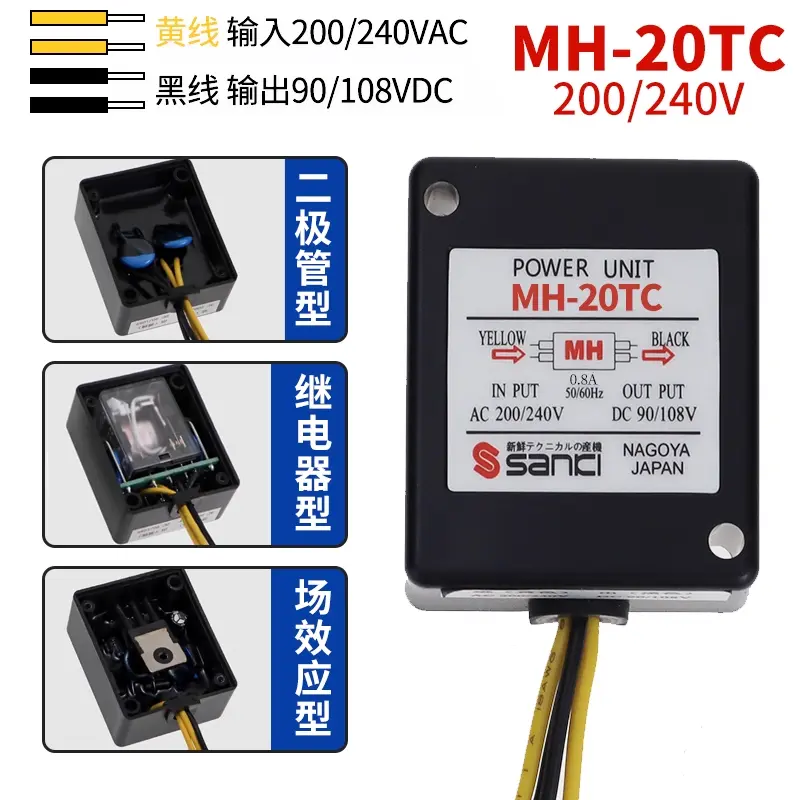
MH-20TC Motor Brake Rectifier Intermediate Relay Type
The MH-20TC is a compact electromagnetic brake rectifier designed to convert AC power into the DC voltage your motor brake coil needs to engage and release cleanly. No clean DC supply, no reliable braking — it's that simple. Whether you're running conveyor lines, packaging equipment, hoisting gear, or CNC machinery, this rectifier sits between your control circuit and the brake coil and makes sure the stopping happens exactly when it should.
Four Circuit Configurations — One Platform
One of the real advantages here is that we manufacture this unit in four internal circuit types, so you're not forced to over-specify or compromise:
| Type | Best For | Characteristic |
|---|---|---|
| Diode Type | Basic on/off brake control, cost-sensitive builds | Simple, reliable, lowest part count |
| Relay Type (this listing) | Intermediate control logic, isolated switching | Relay contact provides clean signal separation |
| Economy FET Type | Moderate switching frequency, budget-conscious | Solid-state, quieter operation than relay |
| Performance FET Type | High-cycle applications, precise brake timing | Fast response, reduced heat generation |
Buyer tip: If your machine cycles more than 30 times per hour, the Performance FET type tends to outlast relay types significantly. We're happy to advise based on your duty cycle before you place an order.
Key Specification Highlights
- Input Voltage: AC 200V / 240V (50/60Hz compatible — works across most global industrial standards)
- Output Voltage: DC 90V / 108V — matches standard electromagnetic brake coil ratings
- Rated Input Current: 0.8A
- Wiring: Yellow leads = AC input | Black leads = DC output (color-coded, no guessing)
- Mounting: Direct weld/screw mount, fits standard control panel or machine frame
- Heatsink: Integrated aluminum heat-dissipation plate — passive cooling, no fan required
- Build: Compact molded housing, aluminum back plate, lightweight but mechanically solid
Why Procurement Engineers Actually Like This Unit
Wiring is genuinely straightforward. Yellow in, black out. The leads are long enough to reach typical panel terminals without extension. Your electricians won't be calling you with questions.
The aluminum heatsink plate is built-in — not an afterthought. A lot of lower-cost rectifiers skip proper thermal management and rely on ambient air alone. In enclosed panels or high-ambient environments, that's where failures happen. The MH-20TC's aluminum backing plate pulls heat away from the internal circuit passively and consistently.
Four types, same footprint. If your engineering team decides mid-project to switch from relay to FET logic, you don't redesign the mounting or rewiring. Same dimensions, same terminal positions. That matters when you're doing a production run.
Sourced direct from the manufacturer. No distributor margin, no gray-market substitution risk. What you order is what gets built. Lead time and minimum quantities are transparent.
Typical Application Scenarios
- Three-phase motor brake systems on conveyors, hoists, and elevators
- Packaging machinery requiring precise stop positioning
- Machine tools / CNC equipment with electromagnetic spindle or axis brakes
- Textile and printing machinery where repeatable stop points are critical
- Material handling equipment in warehousing and logistics automation
Installation Best Practices (From Field Experience)
- Always verify your brake coil's rated DC voltage before selecting input configuration. The 240V input produces ~108VDC output; 200V input produces ~90VDC. Mismatching coil rating is the #1 installation mistake.
- Mount with the aluminum plate facing a ventilated surface or metal panel. Don't sandwich it against foam or plastic — let the heat move.
- For relay type specifically: avoid applications exceeding ~20 cycles/minute sustained. At higher duty cycles, move to the Performance FET variant. The relay contacts have a finite mechanical life.
- Use appropriate wire gauge for the 0.8A input current. Don't over-tighten terminals on the lead wires — the insulation near the entry point is the most common mechanical failure point on any wired rectifier.
- Check for voltage drop across long cable runs to the brake coil. If your coil is more than 10 meters from the rectifier, factor in wire resistance to ensure sufficient DC voltage arrives at the coil.
FAQ
Can I use this rectifier with any brand of electromagnetic brake, or only specific ones?
A: It's brand-agnostic. As long as your brake coil is rated for DC 90V or 108V and the current draw is within the rectifier's capacity, it will work. We recommend sharing your brake coil spec sheet if you're uncertain — we'll confirm compatibility before you commit to an order.
What's the minimum order quantity, and do you support OEM labeling?
A: MOQ is flexible depending on configuration type — typically starts at 50 units per type. OEM labeling (your brand, your model number on the housing) is available from certain quantities. Contact us with your volume estimate and we'll give you a straight answer.
How does the relay type differ from the FET types in actual service life?
A: The relay type has mechanical contacts that wear over time — typical service life is several hundred thousand cycles under normal load. FET types are solid-state, so there's no mechanical wear on the switching element. For high-frequency cycling applications, FET types measurably outlast relay types. For low-cycle or infrequent use, relay types perform reliably and are easier to diagnose in the field.
Do you provide test reports or quality certifications for customs clearance and incoming inspection?
A: Yes. We can provide batch test records, inspection reports, and relevant certification documentation with shipment. If your import country has specific certification requirements, let us know in advance so we can prepare accordingly.
What's your lead time for a mixed order of multiple types (e.g., diode + relay + FET)?
A: Standard production lead time is typically 2–3 weeks for mixed configurations. We maintain partial stock of common types, so small urgent orders can sometimes ship faster. Share your full BOM and quantities and we'll give you an honest production schedule.
Ready to discuss quantities, OEM requirements, or need help matching the right circuit type to your application? Send us your inquiry with brake coil specs and annual volume estimate — we'll respond with pricing and lead time within one business day.