
LXLZ Note: This Product Provides Solutions for Parameter Customization And Application.

RYK-170V Brake Rectifier 380V AC to 170V DC Module
If you're sourcing brake rectifiers for electric motor braking systems, you already know how much riding on a reliable, fast-response unit. The RYK-170V is built specifically for industrial electromagnetic brake coils — converting 380V AC input to a stable 170V DC output to engage and disengage motor brakes with precision and speed.
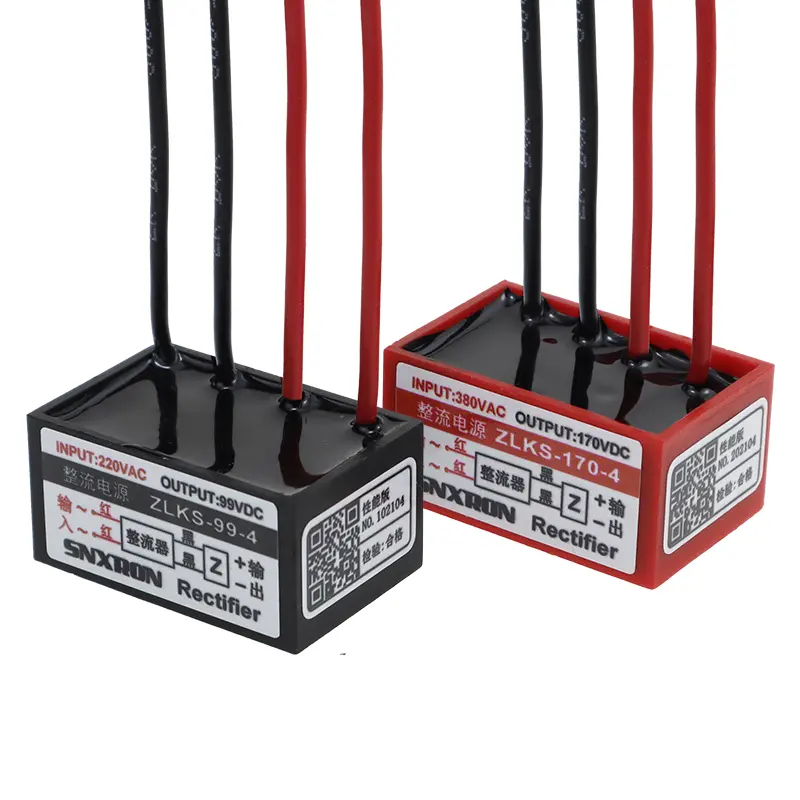
From the image, you can see two SNXRON rectifier units side by side — the black unit (220VAC / 99VDC) and the red unit (380VAC / 170VDC), which is the model we're featuring here. Both share the same compact, potted-epoxy block construction with pre-wired leads color-coded for easy installation. The build quality speaks for itself: clean wire terminations, solid epoxy encapsulation, and a clear labeled identification system — exactly what production line electricians want to see.
What Is It Used For?
This rectifier module sits between your three-phase 380V AC power supply and the DC electromagnetic brake coil on AC motors — commonly used in:
- Crane & hoist systems
- CNC machine tool spindles
- Conveyor and packaging line drives
- Elevator traction motors
- Industrial gearbox braking assemblies
When the motor stops, the rectifier cuts DC supply to the brake coil, releasing the electromagnetic hold and allowing the brake to clamp. Fast-response variants do this in milliseconds — critical for precision positioning or safety-critical stop cycles.
Key Product Specifications
| Parameter | Details |
|---|---|
| Model | RYK-170V / 18-RYK-170V |
| Input Voltage | 380V AC (3-phase industrial standard) |
| Output Voltage | 170V DC |
| Circuit Type | Diode type / MOSFET (FET) type — available |
| Response Version | Standard brake / Fast-acting brake |
| Conductor Material | Pure copper wiring throughout |
| Housing Material | Premium PBT thermoplastic enclosure |
| Application | Motor electromagnetic brake coil driving |
| Color Coding | Red housing = 380V input version |
| QC Status | Factory inspection passed (质检: 合格) |
Why Buyers Choose This Unit — Manufacturing Advantages
✅ Pure Copper Conductors — No Shortcuts
A lot of budget rectifiers out on the market use copper-clad aluminum leads. We don't. Every unit ships with full pure copper wiring, which means lower resistance, better heat handling, and longer service life under continuous duty cycles. Your maintenance team will thank you three years from now.
✅ Premium PBT Shell — Built for Industrial Environments
The enclosure is molded from PBT (Polybutylene Terephthalate) — not cheap ABS. PBT handles higher operating temperatures, resists vibration cracking, and holds up better in oily or damp electrical cabinet environments. If you've ever had a rectifier housing crack after six months on a crane — this is the upgrade.
✅ Two Circuit Topologies — Pick What Your Application Needs
- Diode-type: Simple, robust, cost-effective. Great for standard brake applications where stopping time isn't critical.
- MOSFET (FET)-type: Active switching for fast brake release/engagement. Recommended for high-cycle or precision positioning applications.
✅ Fully Encapsulated / Potted Construction
The epoxy-potted body you see in the image isn't just cosmetic — it protects internal components from moisture ingress, vibration shock, and contamination. This matters a lot in crane cabinets, outdoor enclosures, and food/packaging environments.
✅ Pre-wired With Clear Color Coding
Red leads = AC input. Output leads are labeled. No guesswork during installation. Electricians in the field appreciate clear wire identification — it cuts installation time and reduces wiring errors.
✅ Factory Direct, OEM-Ready
We manufacture these in-house. No middleman markup. MOQ is flexible for B2B buyers, and we support custom voltage configurations, lead length, and label branding for OEM customers.
Standard vs. Fast-Acting — Which Should You Order?
Best Practice from Field Experience:
| Application Type | Recommended Version |
|---|---|
| General conveyor, pump motors | Standard (Diode-type) |
| Cranes, hoists, lifting equipment | Fast-acting strongly recommended |
| CNC / servo brake hold | Fast-acting MOSFET type |
| High-cycle automation (>100 cycles/hr) | Fast-acting MOSFET type |
| Budget retrofit / low-cycle use | Standard Diode type |
Fast-acting units reduce brake wear significantly in high-frequency stop/start applications. The slightly higher unit cost is typically recovered within months through reduced brake pad replacement.
Installation Tips (Best Practice)
- Always match input voltage — the 380V version (red housing) is not interchangeable with 220V units (black housing). Double-check before wiring.
- Mount the rectifier inside a ventilated control cabinet — not exposed to direct water spray.
- For MOSFET-type units, ensure your brake coil resistance is within the rated load range — consult specs sheet before ordering.
- Use DIN rail mounting clips or adhesive pads on flat cabinet surface — the compact block body is easy to secure.
- On fast-acting models, do not add external capacitors across output terminals — it will defeat the fast-release function.
FAQ
What's the actual difference between the diode type and MOSFET type? Does it matter for my application?
A: Yes, it matters quite a bit depending on your duty cycle. The diode-type is a passive half-wave or full-wave rectifier — it's simple, reliable, and works well for standard start/stop applications. The MOSFET (FET) type uses active switching to rapidly collapse the magnetic field in the brake coil when power is cut, resulting in dramatically faster mechanical brake engagement — typically 5–10x quicker than diode versions. If you're running cranes, hoists, or precision CNC braking, go MOSFET. For basic conveyor or pump motors, diode type is fine and more cost-efficient.
Can we get custom output voltages, or is it only 170V DC?
A: We manufacture across multiple output voltage levels — 99V DC (for 220V input systems), 170V DC (for 380V input), and other configurations on request. For OEM or large-volume orders, custom voltage output is available. Just tell us your brake coil rated DC voltage and input supply, and we'll confirm the configuration.
What's your MOQ and lead time for bulk orders?
A: MOQ is flexible — we work with buyers from small batch trials to container-level orders. Standard models (diode type, 170V) typically ship from stock or within 5–7 business days for production runs. Custom configurations or OEM labeling require 2–3 weeks lead time depending on volume. We recommend requesting a sample batch first for qualification testing before committing to large orders — we support that process.
How do we verify the units are genuine pure copper wire — not copper-clad aluminum (CCA)?
A: Fair question — this is a real problem in the market. Our units use verifiable pure copper conductors throughout. You can confirm this with a simple resistance test on arrival, or by requesting a material certificate / test report with your order. We're happy to provide documentation. We also welcome third-party incoming inspection for large OEM customers.
Are these CE/RoHS compliant? What certifications do you carry?
A: Our products are manufactured to comply with RoHS material standards, and we can provide relevant test documentation. CE marking availability depends on the specific product variant and destination market — please specify your target country when inquiring so we can provide the correct compliance paperwork. For OEM customers, we support product certification processes as needed.
📩 Ready to discuss your requirements? Send us your motor brake coil specs and application details — we'll recommend the right configuration and get you a quote fast.